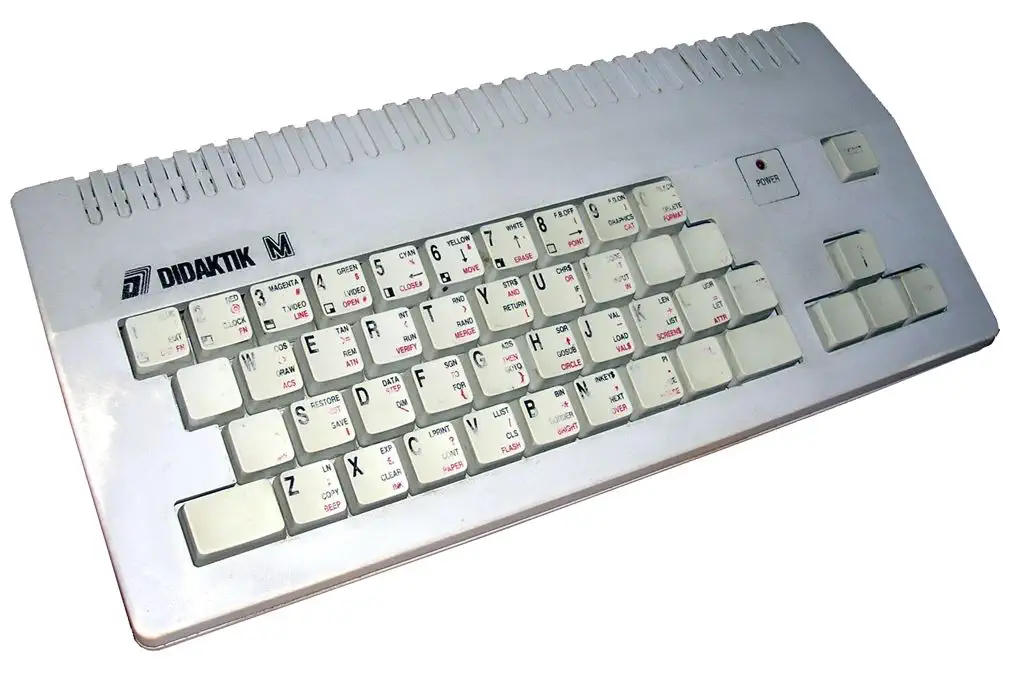

Didaktik M
The Didaktik M was introduced in 1990. It was a clone of the ZX Spectrum, but with some different specifications. The system timings were different than the Spectrum causing some software to display incorrectly due to the software using visual effects that were tuned to the original Spectrum timing. This did impacted mostly the demo-scene and some games.
The Didaktik-M had two joystick ports, but they were edge connectors, not the typical Atari-style connectors that were used on most other computers. Also the internal circuitry was hardwired, so that unlike on the spectrum, the left- and right- joysticks could not be swapped.
Another change fromt he spectrum was that instead of the ULA chip for display, it used the Soviet Angstrem chip. It had 64KB RAM built in, but only 48K was usable as there was no bank-switching provided, and 16K of the Z80's 64K address space was taken up by the BASIC ROM.
Because of the Anstrem chip, display was slightly different, the screen's aspect ratio was not really 4:3. The reason for the chip choice was that it had better thermal stability, something that earlier Didaktik computers and the computers they were based on lacked, causing overheating issues.
Sinclair BASIC
Sinclair BASIC was the dialect of the BASIC programming language developed for the ZX series of microcomputers produced by Sinclair Research in the early 1980s. It first appeared on the ZX80 and ZX81, and was later expanded for the ZX Spectrum. Its design reflected the hardware constraints of the machines it ran on, providing a compact interpreter that could fit into limited ROM space while still giving the user access to floating-point arithmetic, simple graphics, and sound on later models. Unlike some other home computer BASICs, Sinclair BASIC tightly integrated with the machine’s display and input system, allowing beginners to quickly see results of their programs.
One of its most distinctive features was the use of single-key keyword entry. Instead of typing out full commands like "PRINT" or "GOTO," users pressed a single key which inserted the entire keyword into the program. This approach minimized typing errors and sped up coding, but also made the system idiosyncratic compared to other BASIC implementations. Each key on the ZX Spectrum’s rubber keyboard had multiple keyword assignments, depending on whether it was pressed with shift or symbol shift, reflecting Sinclair’s attempt to maximize functionality from a minimal physical keyboard design.
Sinclair BASIC also included support for graphics and sound, at least on the Spectrum, which made it more versatile than the versions on the earlier ZX80 and ZX81. Commands like PLOT, DRAW, and SOUND allowed users to build interactive programs and games directly in BASIC, which was important since many Spectrum owners learned to program through it. However, it was slower than machine code, so commercial games typically bypassed it in favor of assembly language. Despite its limitations, Sinclair BASIC became a formative language for a generation of programmers in the UK and Europe, and it remains closely tied to the legacy of low-cost home computing in the 1980s.
CPU - The Zilog Z80
The Z80 quickly became popular in the personal computer market, with many early personal computers, such as the TRS-80 and Sinclair ZX80, using the Z80 as their central processing unit (CPU). It was also widely used in home computers, such as the MSX range, SORD, and the Amstrad CPC, as well as in many arcade games. Additionally, it was also used in other applications such as industrial control systems, and embedded systems. The Z80 was widely used until the mid-1980s, when it was gradually replaced by newer microprocessors such as the Intel 80286 and the Motorola 68000.
The Z80 microprocessor was developed by Zilog, a company founded by Federico Faggin in 1974. The Z80 was released in July 1976, as a successor to the Intel 8080. It was designed to be fully compatible with the 8080, but also included new features such as an improved instruction set, more powerful interrupts, and a more sophisticated memory management system.
Originally the Z80 was intended for use in embedded systems, just as the 8080 CPU. But the combination of compatibility, superior performance to other CPUs of the era, and the affordability led to a widespread use in arcade video game systems, and later in home computers such as the Osborne 1, TRS-80, ColecoVision, ZX Spectrum, MSX, Sega's Master System and many more. The Z-80 ran the original Pac-Man arcade cabinet. The Z-80 was used even in the Game Gear (1990s), and the TI-81 and succeeding graphic calculators.
The Z-80 remained in production until June of 2024, 48 years after its original release. Zilog replaced the processor with its successor the eZ80, an 8-bit microprocessor that features expanded memory addressing up to 16 megabytes, and running up to 50MHz, comparable to a Z80 clocked at 150MHz.

256x192 8 colors