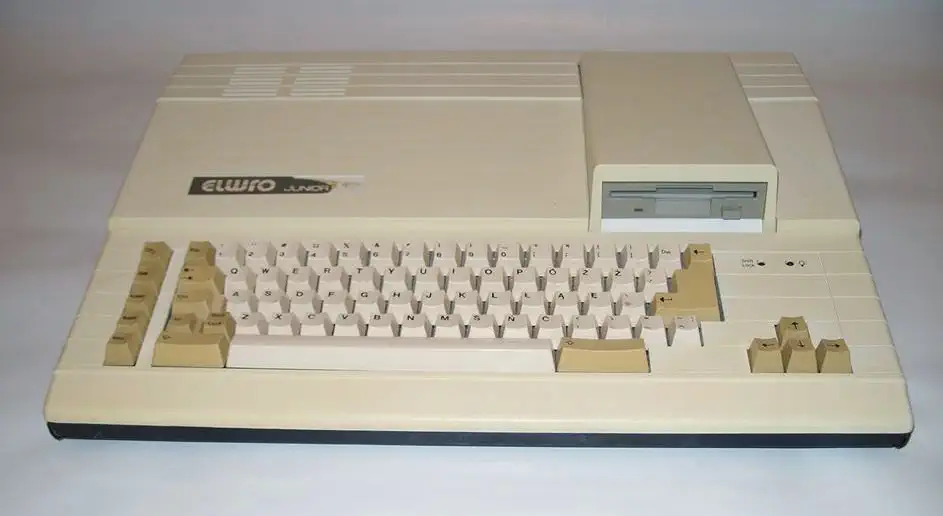

Elwro Junior 800-4 (Prototype)
The Elwro 800-4 Junior PC was an Elwro 800-3 Junior with new capabilities. It no longer had the toy piano housing, but a specially designed case that borrows elements from the Commodore 65.
The main differences to the previous version of the Elwro Junior were
- Built in 720k 3.5" Disk-Drive
- Default boot to CP/M
- Color TV modulator
- Support for 3 floppy disk drives
One of the biggest draw-back of this computer was the slower emulation for Spectrum Software: spectrum programs ran about 20% slower than on previous Elwro Juniors.
Overview of Elwro Junior Computers
From 1985 to 1990 Elwro produced the Elwro 800 Junior line of computers, meant for education. The polish department of education needed computers for the students. Many biggers schools had opted for ZX Spectrum, Timex or MSX. For smaller schools, the computer had to be cheap, ZX Spectrum compatible and easy to produce and repair.
The 800 Junior computers were produced using an existing case that was designed for the "Elwirka" toy piano. The elwro computers therefore have an odd feature: a sheet music stand that folds up to hold a paper with a music score.
I/O on the Elwro Junior
Elwro Junior computers were cheap, but well designed. It was ZX SPectrum compatible, but had better specifications than the Spectrum itself.
- Joystick connector
- SPectrum network connector
- Composite Output
- RGB Output
- Tape connector
- Junet network connector
- Diskdrive connector (if controller installed)
- Centronics Printer Port
JUNET was a serial bus network. The computers were daisy-chained; if you disconnected one computer, all computers further in the chain were disconnected from network. Connecting to network was performed by plugging 2-DIN plugs into the computer. Sockets are jumpered 1:1 inside. Network has 3 lines: Data, Clock and busy. The clock was set at 14MHz/256, with the master computer giving the clock to the rest; the data transfer rate is around 55kbit/sec The networking is done by 8521 USART or it's Soviet cousin, the KP580BB51A.
History of Elwro Computers
The Elwro company was established in February of 1959 in Wroclaw, Poland. The company's full name is The Wroclaw Electronic Works (Wroclawskie Zaklady Elektroniczne). The Elwro's first computer was the vacuum-tube based Odra 1001. This computer only reached the research stage and not mass produced. The next model was the Odra 1002 which replaced the vacuum tubes with transistors. The company also produced the tube-based UMC-1 from 1962 to 1965, 25 units were built.
Elwro Basic, a Sinclair clone
On the Elwro 800 Junior, the Polish 8-bit computer produced in the mid-1980s, Sinclair BASIC was essentially a localized clone of the ZX Spectrum implementation. The 800 Junior was built to be hardware-compatible with the Spectrum, so it could run much of the same software, including programs written in Sinclair BASIC. This was achieved by replicating the Spectrum’s ROM structure and providing an almost identical BASIC interpreter in the system firmware. The keyboard layout, however, was redesigned for the Junior, which meant that while the same one-key keyword entry system was retained, the physical placement of certain commands was different, requiring Polish users to adjust to a slightly altered mapping.
Like the Spectrum, the Junior’s Sinclair BASIC interpreter included graphics and sound commands such as PLOT, DRAW, and BEEP, all of which tied directly into the computer’s video and sound hardware. The Junior used a ULA-like chip that mimicked the Spectrum’s display handling, so the interpreter could be carried over with minimal modification. The graphics routines were therefore identical in behavior to their Spectrum equivalents, which ensured that most Spectrum BASIC listings printed in magazines could be typed in and executed without major changes. Similarly, tape I/O commands like LOAD and SAVE were implemented in the same way, maintaining compatibility with cassette-based storage.
One key distinction was that the Elwro 800 Junior was intended for use in Polish schools, so its Sinclair BASIC environment was not just a hobbyist tool but a standardized educational platform. The firmware and BASIC environment were sometimes modified slightly for classroom use, but the core was unmistakably the same Sinclair BASIC interpreter. This allowed Polish students to learn programming in exactly the same dialect as their peers in the UK using Spectrums, bridging an otherwise difficult technological gap behind the Iron Curtain.
CPU - The Zilog Z80
The Z80 quickly became popular in the personal computer market, with many early personal computers, such as the TRS-80 and Sinclair ZX80, using the Z80 as their central processing unit (CPU). It was also widely used in home computers, such as the MSX range, SORD, and the Amstrad CPC, as well as in many arcade games. Additionally, it was also used in other applications such as industrial control systems, and embedded systems. The Z80 was widely used until the mid-1980s, when it was gradually replaced by newer microprocessors such as the Intel 80286 and the Motorola 68000.
The Z80 microprocessor was developed by Zilog, a company founded by Federico Faggin in 1974. The Z80 was released in July 1976, as a successor to the Intel 8080. It was designed to be fully compatible with the 8080, but also included new features such as an improved instruction set, more powerful interrupts, and a more sophisticated memory management system.
Originally the Z80 was intended for use in embedded systems, just as the 8080 CPU. But the combination of compatibility, superior performance to other CPUs of the era, and the affordability led to a widespread use in arcade video game systems, and later in home computers such as the Osborne 1, TRS-80, ColecoVision, ZX Spectrum, MSX, Sega's Master System and many more. The Z-80 ran the original Pac-Man arcade cabinet. The Z-80 was used even in the Game Gear (1990s), and the TI-81 and succeeding graphic calculators.
The Z-80 remained in production until June of 2024, 48 years after its original release. Zilog replaced the processor with its successor the eZ80, an 8-bit microprocessor that features expanded memory addressing up to 16 megabytes, and running up to 50MHz, comparable to a Z80 clocked at 150MHz.

ROM: 24kB
10 octaves
64x24 Text
256x192 Graphics 8x2 colors