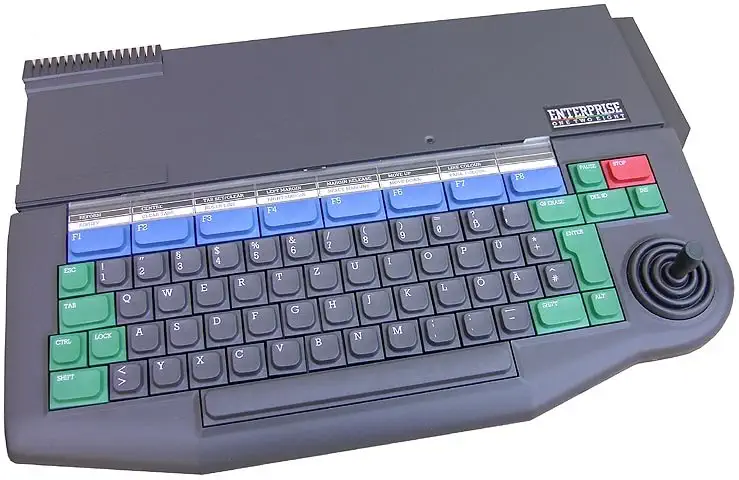

The Enterprise-128 was released A few months after the Enterprise 64, it is basically the same machine, but it was equiped with 128KByte of RAM, that the Z80 could access using bank switching. Internally, an extra circuit board was added that provided space for the extra RAM chips.
Just like the Enterprise-64, the Enterprise-128 is based on the popular Zilog Z80 8-bit CPU, and had two ASIC chips (Dave & Nick, after their creators) for sound and graphics. The sound and graphics capabilities of this machine were superior to many similar computers of the time. The case was colorful, and featured a built in joystick for games. Unfortunately due to delays and a softening computer market for 8-bit systems, the computer was not succesful and the manufacturer went into debt by 1986.
The system ran the EXOS Operating system, that was bundled with a word processor program on a 32K ROM chip. Another 16K ROM provided EXOS Basic. The sound was provided by the ASIC Chip called Dave, named after Dave Woodfield. The system had 3 sound and one noise channel. Unique to the system was that each of the channels can be played freely on the left or right channel, creating stereo effects that the competition could not. It also had options for distortion, low and high- pass filters and ring modulation to create rich sound effects.
Another ASIC chip, called Nick, named after Nick Loop who previously worked on the Acorn Atom computer, managed graphics. The system has the following graphics modes:
- 640x512 - 2 colors, interlaced
- 640x256 - 2 colors, non-interlaced
- 320x256 - 16 colors out of a 256 color palette
- 80x256 - 256 colors
- 1 - Reset button
- 2 - EXT1 External Joystick Connector
- 3 - EXT2 External Joystick Connector
- 4 - Printer Connector
- 5 - Serial/Network Port
- 6 - Tape Connector (In/Out/Remote)
- 7 - RGB Monitor Connector
- 8 - TV(RF) Connector
- 9 - Power connector
Video - Nick ASIC
The Nick ASIC handled all video generation. It was designed as a highly flexible display generator with support for multiple resolutions and color depths, rather than fixed modes. It could produce text, graphics, or mixed displays, with resolutions ranging from 40- or 80-column text up to 672×512 pixels in monochrome, or lower resolutions in up to 256 colors from a 9-bit palette (512 total colors). Unlike simple attribute-based systems such as the Spectrum, Nick used a line-by-line descriptor table that allowed the programmer to define display parameters dynamically, so screen modes could be mixed vertically on the same display (for example, text areas and high-color graphics areas on one screen). Hardware sprite support was absent, but the flexibility of memory-mapped video descriptors made effects that were hard on other Z80 machines possible here.
Sound - Dave ASIC
The Dave ASIC combined sound generation, memory paging, and system timing functions. As an audio chip it supported three tone channels plus one noise channel, similar in concept to the AY-3-8910, but with more advanced frequency control and digital envelope shaping, giving the Enterprise richer sound. Beyond audio, Dave integrated the system’s memory management unit (MMU), providing 4 KB paging across a 4 MB physical address space, far beyond the Z80’s native 64 KB addressing limit. It also handled interrupts, I/O decoding, and general timing functions. This integration meant that Dave was as crucial to system operation as Nick: without it the Z80 could not access extended RAM or coordinate with the rest of the machine.
CPU - The Zilog Z80
The Z80 quickly became popular in the personal computer market, with many early personal computers, such as the TRS-80 and Sinclair ZX80, using the Z80 as their central processing unit (CPU). It was also widely used in home computers, such as the MSX range, SORD, and the Amstrad CPC, as well as in many arcade games. Additionally, it was also used in other applications such as industrial control systems, and embedded systems. The Z80 was widely used until the mid-1980s, when it was gradually replaced by newer microprocessors such as the Intel 80286 and the Motorola 68000.
The Z80 microprocessor was developed by Zilog, a company founded by Federico Faggin in 1974. The Z80 was released in July 1976, as a successor to the Intel 8080. It was designed to be fully compatible with the 8080, but also included new features such as an improved instruction set, more powerful interrupts, and a more sophisticated memory management system.
Originally the Z80 was intended for use in embedded systems, just as the 8080 CPU. But the combination of compatibility, superior performance to other CPUs of the era, and the affordability led to a widespread use in arcade video game systems, and later in home computers such as the Osborne 1, TRS-80, ColecoVision, ZX Spectrum, MSX, Sega's Master System and many more. The Z-80 ran the original Pac-Man arcade cabinet. The Z-80 was used even in the Game Gear (1990s), and the TI-81 and succeeding graphic calculators.
The Z-80 remained in production until June of 2024, 48 years after its original release. Zilog replaced the processor with its successor the eZ80, an 8-bit microprocessor that features expanded memory addressing up to 16 megabytes, and running up to 50MHz, comparable to a Z80 clocked at 150MHz.

each channel can be left or right
Distortion
low/high pass filters
ring modulation effects
640x256 2 color non-interlaced
80x256 256 color
320x256 16 color out of 256 (attribute graphics mode).
interlaced