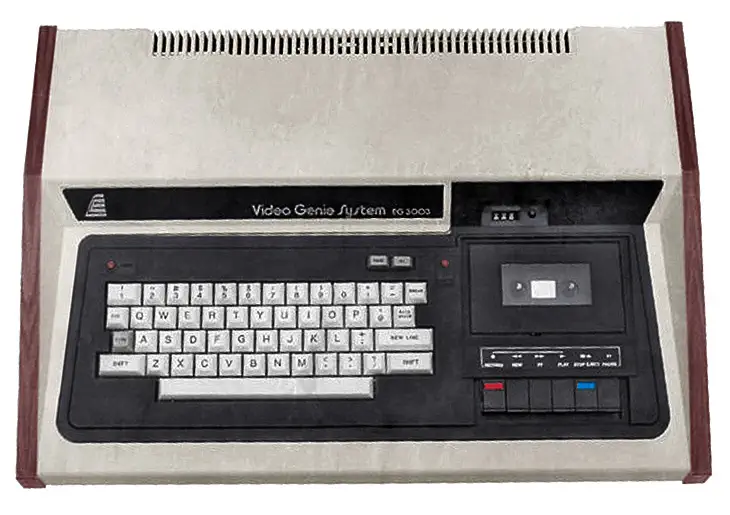

Video Genie
The Video Genie is a computer manufactured by EACA, a Hong Kong based computer company in the early 1980s. The Video Genie was mostly compatible with the Tandy TRS-80 Model I computers and can be considered a clone, although there are some slight differences in hardware.
The Video Genie series consisted of the following computers:
- Video Genie System (EG3003) first version
- Video Genie System (EG3003) second version
- Genie I (EG3003) third version, late 1981
- Genie II (EG3008) late 1981
- Genie III (EG3200) mid 1982, aimed at the business market, CP/M compatible
The first version of the Video Genie only has 51 keys and is missing the CLEAR and TAB keys (compared to the TRS-80). The second version has those keys, but the designers took out the right shift key. The second version also comes with a VU-meter that shows the volume of loading cassettes. Version 3 introduced lower case characters, and the later versions had a numerical keypad.
Video - The Motorola 6845 CRTC
The Motorola 6845 CRT Controller (CRTC), later second-sourced by Hitachi (HD6845), Rockwell, and others, was one of the most influential video timing chips of the late 1970s and 1980s. It was not a graphics generator in itself; instead, it produced the precise timing signals needed to drive a raster display, such as horizontal and vertical sync pulses, row and character addresses, and memory fetch cycles. Systems attached external character generators (ROMs) or pixel logic to interpret the memory data, while the 6845 ensured the scanlines appeared in the correct order and at stable refresh rates. Its programmability, registers controlling horizontal total, vertical total, sync widths, cursor position, and so forth, made it adaptable across a wide range of systems, from text terminals to microcomputers.
The 6845’s flexibility came from its ability to map arbitrary chunks of RAM to display regions using start address registers, row address counters, and cursor control. For instance, a designer could allocate just 2 KB of RAM for a 40×25 text screen, or more for bitmapped graphics, with the 6845 providing the address sequencing. Many early microcomputers such as the BBC Micro, Amstrad CPC, and Commodore PET derivatives used the chip, often combining it with a custom video gate array or ULA to generate the pixel stream. IBM also adopted the 6845 in its original Monochrome Display Adapter (MDA) and Color Graphics Adapter (CGA), cementing its influence on the emerging PC standard.
Although by itself the 6845 did not support modern concepts like sprites or hardware scrolling, its register set was exploited creatively. Programmers discovered that by rewriting registers mid-frame (a technique known as “raster tricks”), they could produce split-screen effects, palette changes, or smooth scrolling beyond the documented capabilities. Over time, more integrated graphics controllers absorbed the 6845’s functionality into larger chips that combined timing, pixel generation, and sometimes even acceleration. Nonetheless, the 6845’s architectural model, separating timing control from pixel memory, shaped early video hardware design and left a strong legacy in the personal computer industry.
The 6845s main function is to properly time access to the display memory, and to calculate the memory address of the next portion to be drawn. Other circuitry in the machine then uses the address provided by the 6845 to fetch the pattern and then draw it. The implementation of that hardware is entirely up to the designer and varied widely among machines. The 6845 is intended for character displays, but could also be used for pixel-based graphics, with some clever programming.
Computers that used the 6845 are, among others:
- BBC Micro
- Amstrad CPC
- Videx VideoTerm display cards for Apple II
Sound - The AY-3-8910 PSG
The AY-3-8910 is a 3-voice Programmable Sound Generator, or PSG. It was designed by General Instruments in 1978 for use with their own 8-bit PIC1650 and their 16-bit CP1610 computers.
The PSG is widely used in many arcade cabinets, pinball machines, and many micro-computers. Here is a list of some of the major brands of computer that used the AY-3-8910:
- Intellivision
- Vectrex
- Amstrad CPC range
- Oric-1
- Color Genie
- Elektor TV Games Computer
- All MSX-1 and MSX-2 computers
- ZX Spectrum home computers
General Instrument spun of MicroChip Technology in 1987 and the chip was sold under the MicroChip brand, and licensed to Yamaha as the YM2149F which the Atari ST range of computers use. Functionally the PSG is very similar to the Texas Instruments SN76489.
Variants:
-
AY-3-8910
Comes with 2 general purpose 8-bit parallel I/O ports, used for Keyboard and Joystick in for instance MSX. -
AY-3-8912
Same chip, but in a 28-pin package. Parallel port B is not connected to save cost and space. -
AY-3-8913
Same chip, but in a 24-pin package. Both parallel ports are not connected. -
AY-3-8914
The AY-3-8914 has the same pinout and is in the same 40-pin package as the AY-3-8910, except the control registers on the chip are shuffled around, and the 'expected input' on the A9 pin may be different. It was used in Mattel's Intellivision console and Aquarius computer. -
AY-3-8930
Backwards compatible but BC2 pin is ignored
YM2149F -
YM3439-D
CMOS version of the Y2149 in 40-pin DIP -
YM3439-F
CMOS version of the Y2149 in 44-pin QFP -
YMZ294
Variant of the YM3249 in an 18-pin package. Parallel ports not connected, and all sound channels mixed on 1 port. -
T7766A
Toshiba variant of the AY-3-8910, fully compatible. Used in some MSX models. - Winbond WF19054, JFC95101, and File KC89C72: Fully compatible versions of the AY-3-8910 produced for slot machines.
Yamaha Produced chip, same pin-out as the AY-3-8910, but pin 26 could halve the master clock. Can be used to replace the AY-3-8910 if pin 26 is left disconnected.
CPU - The Zilog Z80
The Z80 quickly became popular in the personal computer market, with many early personal computers, such as the TRS-80 and Sinclair ZX80, using the Z80 as their central processing unit (CPU). It was also widely used in home computers, such as the MSX range, SORD, and the Amstrad CPC, as well as in many arcade games. Additionally, it was also used in other applications such as industrial control systems, and embedded systems. The Z80 was widely used until the mid-1980s, when it was gradually replaced by newer microprocessors such as the Intel 80286 and the Motorola 68000.
The Z80 microprocessor was developed by Zilog, a company founded by Federico Faggin in 1974. The Z80 was released in July 1976, as a successor to the Intel 8080. It was designed to be fully compatible with the 8080, but also included new features such as an improved instruction set, more powerful interrupts, and a more sophisticated memory management system.
Originally the Z80 was intended for use in embedded systems, just as the 8080 CPU. But the combination of compatibility, superior performance to other CPUs of the era, and the affordability led to a widespread use in arcade video game systems, and later in home computers such as the Osborne 1, TRS-80, ColecoVision, ZX Spectrum, MSX, Sega's Master System and many more. The Z-80 ran the original Pac-Man arcade cabinet. The Z-80 was used even in the Game Gear (1990s), and the TI-81 and succeeding graphic calculators.
The Z-80 remained in production until June of 2024, 48 years after its original release. Zilog replaced the processor with its successor the eZ80, an 8-bit microprocessor that features expanded memory addressing up to 16 megabytes, and running up to 50MHz, comparable to a Z80 clocked at 150MHz.

RAM max: 48kB
ROM: 12kB
127x48 block graphics mono