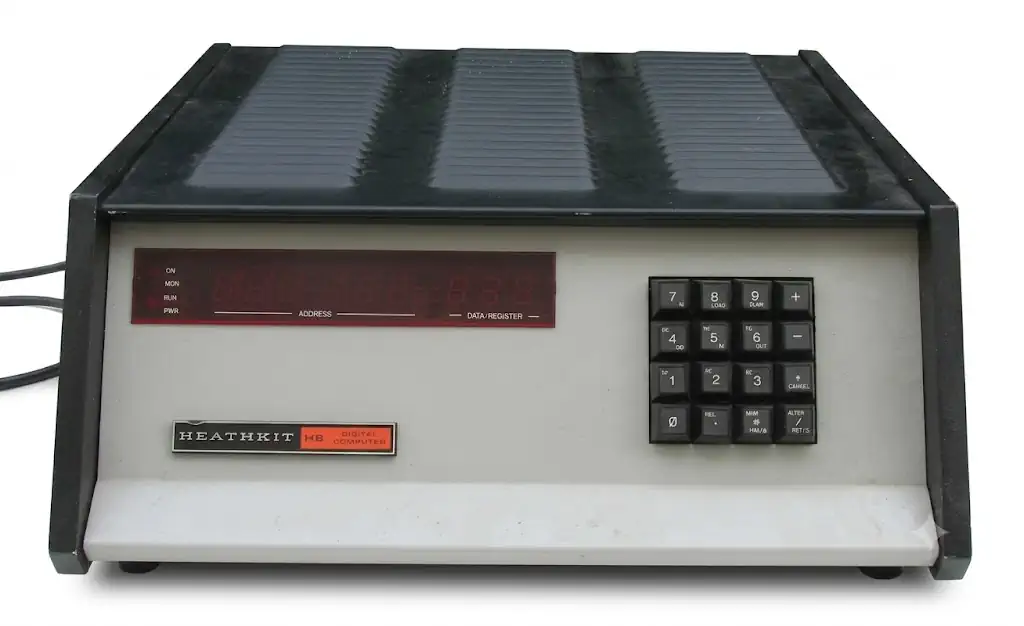

The Heathkit H8
Introduced in 1977, the Heathkit H8 was a prominent early microcomputer offered in kit form, targeting engineers and electronics hobbyists. The system chassis is characterized by its distinct front-panel interface, which features a 9-digit, seven-segment octal LED display and a 16-key keypad. This hardware interface allowed operators to enter machine code directly into memory, inspect registers, and control execution without the immediate need for a separate serial terminal. Internally, the chassis houses a heavy-duty power supply and a passive backplane utilizing the proprietary 50-pin Benton Harbor Bus, which accommodates up to ten expansion boards for significant hardware customization.
The standard CPU board for the H8, designated the H8-1, is powered by the 8-bit Intel 8080A microprocessor operating at 2.048 MHz. To facilitate operations via the front panel, the system utilizes a ROM-based monitor program called PAM-8 (Panel Monitor for the H8), which consumes 1 KB of memory space. Early base configurations typically relied on standard audio cassettes for data storage using the H8-5 Serial I/O and Cassette Interface board, which operated at a speed of 1200 baud. The base system was often configured with static RAM boards, allowing operators to expand memory incrementally from a minimal 4 KB up to 32 KB.
As peripheral technology advanced, Heathkit introduced robust expansion options to elevate the H8 into a fully capable computing platform. The most significant storage upgrade was the H17 floppy disk system, which interfaced via a dedicated controller card. The H17 utilized 5.25-inch, hard-sectored floppy disks with a formatted capacity of 100 KB per diskette. Memory capabilities were also expanded through higher-density dynamic RAM (DRAM) boards, eventually allowing the system to address the full 64 KB limit of the Intel 8080A architecture. Further expansion cards provided multiple RS-232 serial ports and parallel interfaces for printers and terminals, such as the companion Heathkit H9 or H19.
The modular bus design of the H8 enabled considerable aftermarket modification, most notably transitioning the core processor architecture. While originally designed around the Intel 8080A, third-party manufacturers, and eventually Heathkit itself via the HA-8-6 board, offered CPU upgrades based on the Zilog Z80 microprocessor. Integrating a Z80 brought hardware-level enhancements, such as an expanded instruction set, dual register banks for faster interrupt handling, and integrated memory refresh logic, while maintaining strict backward compatibility with existing 8080 software. With the Z80 installed and maximum memory populated, the H8 could fully leverage standardized operating systems like CP/M, keeping the hardware relevant into the early 1980s.
CPU - The Intel 8080
The Intel 8080 was an 8-bit microprocessor that was designed and manufactured by Intel Corporation. It was the first CPU in the x80 series, and was released in April 1974. The 8080 had a clock speed of 2 MHz and was capable of addressing 64 KB of memory. It had a total of 45 instructions and 7 registers, including the Accumulator, the Flags register and the stack pointer.
One of the key features of the 8080 was its ability to directly execute instructions for input/output operations, allowing for more efficient communication with peripheral devices such as keyboard, display, and storage. This made the 8080 a popular choice for early personal computers like the Altair 8800, the IMSAI 8080 and the first IBM PC.
Additionally, the 8080's architecture was widely adopted in industrial control systems and arcade games. It was also used as the basis for other microprocessors such as the Zilog Z80 which was widely used in home computers of the 1980s.
The 8080 was succeeded by the 8085 microprocessor in 1976, which was similar to the 8080 but had an additional instruction set and an integrated clock generator. The 8080 and the 8085 together with their variants and clones played an important role in the development of the microcomputer industry and the personal computer revolution.
CP/M Operating System
CP/M (Control Program for Microcomputers), created by Gary Kildall in 1974 for Intel 8080-based systems, was the first widely adopted microcomputer operating system to establish a standard software platform. At its core, CP/M was divided into three layers: the BIOS (Basic Input/Output System) for hardware-dependent routines, the BDOS (Basic Disk Operating System) for file and device abstractions, and the CCP (Console Command Processor) for the command-line interface. This modular design meant CP/M could be ported to a wide variety of 8-bit systems simply by rewriting the BIOS layer, while the BDOS and CCP remained binary-compatible. This allowed application developers to target a single OS API rather than custom hardware interfaces, which was a radical departure from the fragmented landscape of early microcomputers.
Memory management in CP/M was constrained by the 8080 and Z80’s 64 KB address space, so the operating system was designed to occupy only the top portion of memory. The BDOS and CCP were typically loaded into high memory, leaving a contiguous block of low memory available for transient programs (user applications). Applications were written to expect a fixed TPA (Transient Program Area), with the starting address varying slightly depending on how much memory was available after BIOS/BDOS were loaded. This simple scheme avoided the need for virtual memory or sophisticated protection mechanisms, but it limited multitasking: CP/M was strictly a single-tasking environment. Program overlays and clever memory swapping techniques were sometimes used by developers to fit larger applications into the available TPA, especially for compilers and database software.
Application support was the main driver of CP/M’s dominance. Its standardization around the BDOS interface meant that word processors, assemblers, compilers (notably for C, Pascal, and BASIC), and business applications could run on hundreds of different hardware platforms with minimal modification. Programs were distributed as .COM files—binary images loaded directly into the TPA without relocation—which simplified the loader at the cost of flexibility. Libraries like Digital Research’s PL/I subset and third-party toolchains extended CP/M into a development platform, while the vast ecosystem of utilities (from editors like ED to debuggers and communications software) established it as the de facto operating system of the late 1970s and early 1980s microcomputing world. For retrocomputing enthusiasts, CP/M represents the moment when software compatibility, not just hardware, became the central value in the microcomputer marketplace.
ROM: 1KiB
HDOS