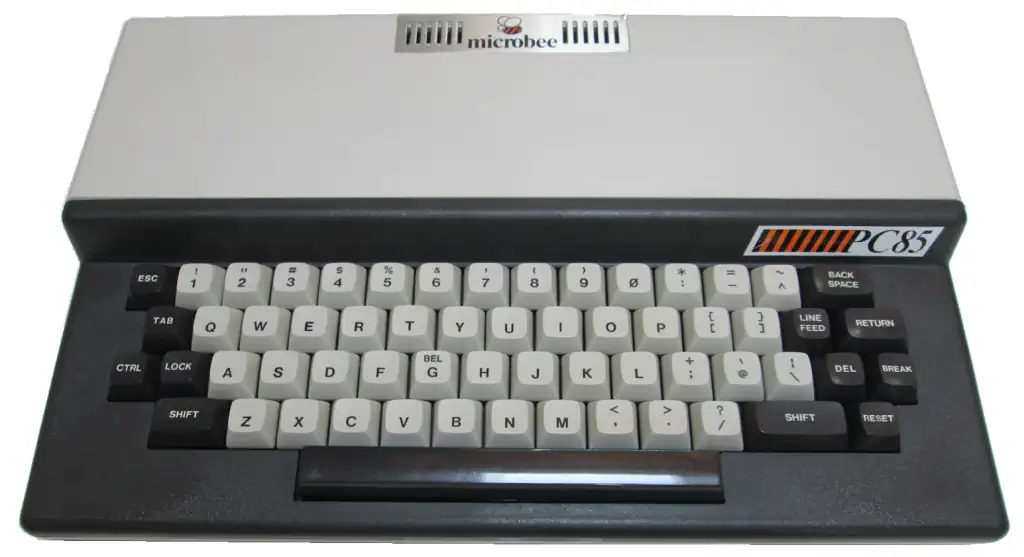

MicroBee Personal Communicator PC-85
In 1985, MicroBee Systems introduced the MicroBee PC85, an 8-bit personal computer designed to cater to educational needs and individual computing enthusiasts. Based on the earlier version of the Microbee, the SBC, this computer was fueled by a Zilog Z80A CPU and offered 64 KB or 128 KB of RAM. The PC85 found its place in the Australian computing landscape as a versatile and accessible system. Boasting a 512x240 pixel monochrome display and basic audio capabilities, it struck a balance between functionality and affordability.
Equipped with expansion ports and optional dual 5.25-inch floppy disk drives, the PC85 was not only a tool for learning programming with its built-in BASIC interpreter but also a platform for educational and productivity software. Its full-stroke keyboard and numeric keypad added to the user-friendly interface. While it might not have achieved international recognition, the MicroBee PC85 became a staple in Australian schools, leaving a lasting legacy as a platform that contributed to the early development of computer literacy among students.
As technology advanced, the MicroBee PC85, along with its predecessors, faced discontinuation. Nevertheless, it remains a nostalgic symbol for those who experienced the era of 8-bit computing in Australia. Its contribution to education and its unique design mark the MicroBee PC85 as a noteworthy chapter in the history of personal computing, showcasing how a compact and accessible system played a vital role in shaping the early days of computing in the land Down Under.
CPU - The Zilog Z80
The Z80 quickly became popular in the personal computer market, with many early personal computers, such as the TRS-80 and Sinclair ZX80, using the Z80 as their central processing unit (CPU). It was also widely used in home computers, such as the MSX range, SORD, and the Amstrad CPC, as well as in many arcade games. Additionally, it was also used in other applications such as industrial control systems, and embedded systems. The Z80 was widely used until the mid-1980s, when it was gradually replaced by newer microprocessors such as the Intel 80286 and the Motorola 68000.
The Z80 microprocessor was developed by Zilog, a company founded by Federico Faggin in 1974. The Z80 was released in July 1976, as a successor to the Intel 8080. It was designed to be fully compatible with the 8080, but also included new features such as an improved instruction set, more powerful interrupts, and a more sophisticated memory management system.
Originally the Z80 was intended for use in embedded systems, just as the 8080 CPU. But the combination of compatibility, superior performance to other CPUs of the era, and the affordability led to a widespread use in arcade video game systems, and later in home computers such as the Osborne 1, TRS-80, ColecoVision, ZX Spectrum, MSX, Sega's Master System and many more. The Z-80 ran the original Pac-Man arcade cabinet. The Z-80 was used even in the Game Gear (1990s), and the TI-81 and succeeding graphic calculators.
The Z-80 remained in production until June of 2024, 48 years after its original release. Zilog replaced the processor with its successor the eZ80, an 8-bit microprocessor that features expanded memory addressing up to 16 megabytes, and running up to 50MHz, comparable to a Z80 clocked at 150MHz.

RAM max: 48kB
ROM: 8kB
VRAM: 16kB
2 octaves