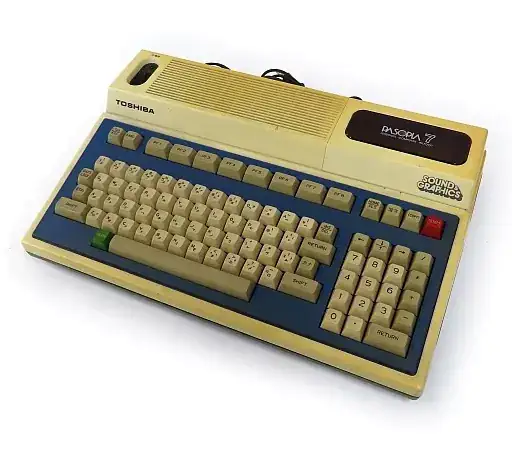

Toshiba Pasopia 7
The Toshiba Pasopia 7 was released in 1983 alongside the Pasopia 5 in Japan. It was the successor of the Pasopia computer, and offered improved sound and graphics. The machine is not fully backwards compatible, but it does support the cartridge type peripherals from the earlier Pasopia.
The computer has a separate VRAM of 48kByte and offered hardware dithering in high resolution mode to simulate intermediate color intensities. The screen uses 640x200 pixels, but each 2 horizontal pixels are combined to produced 27 different colors using the dithering.
The Pasopia 7 has two SN76489 sound chips to produce six five-octave sound channels, and two noise channels. This was pretty advanced for computers in 1983.
After the release of the Pasopia 7, Toshiba concentrated on producing their Pasopia IQ line of computers, which were all part of the MSX standard, you can find them on Retrobug.org in the MSX group.
The Toshiba Pasopia 7 represents an evolutionary step in Toshiba’s 8-bit architecture, maintaining the Zilog Z80A CPU clocked at 4 MHz While it shares many structural similarities with its predecessor, the Pasopia 7 features an enhanced memory subsystem and refined video capabilities. The machine includes 64 KB of main RAM and a standard 64 KB of ROM which houses the advanced T-BASIC 7 interpreter. This ROM space is managed via bank-switching to allow the Z80A to access the full range of physical RAM when running disk-based operating systems like CP/M, utilizing a hardware-level memory management unit (MMU) to swap between internal firmware and user workspace.
The video hardware in the Pasopia 7 is a significant focal point, utilizing a dedicated Toshiba T7710 Video Display Controller (VDC). The system is equipped with 48 KB of Video RAM (VRAM) which supports a variety of display modes including a high-resolution 640 × 200 monochrome mode and a 320 × 200 mode with an 8-color palette. A notable technical addition in the Pasopia 7 is the improved handling of color attributes and character generation, allowing for more efficient text and tile-based rendering compared to the original Pasopia. The video output is provided via both a digital RGB interface and a composite video port, supporting a broader range of monitor hardware.
Audio capabilities on the Pasopia 7 are handled by dual General Instrument AY-3-8910 Programmable Sound Generators (PSG). This configuration provides the system with six independent square-wave sound channels and two noise generators, a substantial upgrade over the single PSG found in many contemporary 8-bit machines. These chips are mapped to the I/O port space, typically within the $18 – $1F range, and also provide additional general-purpose I/O ports used for reading joystick inputs and sensing system dip-switch settings.
Peripheral connectivity remains consistent with the Pasopia lineage, featuring a Centronics parallel port, dual joystick ports, and a specialized expansion bus for the PAC-2 floppy disk controller. The integration of the Intel 8255 Programmable Peripheral Interface (PPI) manages the keyboard matrix and cassette interface, operating at 1200 baud for data storage. The Pasopia 7's architecture is designed for modularity, allowing for RS-232C serial communication modules and additional RAM expansions to be addressed through the Z80's 256-port I/O space. This robust I/O mapping ensures that the machine remains a versatile platform for both legacy hobbyist applications and more structured CP/M-based professional software.
Toshiba Pasopia 7: Expanded I/O Port Mapping
| Port Range (Hex) | Component / Controller | Description |
|---|---|---|
| $00–$03 | Intel 8255 PPI | Primary interface for keyboard scanning, cassette relay, and LED status indicators. |
| $08–$0B | Intel 8253 PIT | Programmable Interval Timer; manages internal system interrupts and basic clock functions. |
| $10–$11 | VDC (T7710) | Video Display Controller registers; handles resolution switching and VRAM bank control. |
| $18–$1B | PSG 1 (AY-3-8910) | First sound generator; provides 3 voices and handles Joystick Port A data. |
| $1C–$1F | PSG 2 (AY-3-8910) | Second sound generator; adds 3 voices (total 6) and handles Joystick Port B/DIP switches. |
| $3C–$3F | MMU / Banking | Memory Management Unit; controls the 64 KB ROM/RAM bank-switching logic. |
Video - The Toshiba T7710 VDC
The Toshiba T7710 is a proprietary Video Display Controller (VDC) developed specifically for Toshiba’s 8-bit computer ecosystem, most notably the Pasopia 5 and Pasopia 7 series. Architecturally, it is designed to offload complex raster generation from the Zilog Z80A CPU, managing a dedicated pool of up to 48 KB of Video RAM (VRAM). The chip functions as a programmable timing generator and attributes controller, capable of driving both digital RGB and composite video signals. It supports multiple display modes, ranging from standard 40-column text to high-resolution bitmapped graphics of 640 × 200 pixels. In its color modes, the T7710 handles an 8-color palette (Black, Blue, Red, Magenta, Green, Cyan, Yellow, White) by assigning specific bit-planes within the VRAM to color attributes.
The T7710 interfaces with the system bus via a set of internal registers mapped to I/O ports, typically at $10 (Address/Status) and $11 (Data) in the Pasopia series. It features an internal character generator ROM for text modes but allows the CPU to redefine character patterns or switch to a full "Graphics" mode where every pixel is individually addressable. A critical technical aspect of the T7710 is its VRAM banking logic; because the Z80A can only address 64 KB of total memory, the T7710 manages the switching of 16 KB VRAM blocks into the CPU's address space. This allows the processor to update background buffers or draw complex sprites without interfering with the active display scan, provided the programmer correctly manages the bank-switching latencies.
The internal logic of the T7710 also incorporates hardware-level synchronization for the General Purpose Interface Bus (GPIB) and other timing-critical I/O found on Toshiba's professional-grade 8-bit hardware. It generates the Horizontal Sync (HSYNC) and Vertical Sync (VSYNC) pulses required for NTSC-standard monitors, and in specialized configurations, it can support a "Superimpose" mode. This mode allows the chip to synchronize its internal dot clock with an external video source, enabling the computer's graphics to be overlaid on top of a live video signal—a precursor to modern desktop video editing capabilities.
Toshiba T7710 VDC Specifications
| Parameter | Specification |
|---|---|
| Max Resolution | 640 × 200 (Monochrome) / 320 × 200 (8 Colors) |
| VRAM Support | Up to 48 KB (Bank-switched) |
| Text Modes | 40x25 or 80x25 characters |
| Color Depth | 3-bit RGB (8 Colors total) |
| Clock Input | Synchronized with system Z80A (typ. 4 MHz) |
Sound - The AY-3-8910 PSG
The AY-3-8910 is a 3-voice Programmable Sound Generator, or PSG. It was designed by General Instruments in 1978 for use with their own 8-bit PIC1650 and their 16-bit CP1610 computers.
The PSG is widely used in many arcade cabinets, pinball machines, and many micro-computers. Here is a list of some of the major brands of computer that used the AY-3-8910:
- Intellivision
- Vectrex
- Amstrad CPC range
- Oric-1
- Color Genie
- Elektor TV Games Computer
- All MSX-1 and MSX-2 computers
- ZX Spectrum home computers
General Instrument spun of MicroChip Technology in 1987 and the chip was sold under the MicroChip brand, and licensed to Yamaha as the YM2149F which the Atari ST range of computers use. Functionally the PSG is very similar to the Texas Instruments SN76489.
Variants:
-
AY-3-8910
Comes with 2 general purpose 8-bit parallel I/O ports, used for Keyboard and Joystick in for instance MSX. -
AY-3-8912
Same chip, but in a 28-pin package. Parallel port B is not connected to save cost and space. -
AY-3-8913
Same chip, but in a 24-pin package. Both parallel ports are not connected. -
AY-3-8914
The AY-3-8914 has the same pinout and is in the same 40-pin package as the AY-3-8910, except the control registers on the chip are shuffled around, and the 'expected input' on the A9 pin may be different. It was used in Mattel's Intellivision console and Aquarius computer. -
AY-3-8930
Backwards compatible but BC2 pin is ignored
YM2149F -
YM3439-D
CMOS version of the Y2149 in 40-pin DIP -
YM3439-F
CMOS version of the Y2149 in 44-pin QFP -
YMZ294
Variant of the YM3249 in an 18-pin package. Parallel ports not connected, and all sound channels mixed on 1 port. -
T7766A
Toshiba variant of the AY-3-8910, fully compatible. Used in some MSX models. - Winbond WF19054, JFC95101, and File KC89C72: Fully compatible versions of the AY-3-8910 produced for slot machines.
Yamaha Produced chip, same pin-out as the AY-3-8910, but pin 26 could halve the master clock. Can be used to replace the AY-3-8910 if pin 26 is left disconnected.
CPU - The Zilog Z80
The Z80 quickly became popular in the personal computer market, with many early personal computers, such as the TRS-80 and Sinclair ZX80, using the Z80 as their central processing unit (CPU). It was also widely used in home computers, such as the MSX range, SORD, and the Amstrad CPC, as well as in many arcade games. Additionally, it was also used in other applications such as industrial control systems, and embedded systems. The Z80 was widely used until the mid-1980s, when it was gradually replaced by newer microprocessors such as the Intel 80286 and the Motorola 68000.
The Z80 microprocessor was developed by Zilog, a company founded by Federico Faggin in 1974. The Z80 was released in July 1976, as a successor to the Intel 8080. It was designed to be fully compatible with the 8080, but also included new features such as an improved instruction set, more powerful interrupts, and a more sophisticated memory management system.
Originally the Z80 was intended for use in embedded systems, just as the 8080 CPU. But the combination of compatibility, superior performance to other CPUs of the era, and the affordability led to a widespread use in arcade video game systems, and later in home computers such as the Osborne 1, TRS-80, ColecoVision, ZX Spectrum, MSX, Sega's Master System and many more. The Z-80 ran the original Pac-Man arcade cabinet. The Z-80 was used even in the Game Gear (1990s), and the TI-81 and succeeding graphic calculators.
The Z-80 remained in production until June of 2024, 48 years after its original release. Zilog replaced the processor with its successor the eZ80, an 8-bit microprocessor that features expanded memory addressing up to 16 megabytes, and running up to 50MHz, comparable to a Z80 clocked at 150MHz.

ROM: 16kB
VRAM: 48kB
5 Octaves
640x200
hardware dithering