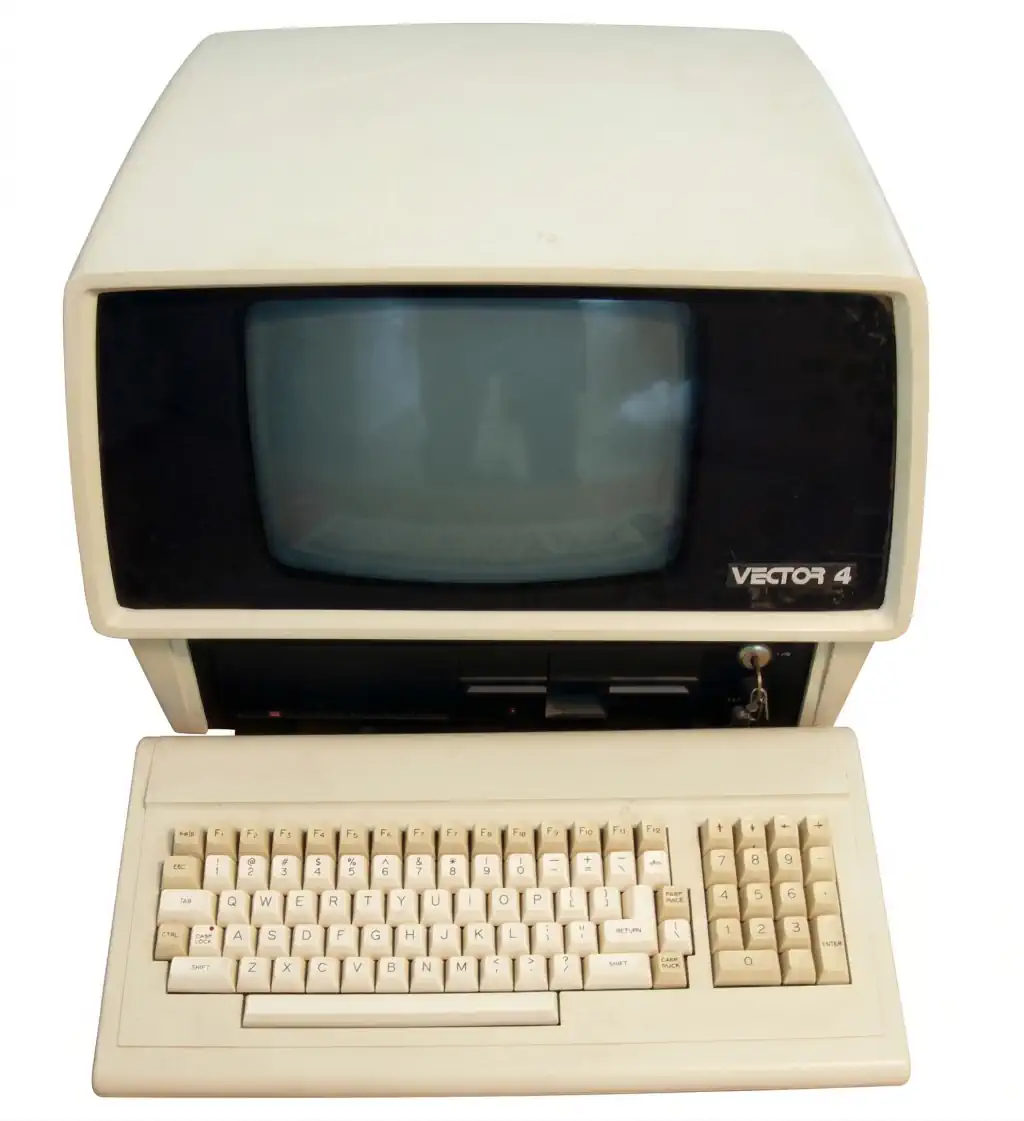

The Vector Graphic Vector 4 represented a refinement of the integrated system concept introduced with the Vector 3, continuing the transition away from modular S-100 hobbyist machines toward turnkey business computers. While it retained the same general architecture and internal S-100 card structure, the Vector 4 improved standardization and usability, particularly in its storage subsystem. Earlier systems like the Vector-1 required external terminals, and the Vector MZ still relied on multiple boards and separate components, but by the time of the Vector 4, the system was fully self-contained with built-in display, keyboard, and disk drives, designed to compete directly with other professional CP/M systems of the early 1980s.
Technically, the Vector 4 was built around a Zilog Z80 processor running at 4 MHz, paired with 64 KB of RAM, with approximately 56 KB available to applications under CP/M. It featured a built-in monochrome display with an 80 by 24 character text resolution and an 8 by 12 character matrix, using a memory-mapped video system derived from the Flashwriter design. One of its most important upgrades was the adoption of standard soft-sectored 5.25-inch floppy drives, typically providing around 360 KB per disk, which improved compatibility with mainstream CP/M software and disk formats compared to earlier hard-sectored systems. The system also included serial and parallel I/O capabilities through its internal S-100 boards and booted from disk using onboard monitor firmware.
The Vector 4’s technical capabilities made it a solid and practical CP/M business machine, particularly due to its improved disk compatibility and integrated design. It supported a wide range of business and development software, including word processing, spreadsheets, and programming tools, benefiting from the maturity of the CP/M ecosystem. Although it did not represent a radical architectural leap over the Vector 3, its refinements addressed many of the limitations of earlier Vector systems and aligned it more closely with industry standards. This made it a more accessible and reliable platform for business users, even as the market was beginning to shift toward newer 16-bit systems.
Vector Graphic, Inc.
Vector Graphic, Inc. started out by creating expansion cards for S-100 computer systems. Their first products were an 8kByte RAM card and a High Resolution Graphics card, HRG, which offered a resolution of 256x256 pixels.
The first computer Vector Graphic produced was the Victor-1, an S-100 clone. The company was founded by Bob Harp, his wife Lore, and their neighbor Carol Ely. Bob designed the first Vector 1 system, while his wife and the neighbor ran the company. Within four years their revenue exceeded $3M per month.
The company expanded their line of Vector computers up to the Vector 5. Unfortunately Bob and Lore believed that their success was unstoppable, even in the early 1980s. They made their company public and sold stock in it. But the company was plagued by bad decisions. A huge number of Vector 3 computers had been produced while the marketing department already started advertising the Vector 4. This caused consumers to wait with the purchase until the 4 came out. Bob and Lore got a divorce which caused a shake up in the leadership of the company and Vector Graphics filed for bacnkruptcy in the late 1980s.
CP/M Operating System
CP/M (Control Program for Microcomputers), created by Gary Kildall in 1974 for Intel 8080-based systems, was the first widely adopted microcomputer operating system to establish a standard software platform. At its core, CP/M was divided into three layers: the BIOS (Basic Input/Output System) for hardware-dependent routines, the BDOS (Basic Disk Operating System) for file and device abstractions, and the CCP (Console Command Processor) for the command-line interface. This modular design meant CP/M could be ported to a wide variety of 8-bit systems simply by rewriting the BIOS layer, while the BDOS and CCP remained binary-compatible. This allowed application developers to target a single OS API rather than custom hardware interfaces, which was a radical departure from the fragmented landscape of early microcomputers.
Memory management in CP/M was constrained by the 8080 and Z80’s 64 KB address space, so the operating system was designed to occupy only the top portion of memory. The BDOS and CCP were typically loaded into high memory, leaving a contiguous block of low memory available for transient programs (user applications). Applications were written to expect a fixed TPA (Transient Program Area), with the starting address varying slightly depending on how much memory was available after BIOS/BDOS were loaded. This simple scheme avoided the need for virtual memory or sophisticated protection mechanisms, but it limited multitasking: CP/M was strictly a single-tasking environment. Program overlays and clever memory swapping techniques were sometimes used by developers to fit larger applications into the available TPA, especially for compilers and database software.
Application support was the main driver of CP/M’s dominance. Its standardization around the BDOS interface meant that word processors, assemblers, compilers (notably for C, Pascal, and BASIC), and business applications could run on hundreds of different hardware platforms with minimal modification. Programs were distributed as .COM files—binary images loaded directly into the TPA without relocation—which simplified the loader at the cost of flexibility. Libraries like Digital Research’s PL/I subset and third-party toolchains extended CP/M into a development platform, while the vast ecosystem of utilities (from editors like ED to debuggers and communications software) established it as the de facto operating system of the late 1970s and early 1980s microcomputing world. For retrocomputing enthusiasts, CP/M represents the moment when software compatibility, not just hardware, became the central value in the microcomputer marketplace.
CPU - The Zilog Z80
The Z80 quickly became popular in the personal computer market, with many early personal computers, such as the TRS-80 and Sinclair ZX80, using the Z80 as their central processing unit (CPU). It was also widely used in home computers, such as the MSX range, SORD, and the Amstrad CPC, as well as in many arcade games. Additionally, it was also used in other applications such as industrial control systems, and embedded systems. The Z80 was widely used until the mid-1980s, when it was gradually replaced by newer microprocessors such as the Intel 80286 and the Motorola 68000.
The Z80 microprocessor was developed by Zilog, a company founded by Federico Faggin in 1974. The Z80 was released in July 1976, as a successor to the Intel 8080. It was designed to be fully compatible with the 8080, but also included new features such as an improved instruction set, more powerful interrupts, and a more sophisticated memory management system.
Originally the Z80 was intended for use in embedded systems, just as the 8080 CPU. But the combination of compatibility, superior performance to other CPUs of the era, and the affordability led to a widespread use in arcade video game systems, and later in home computers such as the Osborne 1, TRS-80, ColecoVision, ZX Spectrum, MSX, Sega's Master System and many more. The Z-80 ran the original Pac-Man arcade cabinet. The Z-80 was used even in the Game Gear (1990s), and the TI-81 and succeeding graphic calculators.
The Z-80 remained in production until June of 2024, 48 years after its original release. Zilog replaced the processor with its successor the eZ80, an 8-bit microprocessor that features expanded memory addressing up to 16 megabytes, and running up to 50MHz, comparable to a Z80 clocked at 150MHz.

RAM max: 64kB
56kB Usable memory
OASIS