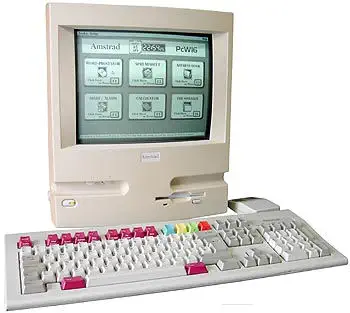

Amstrad PCW16
In 1995 Amstrad released the PCW16. Despite having the same PCW branding, the system was not compatible with any of the previous PCW systems. The PCW16 came with a new GUI operating system called Rosanne. It was not capable of multi-tasking, so only one application could be run at a time. If a user started a new application, the running application would save it's files and close. The Word Processor that came with the PCW16 was created by Creative Technoloty and for backwards compatibily could read the older Locoscript files, but saved them in its own format. The sofware bundle also included a spreadsheet, address book, diary, calculator, and a file manager. No third party software was produced for this system.
The PCW16 was capable of a more standard 640x480 pixels in VGA mode. It came with a 1.4MByte High Density floppy disk drive and had 1 1MByte Flash memory to store programs and user files. The PCW16 still used the older Z80 CPU, but at higher speed than it's predecessors.
CP/M 3.0 Operating System
CP/M Plus, also known as CP/M 3.0, was the last major 8-bit release of Digital Research’s Control Program for Microcomputers, introduced in 1983. Architecturally, it extended the traditional CP/M design of BIOS, BDOS, and CCP by introducing a bank-switched memory model that allowed systems with more than 64 KB of RAM (commonly 128 KB or more) to take advantage of the extra space. The BDOS was redesigned to reside partly in a common memory bank, while transient programs executed in a separate banked region, giving applications nearly the full 64 KB address space while still preserving the operating system in memory. This scheme enabled larger, more complex programs to run on 8-bit Z80 and 8080-class machines, while maintaining backward compatibility with existing CP/M 2.2 applications.
In addition to expanded memory support, CP/M Plus added advanced system features such as password-protected files, improved file and record locking for multiuser scenarios, and more granular error handling. The BDOS call set was extended to provide enhanced time and date stamping, disk parameterization, and buffered console I/O, improving performance on systems with floppy and Winchester disks. From the user perspective, CP/M Plus included a more sophisticated CCP with command history, aliasing, and the ability to chain commands, making it more interactive than earlier CP/M releases. For developers, its richer API and banking model made it a more capable target for compilers and application suites, bridging the gap between classic 8-bit CP/M environments and the emerging 16-bit world of CP/M-86 and MS-DOS.
CPC Asic Chip
“CPC ASIC” refers to two different integrations in the CPC line. The 1988 cost-down CPC464/6128 used a 100-pin pre-ASIC (Amstrad 40226) that consolidated the Gate-Array, the RAM-management PAL and a 6845-class CRTC into one device; it adds no new graphics or audio features versus earlier CPCs and is commonly labeled CRTC type 4 in scene documentation. The later 1990 CPC+/GX4000 machines used a distinct ASIC (AMS40489) that both replaces earlier custom logic and adds new display/audio capabilities; CPCWiki describes it as the “second heart” of the Plus range.
Technically, the CPC+ ASIC integrates the Gate-Array, a 6845-compatible CRTC, the 8255 PPI (with caveats), printer-port glue, and exposes an extended register set that can be paged into 0x4000–0x7FFF after a purposely obscure unlock I/O sequence. Once paged, the ASIC provides 16 hardware sprites (fixed 16×16, 4 bpp, 256-byte patterns each) with per-sprite control blocks at 0x6000–0x607F and sprite pattern RAM at 0x4000 + n×0x100. It also replaces the CPC’s 27-colour scheme with a 12-bit (4:4:4) palette selecting 32 pens from 4096 colours, memory-mapped at 0x6400–0x643F (main inks 0–15, border, and sprite inks 1–15). DMA-driven sound is supplied via three DMA channels targeting the AY-3-8912 registers; control/status and channel pointers live at 0x6C00–0x6C0F.
Timing/compatibility details matter. The Plus boots in CPC-compatible mode; enhanced features are inert until the unlock sequence runs. Certain I/O semantics differ (e.g., on the Plus, INs to Gate-Array/CRTC ports act like OUTs), the ASIC’s CRTC timing shifts some effects (e.g., colour changes appear ~½ NOP later), and the PPI emulation is not cycle-accurate, which breaks a few programs unless adjusted. In community taxonomy, the CPC+ ASIC CRTC is “type 3”, while the pre-ASIC cost-down CRTC is “type 4”.
CPU - The Zilog Z80
The Z80 quickly became popular in the personal computer market, with many early personal computers, such as the TRS-80 and Sinclair ZX80, using the Z80 as their central processing unit (CPU). It was also widely used in home computers, such as the MSX range, SORD, and the Amstrad CPC, as well as in many arcade games. Additionally, it was also used in other applications such as industrial control systems, and embedded systems. The Z80 was widely used until the mid-1980s, when it was gradually replaced by newer microprocessors such as the Intel 80286 and the Motorola 68000.
The Z80 microprocessor was developed by Zilog, a company founded by Federico Faggin in 1974. The Z80 was released in July 1976, as a successor to the Intel 8080. It was designed to be fully compatible with the 8080, but also included new features such as an improved instruction set, more powerful interrupts, and a more sophisticated memory management system.
Originally the Z80 was intended for use in embedded systems, just as the 8080 CPU. But the combination of compatibility, superior performance to other CPUs of the era, and the affordability led to a widespread use in arcade video game systems, and later in home computers such as the Osborne 1, TRS-80, ColecoVision, ZX Spectrum, MSX, Sega's Master System and many more. The Z-80 ran the original Pac-Man arcade cabinet. The Z-80 was used even in the Game Gear (1990s), and the TI-81 and succeeding graphic calculators.
The Z-80 remained in production until June of 2024, 48 years after its original release. Zilog replaced the processor with its successor the eZ80, an 8-bit microprocessor that features expanded memory addressing up to 16 megabytes, and running up to 50MHz, comparable to a Z80 clocked at 150MHz.

1MB Flash RAM
CP/M Plus