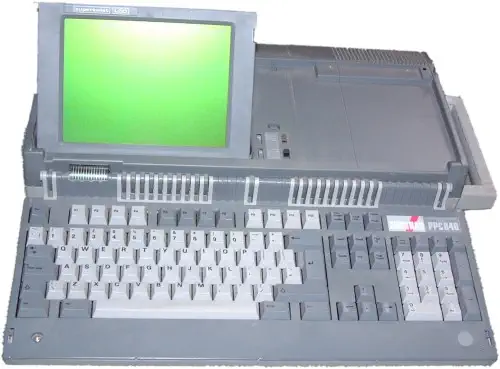

Amstrad PPC 640
The Amstrad PPC 512 and the later PPC 640, were portable PC-XT clones made by Amstrad. The machines had a keyboard and a monochrome LCD display and could run off of batteries or a 12V power source. Both had one or two double density double sided floppy disk drives, and the PPC640 also came with a modem. Software provided was the PPC Organizer and the PPC640 came with a communications package.
Key difference between the 512 and the 640 was the memory that was built in, and the modem. Both machines had a standard RS232, centronics printer port and CGA/MDA video output. The batteries needed to run the unit were massive, Ten C-size batteries were needed making the machine a power hog.
MS-DOS Operating System
MS-DOS (Microsoft Disk Operating System) originated in 1981 when Microsoft acquired QDOS (Quick and Dirty Operating System) from Seattle Computer Products and adapted it for IBM’s upcoming 8088-based personal computer. Initially branded as IBM PC-DOS 1.0 for IBM, and MS-DOS for other vendors, it provided a single-user, single-tasking environment that was heavily inspired by CP/M. The system was structured around a kernel (IBMBIO.COM and IBMDOS.COM in PC-DOS, IO.SYS and MSDOS.SYS in MS-DOS) that interfaced with hardware and implemented system services, plus a command interpreter (COMMAND.COM) that offered a user interface and executed batch files. Early versions supported only 160 KB or 320 KB floppy disks, a flat directory structure, and a very limited system call API.
Technically, MS-DOS was designed around the Intel 8086/8088’s segmented memory model, giving programs access to up to 640 KB of conventional memory, with the upper memory area reserved for system BIOS and hardware. The OS itself was not re-entrant and offered no process isolation: a single foreground program owned the machine at any given time, and the kernel simply provided file and device I/O calls. Devices were abstracted as special files (CON, PRN, AUX, NUL), allowing consistent access via the same system calls used for disk files. Its filesystem, FAT12, offered a simple, space-efficient design suitable for floppy media but imposed limits such as 8.3 filenames and small maximum volume sizes.
As the IBM PC platform expanded, MS-DOS evolved rapidly. Version 2.0 (1983), designed for the IBM XT with a hard drive, introduced FAT16, hierarchical subdirectories, file handles, and device drivers that could be dynamically loaded. Later releases added support for larger disks, expanded memory (via EMS/XMS standards), internationalization, and more sophisticated batch scripting. Version 3.x aligned with the IBM AT and its 80286 CPU, supporting 1.2 MB floppies, larger hard disks, and network redirectors. By version 4.0, MS-DOS began showing signs of strain under the growing complexity of PC hardware, and memory management became a recurring challenge due to the 640 KB conventional memory limit and the awkward use of extended and expanded memory schemes.
Despite being inherently single-tasking, MS-DOS was extended through third-party multitasking shells and Microsoft’s own attempts such as MS-DOS 4.0 Multitasking (rarely used). Eventually, MS-DOS served as the underlying runtime for Windows 3.x, which leveraged DOS for file and device I/O but implemented a cooperative multitasking GUI environment on top. With the release of Windows 95 and later, MS-DOS was gradually absorbed into Windows as a bootstrapping layer and compatibility subsystem. Nonetheless, MS-DOS’s simple architecture, reliance on BIOS and device drivers, and its widespread adoption made it the de facto standard for microcomputer operating systems throughout the 1980s, shaping software design and hardware standards for years to come.
CPU - The Nec v30 (8086 clone)
The NEC V30 was a version of the NEC V20 that was pin compatible with the Intel 8086 processor. It also supports a 8080 emulation mode. The V30, running up to 10MHz, could be used as an upgrade for the 8086.
In 1984 Intel filed a lawsuit against NEC, claiming that the microcode of the V30 infringed on its patent for the 8088 and the 8086 processors. The courts ruled that microcode is protected by copyright, but that Intel had forfeited it, by neglecting to ensure that second-source chips were suitably marked. It also noted that the microcode of the V30 was not a copy of Intel's.