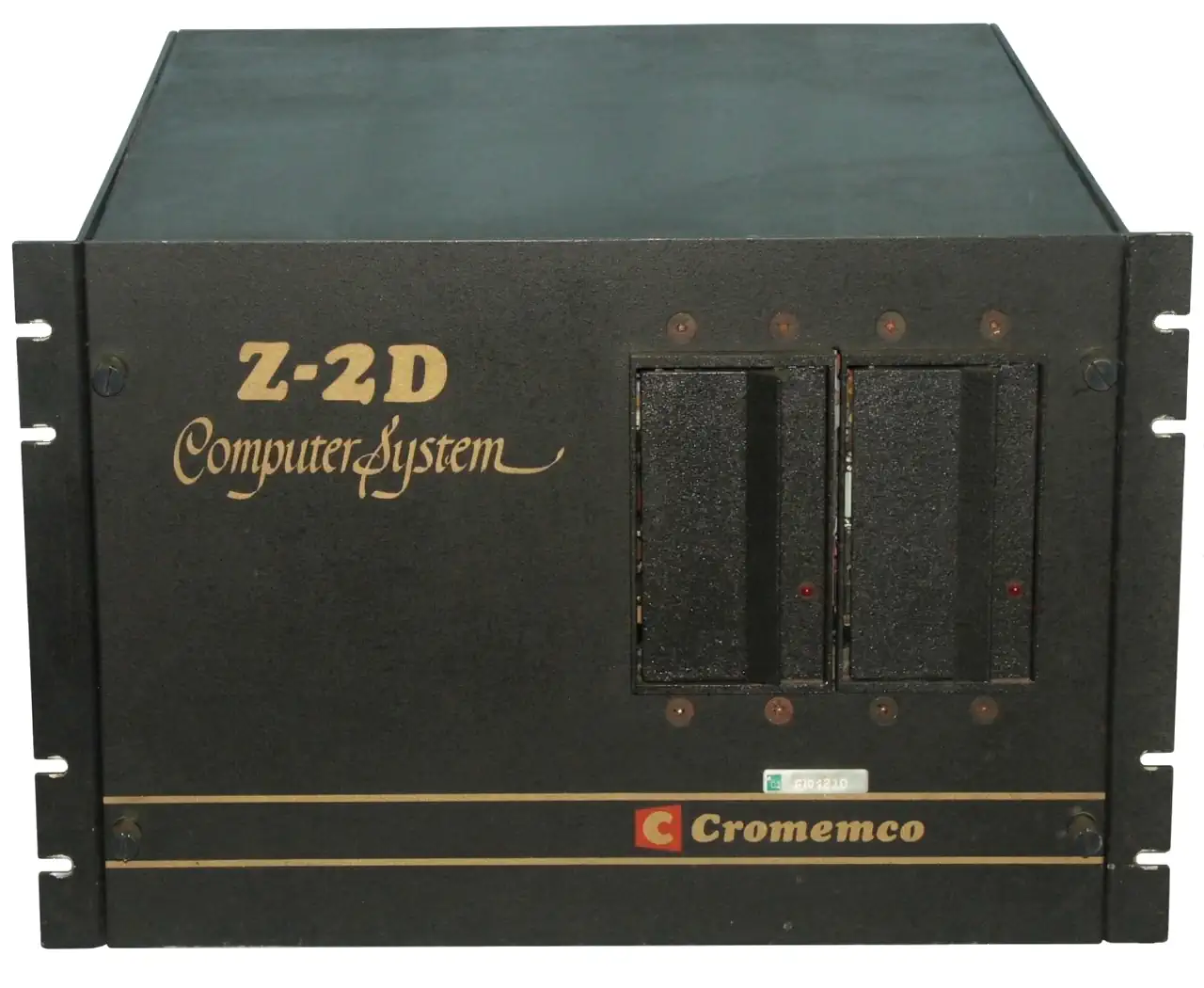

The Cromemco Z2
Z-2 is a series of microcomputers made by Cromemco, Inc. which were introduced to the market in the middle to late 1970s. They were S-100 bus machines powered by the Zilog Z80 processor and typically ran on the CP/M operating system.
At first the Z2 was available in kit form, which was popular at the time, or fully assembled for the commercial market. Later the machines were only available as factory assembled complete units. The machines were known for their speed, configurability, durability, and reliability.
The Z-2 was a Z80–based microcomputer system that was introduced in 1977. The original Z-2 in kit form included a ZPU-K Z80 CPU card, S-100 bus motherboard, all-metal rack-mount chassis and dust case, card socket and card guide; the assembled form included a complete set of sockets and card guides, and a cooling fan. The Z-2 series was capable of supporting up to 21 S-100 boards and could be configured with any of the boards supplied by Cromemco.
Configurations of the Z2
| Model | Primary Storage | Slot Capacity |
|---|---|---|
| Z-2 | External Only (Mainframe) | 21 S-100 Slots |
| Z-2D | Dual 5.25" Floppy Drives | 21 S-100 Slots |
| Z-2H | 11 MB Internal Hard Disk | 12 S-100 Slots |
| CS-2 | Dual Floppy (System 2 Bundle) | 21 S-100 Slots |
Video Capabilities
Unlike modern PCs or even 1980s home computers, it didn't come with "built-in" video or sound in the way we think of today. Instead, its capabilities were entirely dependent on which S-100 expansion cards were plugged into its 21-slot chassis.
For a professional system of that time, its multimedia options were actually quite advanced, particularly in the realm of color graphics. Standard Z-2D systems often functioned as "headless" units connected to a text-only terminal (like a Lear Siegler ADM-3A) via a serial port. However, Cromemco was a pioneer in high-end graphics through specific interface cards:- The Dazzler (Cromemco SDI): This was one of the first commercial color graphics cards for microcomputers.
- Resolution: It typically offered $64 \times 64$ pixels in "high resolution" or $32 \times 32$ in a lower mode.
- Color: It could display up to 16 colors. While this sounds primitive now, in 1976/77, seeing a color map or a simple animation on a standard NTSC TV or monitor was revolutionary.
- The SDI (Super Dazzler Interface): Later versions of the Z-2D could use the SDI card set, which pushed the resolution much higher—up to $756 \times 484$ pixels—targeting broadcast television and industrial design markets.
Sound Capabilities
Out of the box, the Z-2D was silent (aside from the hum of its massive power supply and the "clunk" of the 5.25-inch Wangco disk drives). To get audio, users typically turned to:- Cromemco D+7A IO Card: This was a multi-purpose I/O card that included an 8-bit Digital-to-Analog Converter (DAC). By rapidly feeding values to the DAC via software, the Z-2D could produce primitive waveforms, speech synthesis, or even basic music.
- Third-Party S-100 Sound Cards: Because the Z-2D used the industry-standard S-100 bus, owners could install cards like the Newtech Model 6 which was a dedicated 6-bit DAC specifically designed for music synthesis on 8080/Z80 systems.
Technical Context
It's worth noting that the Z-2D was powered by a Z80A CPU running at 4 MHz. Processing complex video or high-fidelity sound required significant CPU overhead, which is why most "multimedia" on this machine was used for specialized laboratory or broadcast applications rather than gaming.| Feature | Typical Hardware | Output Type |
|---|---|---|
| Color Video | Cromemco Dazzler | NTSC Composite / RGB |
| High-Res Graphics | Cromemco SDI | Broadcast Quality (525 lines) |
| Audio | D+7A (DAC) | Mono Analog Jack |
| Text | Serial Interface | External Terminal (RS-232) |
Cromemco Model Comparison
Cromemco's product line expanded significantly from its early S-100 boards into a diverse range of systems. While the Z-2 series was their most iconinc, they offered everything from entry-level systems to high-end unix-like workstations.
Here is an overview of the other major models available
The System Series
- System Zero (CS-0): A compact, low-cost entry point. It was designed primarily for ROM-based applications but could be expanded to support disks. It used the SCC (Single Card Computer) as its heart.
- System One (CS-1): A smaller, 8-slot desktop version of the Z-2D. It was aimed at the office environment and was often the first to ship with the newer 5.25-inch "quad capacity" floppy drives.
- System Three (CS-3): The "professional" flagship. It was a massive cabinet system featuring dual 8-inch floppy drives (Persci 277) and 21 slots. It was designed specifically for multi-user environments running the Cromix operating system.
- C-10 Personal Computer: A departure from the S-100 "big iron." This was an all-in-one style desktop (similar to a Kaypro or early Mac) with a built-in monitor, Z80A CPU, and 64K RAM, bundled with a suite of business software.
Evolution to 16/32-bit
By the mid-1980s, Cromemco moved beyond the Z80. They introduced the DPU (Dual Processor Unit) which allowed these same chassis to run both a Z80 and a Motorola 68000 This eventually led to the CS-200 and CS-400 series, which were tower-style units designed as powerful Unix servers for the scientific community.
| Model | Architecture / Chassis | Typical Use Case |
|---|---|---|
| System Zero | 4-Slot S-100 / Compact | Dedicated Control / ROM Software |
| System One | 8-Slot S-100 / Desktop | Small Business / Single User |
| System Three | 21-Slot S-100 / Large Cabinet | Multi-user Unix-like (Cromix) |
| C-10 | Integrated Monitor / Non-S100 | Personal Productivity / Word Processing |
| System 100/200 | 68000-based S-100 Tower | High-end Unix Server |
The S-100 Architecture
The S-100 bus formalized as IEEE 696 is a passive backplane architecture originally designed for the MITS Altair 8800. Unlike modern active motherboards, the S-100 backplane contains no active logic; it consists of 100 parallel trace lines with physical slots for daughtercards. The original specification utilized a 100-pin edge connector to facilitate a 15.5-inch wide bus. Because it was designed around the Intel 8080, the signal definitions closely mirrored that processor’s pinout, including specialized status signals such as sMEMW (memory write) and sINP (input from I/O port).
Power distribution on the S-100 bus is characterized by its use of unregulated DC voltages: +8V +16V and -16V This necessitated the inclusion of local voltage regulators—typically TO-3 or TO-220 packages—on every individual expansion card to step the voltage down to the required TTL-level +5V or +/- 12V. While this distributed regulation increased the thermal load of each card, it effectively isolated noise and voltage drops across the long backplane traces, a critical factor for maintaining signal integrity in high-density 21-slot systems like the Cromemco Z-1.
The bus timing and control logic rely on a "master-slave" relationship, where a single CPU card typically acts as the permanent bus master. However, the IEEE 696 standard introduced a sophisticated Temporary Master protocol, allowing for up to 16 different bus masters. This is managed through four prioritized DMA control lines (HOLD pHLDA and the ADSB address disable signals). When a secondary controller, such as a high-speed disk interface, requires the bus, it asserts a request; the primary CPU then tri-states its address, data, and control buffers, effectively disconnecting from the bus to allow the temporary master full transparent access to the system memory.
Data handling on the S-100 bus was originally limited to 8-bit bidirectional communication, but the transition to 16-bit processors necessitated the implementation of the sXTRQ (Sixteen Request) and SIXTN (Sixteen Acknowledge) signals. These pins allow the bus to dynamically gang two 8-bit data paths (Data-In and Data-Out) into a single 16-bit wide data bus. Combined with a 24-bit extended addressing scheme—utilizing pins 12 through 17 and 59 through 64—the S-100 architecture successfully scaled from 64 KB of addressable space to a 16 MB range preserving its relevance through the early 1980s.
CPU - The Zilog Z80
The Z80 quickly became popular in the personal computer market, with many early personal computers, such as the TRS-80 and Sinclair ZX80, using the Z80 as their central processing unit (CPU). It was also widely used in home computers, such as the MSX range, SORD, and the Amstrad CPC, as well as in many arcade games. Additionally, it was also used in other applications such as industrial control systems, and embedded systems. The Z80 was widely used until the mid-1980s, when it was gradually replaced by newer microprocessors such as the Intel 80286 and the Motorola 68000.
The Z80 microprocessor was developed by Zilog, a company founded by Federico Faggin in 1974. The Z80 was released in July 1976, as a successor to the Intel 8080. It was designed to be fully compatible with the 8080, but also included new features such as an improved instruction set, more powerful interrupts, and a more sophisticated memory management system.
Originally the Z80 was intended for use in embedded systems, just as the 8080 CPU. But the combination of compatibility, superior performance to other CPUs of the era, and the affordability led to a widespread use in arcade video game systems, and later in home computers such as the Osborne 1, TRS-80, ColecoVision, ZX Spectrum, MSX, Sega's Master System and many more. The Z-80 ran the original Pac-Man arcade cabinet. The Z-80 was used even in the Game Gear (1990s), and the TI-81 and succeeding graphic calculators.
The Z-80 remained in production until June of 2024, 48 years after its original release. Zilog replaced the processor with its successor the eZ80, an 8-bit microprocessor that features expanded memory addressing up to 16 megabytes, and running up to 50MHz, comparable to a Z80 clocked at 150MHz.

RAM max: 512kB
64x64 using Dazzler (Cromemco SDI) Graphics card
21 S-100 Slots