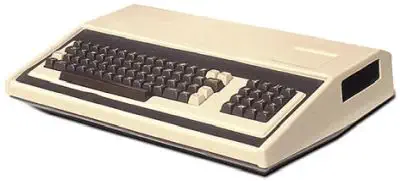

The Exidy Sorcerer
The Exidy Sorcerer was one of the earliest Home Computers, it was launched in 1978. Compared to the competition, the machine had better graphics capability and memory options. It was based on the Z80 architecture which ran at a modest 2MHz.
The Sorcerer was also one of the first home computers that used ROM cartridges as a means of loading software. The cartridge was designed so that it fit in existing 8-track tape casings, which reduced the manufacturing cost. The Sorcerer came standard with a Microsoft BASIC ROM cartridge.
Despite the fact that the marketing was lacking, the machine sold well in Europe. In the Netherlands, the educational broadcasting company TELEAC decided to launch a computer course and viewers could purchase the course bundled with a Sorcerer.
In Europe the Sorcerer was distributed by CompuData, which licensed the design for local production in the Netherlands. Compudata produced the Exidy Sorcerer until 1983 and then switched to a machine of their own design, the Tulip computer which was a 8088-based architecture.
Two versions of the Sorcerer were produced, after some reported problems with the RS-232 serial port on the initial machines, a revised machine the Sorcerer II (DP1000-2 motherboard) was produced, replacing it.
Various hobby groups in the Netherlands and Australia developed RAM upgrades, speed upgrade kits, 80-column add-on cards and updated ROMs that replaced the internal monitor boot-loader program.
European Model
As the Sorcerer sold better in Europe than in the US, manufacturing was licenced to the CompuData company, which produced a slightly different case for the Exidy, using different colors.
The Exidy Sorcerer was one of the earliest Home Computers, it was launched in 1978. Compared to the competition, the machine had better graphics capability and memory options. It was based on the Z80 architecture which ran at a modest 2MHz.
The Sorcerer was also one of the first home computers that used ROM cartridges as a means of loading software. The cartridge was designed so that it fit in existing 8-track tape casings, which reduced the manufacturing cost. The Sorcerer came standard with a Microsoft BASIC ROM cartridge.
Despite the fact that the marketing was lacking, the machine sold well in Europe. In the Netherlands, the educational broadcasting company TELEAC decided to launch a computer course and viewers could purchase the course bundled with a Sorcerer.
In Europe the Sorcerer was distributed by CompuData, which licensed the design for local production in the Netherlands. Compudata produced the Exidy Sorcerer until 1983 and then switched to a machine of their own design, the Tulip computer which was a 8088-based architecture.
Two versions of the Sorcerer were produced, after some reported problems with the RS-232 serial port on the initial machines, a revised machine the Sorcerer II (DP1000-2 motherboard) was produced, replacing it.
Various hobby groups in the Netherlands and Australia developed RAM upgrades, speed upgrade kits, 80-column add-on cards and updated ROMs that replaced the internal monitor boot-loader program.
The designers of the Exidy Sorcerer used 8-track tape cases as the basis for their catridge design, reducing manufacturing costs.
Video - Integrated Circuitry
The Exidy Sorcerer (1978) did not have a sophisticated, dedicated video display processor like the Texas Instruments TMS9918 (MSX) or Motorola 6845 (CRTC). Its video hardware was simpler and closer in spirit to earlier S-100–style designs, built around a character-mapped display system with custom logic.
The display was character-cell based rather than pixel-addressable. The screen was organized as a 30×24 grid of characters (720 × 240 effective pixels if you measure by dot cells). Each character was rendered from a programmable 8×8 character generator ROM. This made the Sorcerer unusual: you could redefine the glyph patterns, which allowed limited pseudo-graphics and even custom “tiles,” a trick often used to simulate bitmapped graphics. There was no true bitmap mode and no hardware sprites; all graphics had to be done by redefining characters or combining them into mosaics. The video output was monochrome only, intended for green-screen or composite monitors. There was no color capability in the stock machine. Video RAM was directly accessible by the CPU, so updates to the display were straightforward but could consume a large share of Z80 cycles for animation.
CPU - The Zilog Z80
The Z80 quickly became popular in the personal computer market, with many early personal computers, such as the TRS-80 and Sinclair ZX80, using the Z80 as their central processing unit (CPU). It was also widely used in home computers, such as the MSX range, SORD, and the Amstrad CPC, as well as in many arcade games. Additionally, it was also used in other applications such as industrial control systems, and embedded systems. The Z80 was widely used until the mid-1980s, when it was gradually replaced by newer microprocessors such as the Intel 80286 and the Motorola 68000.
The Z80 microprocessor was developed by Zilog, a company founded by Federico Faggin in 1974. The Z80 was released in July 1976, as a successor to the Intel 8080. It was designed to be fully compatible with the 8080, but also included new features such as an improved instruction set, more powerful interrupts, and a more sophisticated memory management system.
Originally the Z80 was intended for use in embedded systems, just as the 8080 CPU. But the combination of compatibility, superior performance to other CPUs of the era, and the affordability led to a widespread use in arcade video game systems, and later in home computers such as the Osborne 1, TRS-80, ColecoVision, ZX Spectrum, MSX, Sega's Master System and many more. The Z-80 ran the original Pac-Man arcade cabinet. The Z-80 was used even in the Game Gear (1990s), and the TI-81 and succeeding graphic calculators.
The Z-80 remained in production until June of 2024, 48 years after its original release. Zilog replaced the processor with its successor the eZ80, an 8-bit microprocessor that features expanded memory addressing up to 16 megabytes, and running up to 50MHz, comparable to a Z80 clocked at 150MHz.

RAM max: 32kB
512x240 Mono
ROM cartridges