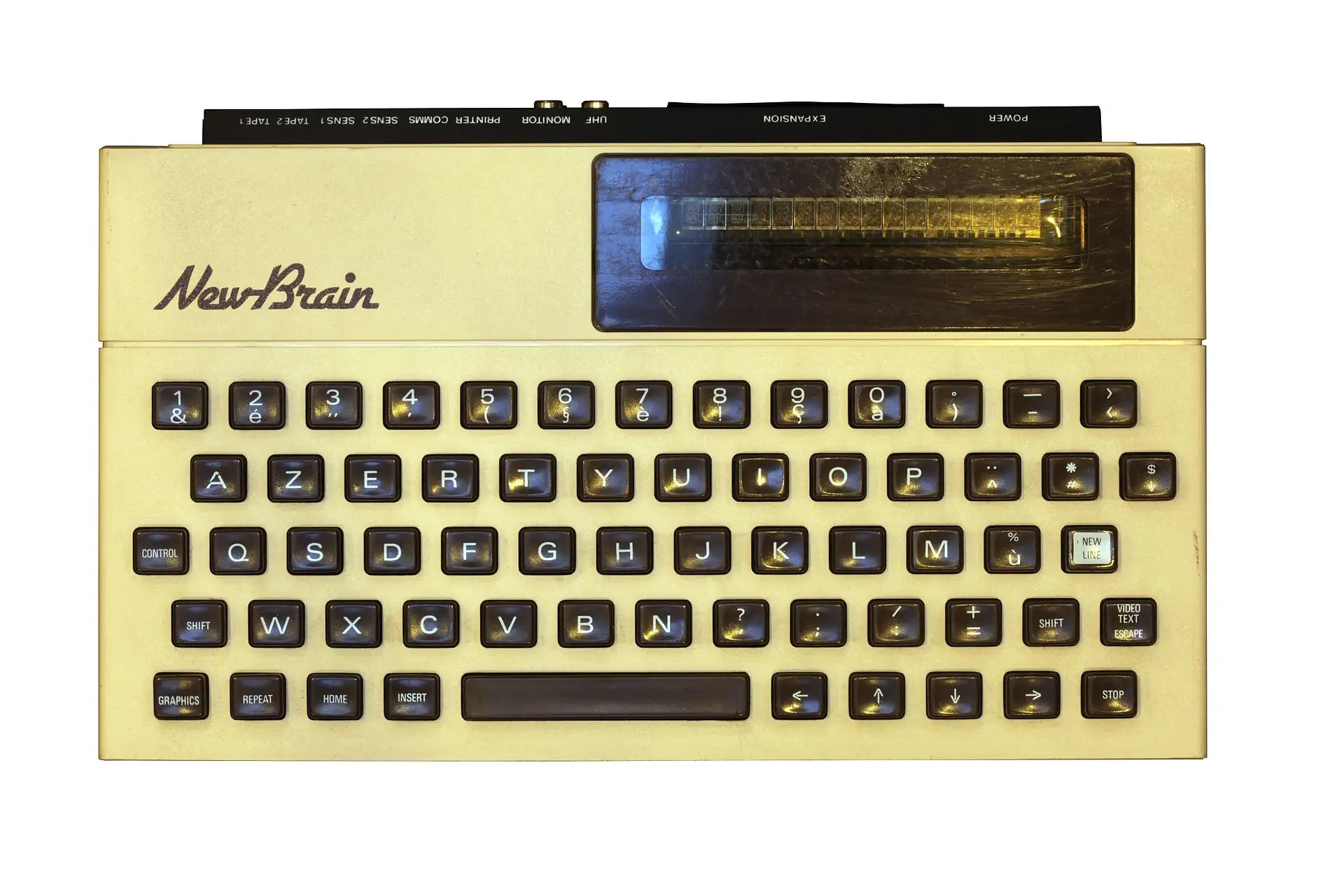

Grundy Newbrain
The NewBrain system was developed according to BBC specifications, as the release was intented for the BBC's Further Education department's push to get computers into British schools. Ultimately the BBC chose Acorn over the NewBrain computers
Two models of the NewBrain were released, model A and model AD. Model AD included a one-line, 16 character vacuum fluorescent display which allowed the user to use the computer without a TV or monitor. Model A lacked this display.
The architecture was based on the Zilog Z80, using bank switching to expand memory beyond 64KByte. The system was capable of running CP/M 2.2. Grundy Business Systems released two 5.25" disk drives that could support 40 track 200kByte single sided, or 80 track 800kByte double sided disks. In 1983 Sony came out with a 3.5" 800KByte disk drive that could be used on the system
The NewBrain came with an extended version of ANSI BASIC, which in turn is similar to Micrsoft BASIC. Graphics were supported with commands that could draw dots, lines, arcs, and fill in areas. Through CP/M the system could also run HiSoft Pascal, Fortran, Modula-2 and other languages.
CPU - The Zilog Z80
The Z80 quickly became popular in the personal computer market, with many early personal computers, such as the TRS-80 and Sinclair ZX80, using the Z80 as their central processing unit (CPU). It was also widely used in home computers, such as the MSX range, SORD, and the Amstrad CPC, as well as in many arcade games. Additionally, it was also used in other applications such as industrial control systems, and embedded systems. The Z80 was widely used until the mid-1980s, when it was gradually replaced by newer microprocessors such as the Intel 80286 and the Motorola 68000.
The Z80 microprocessor was developed by Zilog, a company founded by Federico Faggin in 1974. The Z80 was released in July 1976, as a successor to the Intel 8080. It was designed to be fully compatible with the 8080, but also included new features such as an improved instruction set, more powerful interrupts, and a more sophisticated memory management system.
Originally the Z80 was intended for use in embedded systems, just as the 8080 CPU. But the combination of compatibility, superior performance to other CPUs of the era, and the affordability led to a widespread use in arcade video game systems, and later in home computers such as the Osborne 1, TRS-80, ColecoVision, ZX Spectrum, MSX, Sega's Master System and many more. The Z-80 ran the original Pac-Man arcade cabinet. The Z-80 was used even in the Game Gear (1990s), and the TI-81 and succeeding graphic calculators.
The Z-80 remained in production until June of 2024, 48 years after its original release. Zilog replaced the processor with its successor the eZ80, an 8-bit microprocessor that features expanded memory addressing up to 16 megabytes, and running up to 50MHz, comparable to a Z80 clocked at 150MHz.

640x256 2 colors (External Monitor)