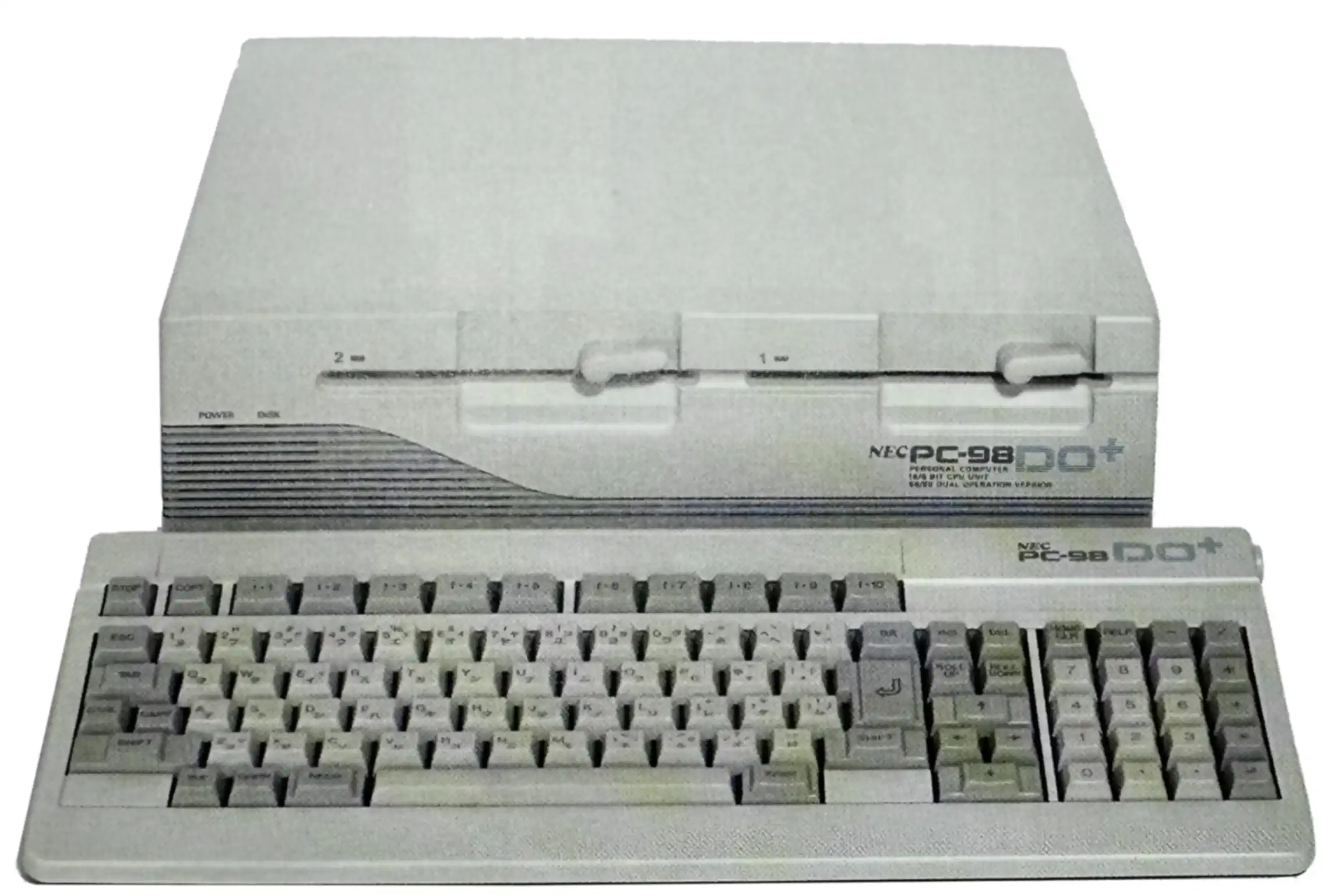

NEC PC-98 DO +, dual CPU computer
The Nec PC-98 DO + was the successor of the PC-98 DO. The DO had only one expansion slot which allowed only for a single expansion board, users would have to choose between more RAM or a hard disk, but could not use both. The PC-98 DO+ had a dedicated expansion slot for an internal hard disk, and for additional memory.
Just like its predecessor, the DO+ was a dual 8-bit and 16-bit machine. The main CPU was upgraded to a V33 16-bit CPU running at 12MHz and it had a Z80-compatible µPD780008 that could run at 4 or 8 MHz for compatibility with PC-8801 software.
But the PC-8801 line had been in decline for a while now and people weren't looking for software compatibility, expecially since the PC-98 DO line did not offer any backwards compatibility for PC-8801 expansion equipment.
Like the DO, the DO+ came with 640kByte of main RAM and 256kByte of VideoRAM. In PC-8801 mode there was only 192 KByte of RAM, and 48KByte of VRAM available. In PC-98 mode, the VRAM enabled advanced graphics of 640x400 pixels using 16 out of 4096 available colors. Storage was provided by two built-in High Density (HD) floppy disk drives. As always the computer came with N88-BASIC provided in ROM. Sound was improved over the DO by the Yamaha YM2608 FM Chip.
Sound - Yamaha YM2608
CPU - The Nec v33 (8086 clone)
The NEC V33 was a super version of the NEC V30 CPU that separates the address and the data bus. It executes all instructions using wired logic and not micro-code. The previous V30 used microcode that was so close to the Intel micro-code that Intel filed a lawsuit against NEC for copyright infringement.
Because the V33 used hard-wired instructions, the CPU is about two times faster than the V30 at the same clock frequencies. The performance of this CPU is comparable to the Intel I80286.
The YM2608 is a member of Yamaha's OPN family of FM Synthesis chips. It is the successor of the YM2203 and was widely used in the later lines of the NEC PC-8801 and PC-9801 series of computers.
The Yamaha 2608 doubles the number of FM channels to 6, where the YM2203 had three. Each channel has four operators that can generate sine waves that can be combined, fed as input of another operator, to generate the final FM sound. There are eight possible operator interconnections for producing the different types of instrument sounds. The chip also includes the YM2149 SSG chip (Software Sound Generator). The SSG provides three sound channels, a noise generator and two 8-bit GPIO ports.
Because the YM2608 has six channels vs the three channels of the YM2203, the chip is used with a YM3016 stereo Digital to Analog Converter (DAC) to create stereo FM sound.
CPU - The Zilog Z80
The Z80 quickly became popular in the personal computer market, with many early personal computers, such as the TRS-80 and Sinclair ZX80, using the Z80 as their central processing unit (CPU). It was also widely used in home computers, such as the MSX range, SORD, and the Amstrad CPC, as well as in many arcade games. Additionally, it was also used in other applications such as industrial control systems, and embedded systems. The Z80 was widely used until the mid-1980s, when it was gradually replaced by newer microprocessors such as the Intel 80286 and the Motorola 68000.
The Z80 microprocessor was developed by Zilog, a company founded by Federico Faggin in 1974. The Z80 was released in July 1976, as a successor to the Intel 8080. It was designed to be fully compatible with the 8080, but also included new features such as an improved instruction set, more powerful interrupts, and a more sophisticated memory management system.
Originally the Z80 was intended for use in embedded systems, just as the 8080 CPU. But the combination of compatibility, superior performance to other CPUs of the era, and the affordability led to a widespread use in arcade video game systems, and later in home computers such as the Osborne 1, TRS-80, ColecoVision, ZX Spectrum, MSX, Sega's Master System and many more. The Z-80 ran the original Pac-Man arcade cabinet. The Z-80 was used even in the Game Gear (1990s), and the TI-81 and succeeding graphic calculators.
The Z-80 remained in production until June of 2024, 48 years after its original release. Zilog replaced the processor with its successor the eZ80, an 8-bit microprocessor that features expanded memory addressing up to 16 megabytes, and running up to 50MHz, comparable to a Z80 clocked at 150MHz.

µPD780008 @4/8MHz
VRAM: 256kB
text 80x25 in 8 colors
000