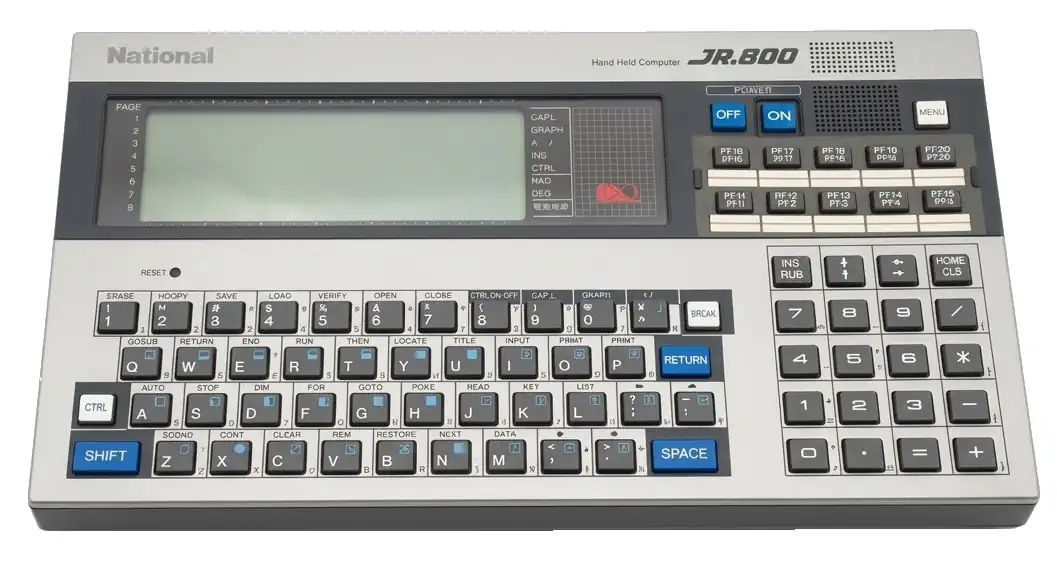

The Panasonic/National JR-800 Handheld computer
The Panasonic/National JR-800, released in 1983, was a sophisticated "handheld" or "briefcase" computer designed for portable professional and scientific computing. Unlike many of its 8-bit contemporaries that used Motorola-style architectures, the JR-800 was built around the MN1800A CPU an 8-bit CMOS microprocessor compatible with the Motorola 6802 instruction set. This processor ran at a clock frequency of approximately 800 kHz optimized for the low power consumption required for battery-operated portability while maintaining enough computational overhead to handle complex BASIC programming.
The memory architecture of the JR-800 was notably robust for its form factor. It featured 16 KB of internal RAM which was expandable to 24 KB via optional plug-in modules. The system’s firmware resided in 32 KB of ROM housing a comprehensive JR-800 BASIC interpreter and the system’s operating environment. This BASIC implementation was specifically tailored for the hardware, supporting advanced mathematical functions and providing direct control over the machine’s unique display and peripheral interfaces.
The device's primary output was a built-in Liquid Crystal Display (LCD) capable of rendering 8 lines of text with 32 characters per line, or a graphical resolution of 192 x 64 pixels This bitmapped display allowed for rudimentary technical graphing and data visualization in the field. To support its role as a professional tool, the JR-800 included a full QWERTY keyboard with a dedicated numeric keypad, a rarity for handhelds of the era, facilitating rapid data entry for engineering or financial applications.
Connectivity and expansion were handled through a variety of specialized ports located on the sides and rear of the unit. The JR-800 featured a RS-232C serial interface for data communication, a Centronics-compatible parallel printer port and a dedicated interface for an external micro-cassette recorder for data storage. Additionally, it possessed a proprietary expansion bus for connecting peripherals such as the JR-F01 floppy disk controller or the RL-P1001 thermal plotter. This suite of I/O options transformed the handheld from a simple calculator into a mobile workstation capable of interfacing with standard laboratory and office equipment.
The Hitachi HD63A01V Processor
The Hitachi HD63A01V is a high-performance 8-bit CMOS single-chip microcomputer that represents a significant evolution of the Motorola 6801 architecture. Operating at a maximum internal clock frequency of 1.5 MHz (from a 6.0 MHz external crystal) for the "A" variant, it was designed with a focus on high integration and low power consumption. Unlike the earlier NMOS 6800 series, the 6301 family utilized CMOS technology, which allowed for a "Sleep" mode and a "Standby" mode, drastically reducing power draw—a critical feature for portable devices like the Panasonic JR-800.
Technically, the HD63A01V is an "expanded" version of the 6801, meaning it incorporates a CPU core, 128 bytes of internal RAM and 4 KB of internal ROM (though in systems like the JR-800, external memory is mapped to the address space). It features an enhanced instruction set that remains upwardly compatible with the 6800 but adds 10 additional instructions including a hardware 8-bit by 8-bit multiply (MUL) and several bit-manipulation commands. The inclusion of a 16-bit Free Running Timer (FRT) and a Serial Communication Interface (SCI) on-chip allowed engineers to reduce the total component count on a PCB significantly.
One of the most versatile aspects of the HD63A01V is its Flexible Operating Modes The chip can be configured into seven different modes via the MP0, MP1, and SC0/SC1 pins at reset. These modes range from a "Single-Chip Mode," where all I/O pins are available for general purpose use, to "Expanded Multiplexed Mode," which allows the processor to address a full 64 KB address space using a multiplexed data/address bus. This adaptability made it a favorite for "smart" peripherals and handheld computers that required a balance between internal efficiency and external expandability.
HD63A01V Architecture & Memory Mapping
The HD63A01V features a sophisticated programming model for an 8-bit chip, notably offering 16-bit operations through its "Double Accumulator" system.
- Accumulators A & B: Two independent 8-bit registers for logic/arithmetic.
- Double Accumulator (D): A concatenated 16-bit register (A+B) allowing for 16-bit loads, stores, and additions.
- Index Register (X): A 16-bit register crucial for memory pointing and indexed addressing modes.
System Memory Map (Typical Expanded Mode)
In a system like the Panasonic JR-800, the processor is set to an expanded mode to address external RAM and the BASIC ROM. The typical memory layout is as follows:
| Memory Range (Hex) | Usage | Technical Description |
|---|---|---|
$0000 - $001F |
Internal Registers | Controls on-chip peripherals: I/O ports, 16-bit Timer (FRT), and Serial SCI. |
$0080 - $00FF |
Internal RAM | 128 bytes of high-speed CMOS RAM. Often used for "Zero Page" fast-access variables. |
$0100 - $BFFF |
External RAM/ROM | Primary workspace. On the JR-800, this contains the 16KB/24KB user memory. |
$C000 - $F7FF |
System ROM | Location of the resident JR-800 BASIC interpreter and system monitor. |
$FF00 - $FFFF |
Interrupt Vectors | Hardwired jump addresses for Reset, NMI, IRQ, and Software Interrupts (SWI). |
Bit Manipulation Capabilities
A key advantage of the Hitachi variant over the standard Motorola 6801 is the inclusion of specialized bit-level instructions. These allow for direct modification of memory bits without affecting the accumulators:
- AIM: AND Immediate with Memory.
- OIM: OR Immediate with Memory.
- EIM: Exclusive OR Immediate with Memory.
Note: These instructions were vital for efficiency in the JR-800's battery-backed environment, reducing code size and execution time.
HD63A01V Architecture & Memory Mapping
The HD63A01V features a sophisticated programming model for an 8-bit chip, notably offering 16-bit operations through its "Double Accumulator" system.
- Accumulators A & B: Two independent 8-bit registers for logic/arithmetic.
- Double Accumulator (D): A concatenated 16-bit register (A+B) allowing for 16-bit loads, stores, and additions.
- Index Register (X): A 16-bit register crucial for memory pointing and indexed addressing modes.
System Memory Map (Typical Expanded Mode)
In a system like the Panasonic JR-800, the processor is set to an expanded mode to address external RAM and the BASIC ROM. The typical memory layout is as follows:
| Memory Range (Hex) | Usage | Technical Description |
|---|---|---|
$0000 - $001F |
Internal Registers | Controls on-chip peripherals: I/O ports, 16-bit Timer (FRT), and Serial SCI. |
$0080 - $00FF |
Internal RAM | 128 bytes of high-speed CMOS RAM. Often used for "Zero Page" fast-access variables. |
$0100 - $BFFF |
External RAM/ROM | Primary workspace. On the JR-800, this contains the 16KB/24KB user memory. |
$C000 - $F7FF |
System ROM | Location of the resident JR-800 BASIC interpreter and system monitor. |
$FF00 - $FFFF |
Interrupt Vectors | Hardwired jump addresses for Reset, NMI, IRQ, and Software Interrupts (SWI). |
Bit Manipulation Capabilities
A key advantage of the Hitachi variant over the standard Motorola 6801 is the inclusion of specialized bit-level instructions. These allow for direct modification of memory bits without affecting the accumulators:
- AIM: AND Immediate with Memory.
- OIM: OR Immediate with Memory.
- EIM: Exclusive OR Immediate with Memory.
Note: These instructions were vital for efficiency in the JR-800's battery-backed environment, reducing code size and execution time.
ROM: 16kB
VRAM: 2kB
192x64 Graphics
FDD