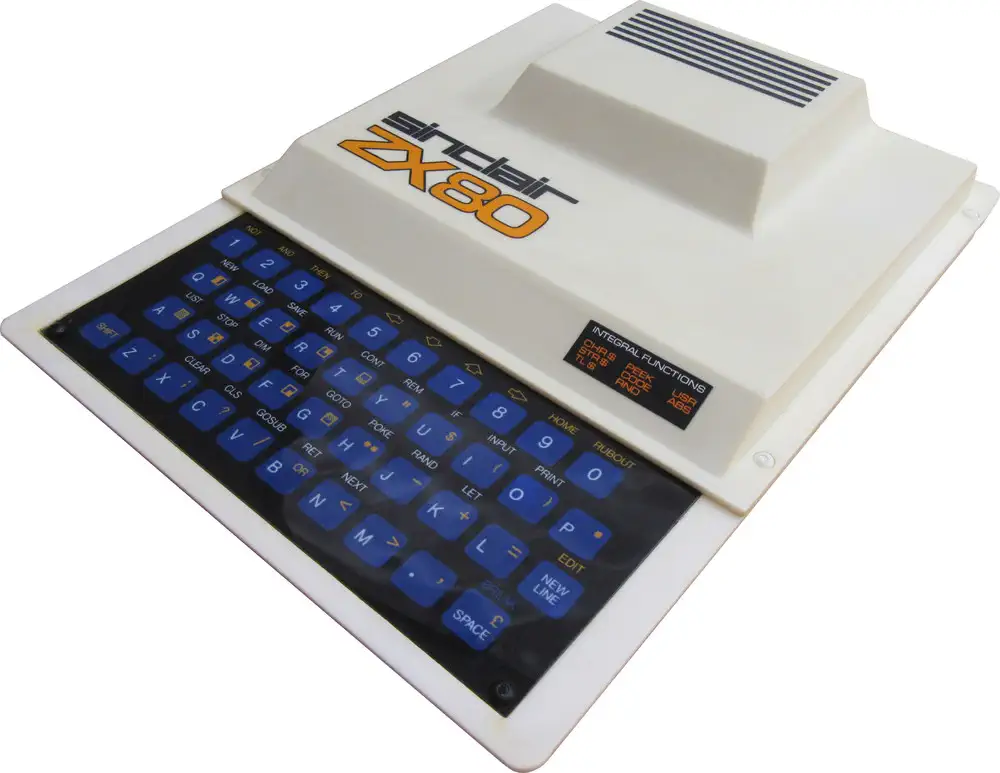

Timex Sinclar ZX80
The Sinclair ZX80 was launched in 1980 by Science of Cambridge Ltd. Later this company was better known as Sinclair Research. It is one of the first computers that was available in the United Kingdom costing less than 100 pounds. It was available in kit-form, where users had to solder the parts together, or in a ready-built version.
The ZX80 was a popular computer and there was a waiting list for people to get one. The computer was named after the CPU used, the Z80, with the X meaning "the mystery ingredient". The computer had 1KByte of static RAM and 4KByte of ROM. There was no sound output, and the display was 24x32 lines of text, or a 64x48 block graphics mode. The computer was made with readily available TTL chips, the only part that was proprietary was the Firmware. This caused many East-Bloc countries to clone the machine and provide illegal copies of the ROMs with it.
The Video Display generator of the ZX80 used minimal hardware plus a combination of software to generate a video signal. The ZX80 could therefore only generate a video signal when the computer was idle, or, when it was waiting for a key-press. When running a BASIC program, or when a key was pressed, the screen would blank out momentarily when the processor was busy. This made animated graphics extremely difficult.
The machine had built-in cassette and video ports, and a slot opening at the rear that exposed the bus edge connector. This same bus was continued on the ZX81 and the later ZX spectrum. One of the expansion options was the ZX80 RAM Pack, which held 1, 2, or 3KByte of Static RAM, and a later model came out with 16KByte of Dynamic RAM.
One of the worst parts of the ZX80 was it's keyboard. The keyboard was a thin membrane keyboard that was very difficult to use. The keys were very close together which often resulted in pressing the wrong key.
Despite it's shortcomings, low memory, weird video circuitry and small flat keyboard, the ZX80 was hugely popular, mainly due to it's low price. It was a true entry level computer for a lot of people to get into the hobby of computing.

CPU - The Zilog Z80
The Z80 quickly became popular in the personal computer market, with many early personal computers, such as the TRS-80 and Sinclair ZX80, using the Z80 as their central processing unit (CPU). It was also widely used in home computers, such as the MSX range, SORD, and the Amstrad CPC, as well as in many arcade games. Additionally, it was also used in other applications such as industrial control systems, and embedded systems. The Z80 was widely used until the mid-1980s, when it was gradually replaced by newer microprocessors such as the Intel 80286 and the Motorola 68000.
The Z80 microprocessor was developed by Zilog, a company founded by Federico Faggin in 1974. The Z80 was released in July 1976, as a successor to the Intel 8080. It was designed to be fully compatible with the 8080, but also included new features such as an improved instruction set, more powerful interrupts, and a more sophisticated memory management system.
Originally the Z80 was intended for use in embedded systems, just as the 8080 CPU. But the combination of compatibility, superior performance to other CPUs of the era, and the affordability led to a widespread use in arcade video game systems, and later in home computers such as the Osborne 1, TRS-80, ColecoVision, ZX Spectrum, MSX, Sega's Master System and many more. The Z-80 ran the original Pac-Man arcade cabinet. The Z-80 was used even in the Game Gear (1990s), and the TI-81 and succeeding graphic calculators.
The Z-80 remained in production until June of 2024, 48 years after its original release. Zilog replaced the processor with its successor the eZ80, an 8-bit microprocessor that features expanded memory addressing up to 16 megabytes, and running up to 50MHz, comparable to a Z80 clocked at 150MHz.