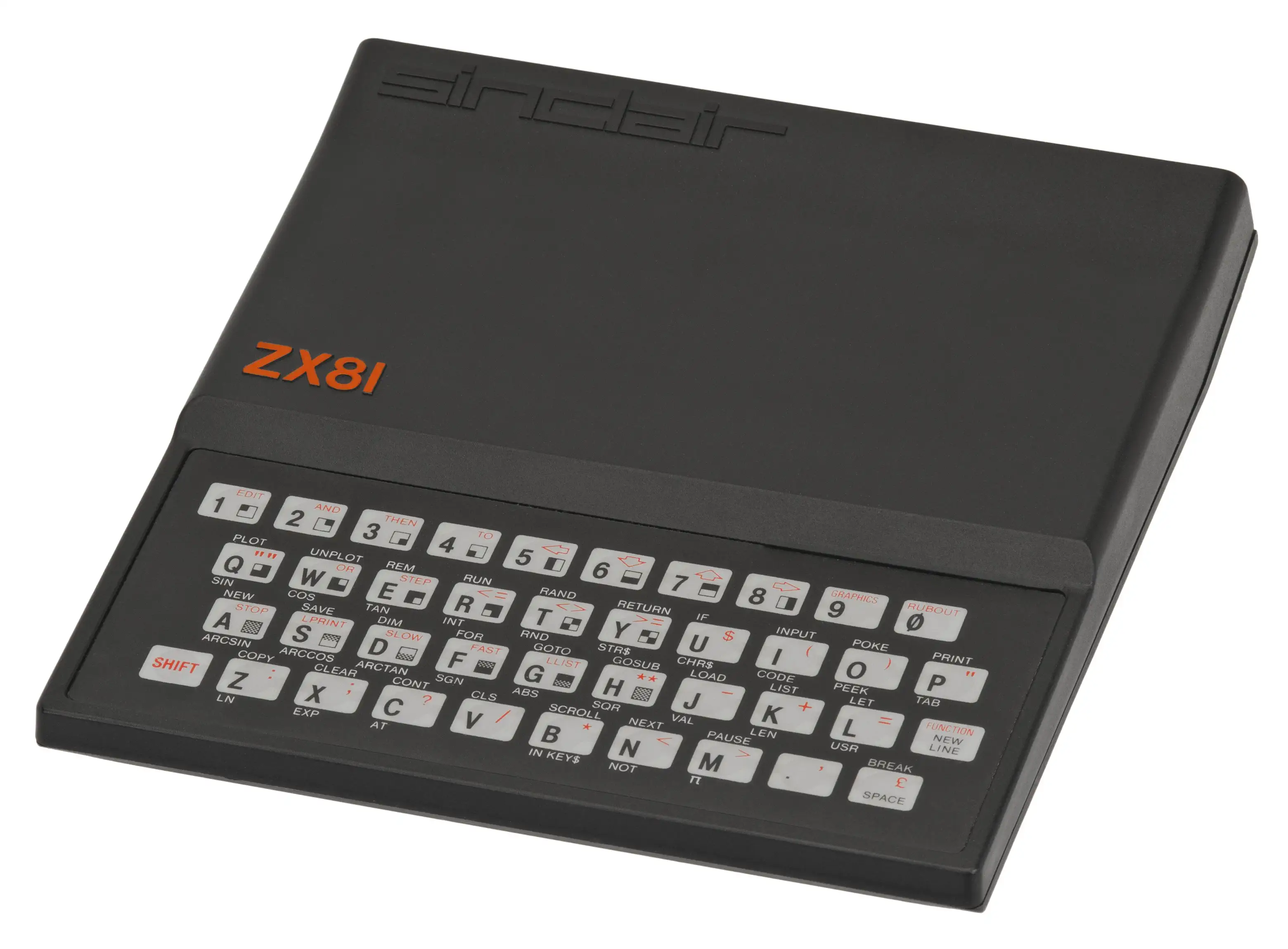

Timex Sinclar ZX81
The ZX81 was produced by SInclair Research in 1981. It was produced in Scotland by the Timex Corporation. The ZX81 was the successor to the ZX80 and had the same goal: to be small, simple, and above everything else: in-expensive.
The ZX81 uses only four chips and 1KByte of RAM. It has no power switch and could be purchased in kit form, or pre-assembled. It was the first inexpensive mass-market home computer to be sold by high-street stores such as W.H. Smith and later by many other retailers. The ZX81 marked a turnaround where computing became a hobby for the general public and not only for electronics hobbyists. The ZX81 created a huge community of followers and spawned many software development companies.
The older ZX80 could be upgraded to a ZX81 at around 20% of the cost of buying a new ZX81. All that you needed was a new ROM and a new keyboard overlay.
The ZX81 came standard with 1KByte of RAM, but could be expanded externally to 16KByte. It runs on the Z80A microprocessor from NEC, an Uncommited Logic Array (ULA) from Ferranti, and 8KByte of ROM that provided the Sinclair BASIC interpreter.
The ULA has various functions in the ZX81:
- Synchronise the screen display.
- Generate a 6.5MHz clock (3.25MHz was used for the Z80)
- Output audio signals for the Cassette recorder
- Process incoming cassette audio signals
- Sensing keystrokes
- Decide between ROM and RAM, based on the CPU address
- Control system timing
CPU - The Zilog Z80
The Z80 quickly became popular in the personal computer market, with many early personal computers, such as the TRS-80 and Sinclair ZX80, using the Z80 as their central processing unit (CPU). It was also widely used in home computers, such as the MSX range, SORD, and the Amstrad CPC, as well as in many arcade games. Additionally, it was also used in other applications such as industrial control systems, and embedded systems. The Z80 was widely used until the mid-1980s, when it was gradually replaced by newer microprocessors such as the Intel 80286 and the Motorola 68000.
The Z80 microprocessor was developed by Zilog, a company founded by Federico Faggin in 1974. The Z80 was released in July 1976, as a successor to the Intel 8080. It was designed to be fully compatible with the 8080, but also included new features such as an improved instruction set, more powerful interrupts, and a more sophisticated memory management system.
Originally the Z80 was intended for use in embedded systems, just as the 8080 CPU. But the combination of compatibility, superior performance to other CPUs of the era, and the affordability led to a widespread use in arcade video game systems, and later in home computers such as the Osborne 1, TRS-80, ColecoVision, ZX Spectrum, MSX, Sega's Master System and many more. The Z-80 ran the original Pac-Man arcade cabinet. The Z-80 was used even in the Game Gear (1990s), and the TI-81 and succeeding graphic calculators.
The Z-80 remained in production until June of 2024, 48 years after its original release. Zilog replaced the processor with its successor the eZ80, an 8-bit microprocessor that features expanded memory addressing up to 16 megabytes, and running up to 50MHz, comparable to a Z80 clocked at 150MHz.

RAM max: 16kB
64x44 pseudo graphics (using block characters)