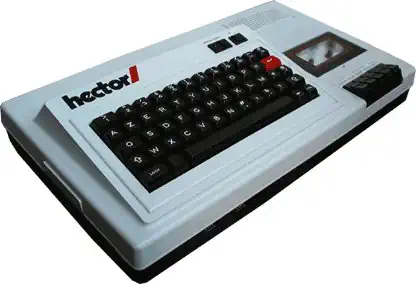

The Hector 1 / Victor Lambda 2
The Hector 1 was essentially the exact same computer as the Victor Lambda 2, but the manufacturer decided to rebrand the line of computers to Hector. Initially this computer was sold as the Victor Lambda 2, but the company wanted to avoid a trademark confusion and renamed the machine to Hector 1. There were about one hundred games produced for this computer.
The machine had 16kByte of memory and in order for a user to program in BASIC, they first had to load the language from tape. The graphics capabilities were limited, even for that time, the machine could produce 112x78 resolution in 8 colors and had a text resolution of 17x12 characters.
Sound - The SN76477
The SN76477 is a sound chip produced by Texas instruments in 1978. This chip was used as the sound generator in arcade games, toys and home computers.
The SN76477 generates complex audio signal waveforms by combining the outputs of a low frequency oscillator, variable frequency (voltage controlled) oscillator (VCO) and noise source, modulating the resulting composite signal with a selected envelope and, finally, adjusting the signal's attack and decay periods. At each stage, the process can be controlled at the programming inputs of the signal modification and generation circuits, using control voltages, logic levels, or different resistor and capacitor values.
CPU - The Zilog Z80
The Z80 quickly became popular in the personal computer market, with many early personal computers, such as the TRS-80 and Sinclair ZX80, using the Z80 as their central processing unit (CPU). It was also widely used in home computers, such as the MSX range, SORD, and the Amstrad CPC, as well as in many arcade games. Additionally, it was also used in other applications such as industrial control systems, and embedded systems. The Z80 was widely used until the mid-1980s, when it was gradually replaced by newer microprocessors such as the Intel 80286 and the Motorola 68000.
The Z80 microprocessor was developed by Zilog, a company founded by Federico Faggin in 1974. The Z80 was released in July 1976, as a successor to the Intel 8080. It was designed to be fully compatible with the 8080, but also included new features such as an improved instruction set, more powerful interrupts, and a more sophisticated memory management system.
Originally the Z80 was intended for use in embedded systems, just as the 8080 CPU. But the combination of compatibility, superior performance to other CPUs of the era, and the affordability led to a widespread use in arcade video game systems, and later in home computers such as the Osborne 1, TRS-80, ColecoVision, ZX Spectrum, MSX, Sega's Master System and many more. The Z-80 ran the original Pac-Man arcade cabinet. The Z-80 was used even in the Game Gear (1990s), and the TI-81 and succeeding graphic calculators.
The Z-80 remained in production until June of 2024, 48 years after its original release. Zilog replaced the processor with its successor the eZ80, an 8-bit microprocessor that features expanded memory addressing up to 16 megabytes, and running up to 50MHz, comparable to a Z80 clocked at 150MHz.

RAM max: 64kB
ROM: 2kB
4 Octaves sound
112x78 in 4 from 8 colors