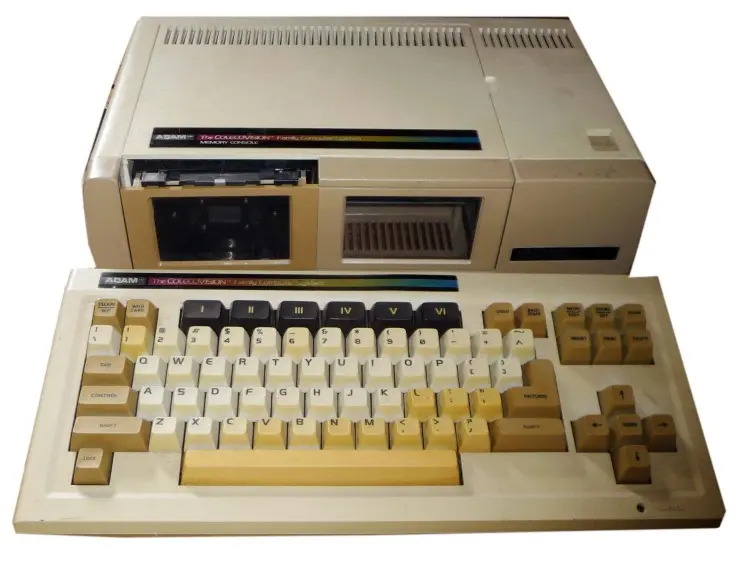

The Coleco Adam computer
The Coleco Adam is an 8-bit home computer released by Coleco in 1983. It was developed as a successor of the ColecoVision console. When it was introduced at the Consumer Electronics Show in 1983 it was shown running a port of the ColecoVision game Donkey Kong. This caused some trouble as it was Atari which had the exclusive rights to the game for the home computer market, Coleco only had a license for game consoles. In the end Coleco had to sign an agreement to not sell the Adam version of the game.
A lot of software for the Adam was derived from the ColecoVision as a lot of the hardware is the same. The system uses the Zilog Z80 as the CPU running at 3.58MHz, which many computer manufacturers did because it is the frequency of the NTSC colorburst, reducing interference between the computer and the television set that the computer would use as display. The display was driven by the Texas Instruments TMS9928A Video Display Controller. This chip was also used in the MSX line of computers and many others. It could display graphics in 16 colors with a resolution up to 256x192, and show 32 sprites. Each sprite could have one single color, and only four sprites were allowed per scanline, causing programmers to have to come up with clever sprite priority switching schemes, causing the infamous sprite flicker. The biggest problem with the VDC was the lack of pixel step hardware scrolling, causing games to be clunky and blocky when scrolling.
In addition, the Adam can run CP/M and had dedicated support processors (3 Motorola 6801s @1MHz) to control Memory I/O, the keyboard, and the tape interface. There were 3 internal expansion slots, 1 external cartridge slot and a half-duplex serial bus called AdamNet that ran 62.5kBit per second.Later Coleco produced a conversion kit, that would convert the ColecoVision to a full Adam computer
A unique feature of the Adam computers was its cassette tape system. The Adam used what was branded the Digital Data Pack. The DPP used a custom tape mechanism that ran the tape almost 10 times faster than other systems, running at 20 inches per second. The system could also fast forward and reverse the tape using software control, which was unique. The DDP could transfer around 1.4kBytes per second, compared to 300 or 1200 bits per second, a huge gain over conventional tape drives used in other home computer systems. The system was still not as fast as Disk Drives, and was sequential, but it put the Adam well ahead of its competitors in data storage. The cassettes used were standard cassettes, although the write-protect tab was relocated, so that the cassettes could not be overwritten in normal tape decks. This was also a mechanism to prevent illegal copying of cassettes, but of course some tape and clever modding circumvented this.
Unlike other home computers, the Adam did not have a built in Basic interperter. The Adam came with a built-in electronic typewriter and word processor program called SmartWriter, and had the EOS (Elementary Operating System) OS Kernel, as well as the OS-7 ColecoVision operating system built in. A SmartBASIC interpreter was included on a DDP tape. The Basic was compatible with Applesoft BASIC, it was developed by Randall Hyde of Lazer Microsystems.
Sound - The SN76489
The SN76489 Digital Complex Sound Generator (DCSG) is a TTL compatible programmable sound generator chip created by Texas Instruments. It main application was the generation of music and sound effects in home computers, arcade machines and home game consoles. Functionally the chip was similar to the General Instrument AY-3-8910.
Sound Capabilities:
- 3 Square Wave tone generators, 16 volume levels
- 1 White Noise Generator (white and periodic noice, 3 frequencies, 16 volumes)
The SN76489 Was originally designed to be used in the TI-99/4 computer, where it was first called the TMS9919 and later SN94624, and had a 500 kHz max clock input rate. Later, when it was sold outside of TI, it was renamed the SN76489, and a divide-by-8 was added to its clock input, increasing the max clock input rate to 4 MHz, to facilitate sharing a crystal for both NTSC colorburst and clocking the sound chip. A version of the chip without the divide-by-8 input was also sold
| Feature | Specification |
|---|---|
| Tone Channels | 3 Square Wave Generators |
| Noise Channels | 1 (Periodic or White Noise) |
| Attenuation | 16 levels per channel (4-bit) |
| Frequency Range | 122 Hz to 125 kHz (at 4 MHz clock) |
| Register Width | 10-bit for frequency, 4-bit for attenuation |
TMS9918 Series Video Display Processor (99n8, 99n9, 91n8, 91n9)
The TMS9918 is a series of video display controllers (VDC) manufactured in 1979 by Texas Instruments, also refered to as 'Video Display Processor' (VDP). The TMS9918 and its variants were used in the ColecoVision, CreatiVision, Memotech MTX, MSX, NABU Personal Computer, SG-1000/SC-3000, Spectravideo SV-318, Spectravideo SV-328, Sord M5, Tatung Einstein, Texas Instruments TI-99/4, Casio PV-2000, Coleco Adam, Hanimex Pencil II, and Tomy Tutor.
Key Features:
- 256x192 pattern based color pixels per screen
- 16 different colors
- 8-bit memory mapped CPU interface
- No need for DMA, CPU can access VRAM
- 32 single color Sprites per screen (4 per scanline)
Variants:
- TMS9918A - 60Hz output, NTSC video
- TMS9928A - 60Hz output, YPbPr video
- TMS9929A - 50Hz output, YPbPr video
- TMS9118 - Different RAM than TMS9918A, otherwise identical
- TMS9128 - Different RAM than TMS9928A, otherwise identical
- TMS9129 - Different RAM than TMS9929A, otherwise identical
CPU - The Zilog Z80
The Z80 quickly became popular in the personal computer market, with many early personal computers, such as the TRS-80 and Sinclair ZX80, using the Z80 as their central processing unit (CPU). It was also widely used in home computers, such as the MSX range, SORD, and the Amstrad CPC, as well as in many arcade games. Additionally, it was also used in other applications such as industrial control systems, and embedded systems. The Z80 was widely used until the mid-1980s, when it was gradually replaced by newer microprocessors such as the Intel 80286 and the Motorola 68000.
The Z80 microprocessor was developed by Zilog, a company founded by Federico Faggin in 1974. The Z80 was released in July 1976, as a successor to the Intel 8080. It was designed to be fully compatible with the 8080, but also included new features such as an improved instruction set, more powerful interrupts, and a more sophisticated memory management system.
Originally the Z80 was intended for use in embedded systems, just as the 8080 CPU. But the combination of compatibility, superior performance to other CPUs of the era, and the affordability led to a widespread use in arcade video game systems, and later in home computers such as the Osborne 1, TRS-80, ColecoVision, ZX Spectrum, MSX, Sega's Master System and many more. The Z-80 ran the original Pac-Man arcade cabinet. The Z-80 was used even in the Game Gear (1990s), and the TI-81 and succeeding graphic calculators.
The Z-80 remained in production until June of 2024, 48 years after its original release. Zilog replaced the processor with its successor the eZ80, an 8-bit microprocessor that features expanded memory addressing up to 16 megabytes, and running up to 50MHz, comparable to a Z80 clocked at 150MHz.

ROM: 32kB
VRAM: 16kB
32x24 16 color text
pattern based
256x192 16 color
2 color per 8 pix.
16x16
4/scanline
32 total
OS-7
Optional CP/M