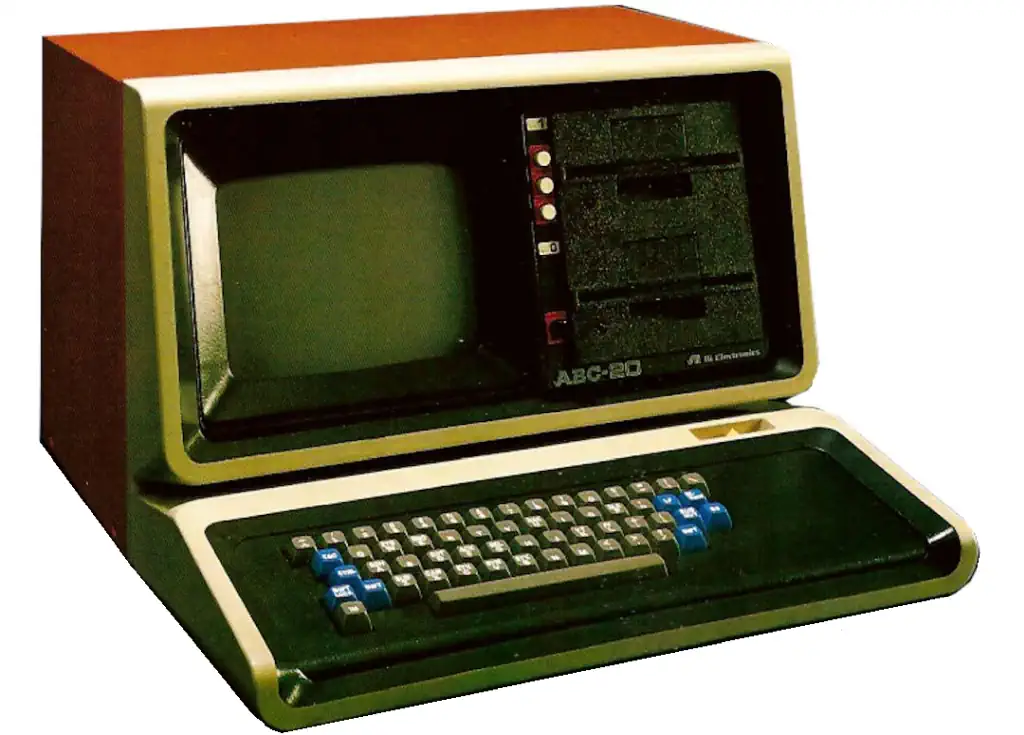

The ABC 20
This is a Z80 based M/PM and CP/m machine, with 64K of RAM, expandable to 1MB and very advanced word processing capabilities. AI used their own operating system called DOSKET, but the machine's could also use CP/M. MP/M, UCSD PASCAL, they could be used in multi terminal configurations, with up to 7 machines linked together.
There was a single CPU board, with LSis, many interface ports and a full ASCII keyboard.
The main unit houses a green screen monitor with 80x32 text, and has twin 8 inch floppy drives with 322kB storage capacity, the separate keyboard has 16 user programmable keys.
The ABC 10 vs the ABC 20
The distinction between the Ai Electronics ABC 10 and the ABC 20 lies primarily in the evolution of integrated storage technology and the standard memory footprint provided in the base configuration. Both systems were released in 1979 as part of Ai Electronics' transition from industrial minicomputers to integrated Z80-based business solutions.Primary Technical Differences
The ABC 10 was the entry-level model of the series, frequently utilizing a digital tape (cassette) interface as its primary auxiliary memory in its most basic form, running a specialized version of the operating system known as DOSKET-T In contrast, the ABC 20 was designed as a disk-centric workstation. While the ABC 10 could be upgraded to support floppy drives, the ABC 20 shipped with dual 5.25-inch floppy disk drives as a standard integrated component, providing a formatted capacity of approximately 322 KB per unit.Memory and Display Specifications
While both machines utilized the 4 MHz Zilog Z80A CPU, the ABC 20 typically standardized on 64 KB of RAM out of the box, whereas the ABC 10 was often marketed with a 32 KB base to target lower price points. The video output also saw a slight revision in the firmware; while both maintained an 80-column text width, some documentation suggests the ABC 20 firmware was optimized for a 32-row display height compared to the 24-row standard found on the earlier ABC 10 and the later ABC 24/26 series.Interface and Expansion
The ABC 20 integrated a GP-IB (IEEE-488) bus interface as a standard feature, a carryover from Ai Electronics' history in laboratory and industrial instrumentation. This allowed the ABC 20 to act as a controller for external hard disks—specifically Winchester-type drives of 10 MB or 20 MB—and scientific plotters. The ABC 10's interface panel was more conservative, focusing on the dual RS-232C serial ports and the Centronics parallel port for standard business printing tasks.Physical Architecture
Both machines adhered to the "all-in-one" robust chassis design, but the ABC 20's internal backplane was more densely populated to accommodate the disk controller and expanded I/O logic. This resulted in a slight increase in weight and power draw compared to the tape-based ABC 10. The ABC 20 served as the direct architectural predecessor to the ABC 24 (5.25-inch drives) and ABC 26 (8-inch drives), which eventually became the most successful iterations of the product line.DOSKET Operating System
Ai DOSKET (short for Disk Operating System for Diskette) was created and deployed by Ai Electronics (Ai Denshi Sokki) across several of their systems—from early AIDACS minicomputers to the ABC series of Z80-based business and desktop micros. It served as the default OS on models like the ABC-24 and ABC-26, and was also present on earlier machines such as the AIDACS-2000 and 3000 series
The ABC line, launched around 1979, was equipped with a Z80A CPU, 64 KB of RAM (expandable), built-in display controllers, floppy drives, and typical I/O interfaces like serial, parallel, and GPIB DOSKET provided system services tailored specifically for these hardware configurations.Technical Characteristics
While documentation on DOSKET is sparse, it is known that the OS operated alongside other more common systems—machines like the ABC-24/26 could also run CP/M, MP/M, or UCSD Pascal This implies DOSKET was purpose-built to deliver a specialized or optimized system environment—potentially offering integrated language support, efficient disk handling, and seamless access to bundled utilities. On the AIDACS-3000, DOSKET was offered alongside options like CP/M and UCSD Pascal, suggesting flexibility in OS deployment depending on customer or application needs.Role in the ABC Series Ecosystem
For the Ai ABC models, DOSKET likely served as the “factory” OS—streamlined for rapid boot, disk operations, and compatibility with Ai’s suite of office software (such as Fortran IV, COBOL, BASIC-2, PL/3, and even localized tools like an Arabic word processor). Though precise technical specs—like the memory layout, file structure, or multitasking capabilities—haven’t surfaced in the sources readily available today, DOSKET’s inclusion alongside more recognized systems indicates it was competent enough for general business applications but perhaps lacked the extensibility or widespread third-party software support of CP/M variants.CP/M Operating System
CP/M (Control Program for Microcomputers), created by Gary Kildall in 1974 for Intel 8080-based systems, was the first widely adopted microcomputer operating system to establish a standard software platform. At its core, CP/M was divided into three layers: the BIOS (Basic Input/Output System) for hardware-dependent routines, the BDOS (Basic Disk Operating System) for file and device abstractions, and the CCP (Console Command Processor) for the command-line interface. This modular design meant CP/M could be ported to a wide variety of 8-bit systems simply by rewriting the BIOS layer, while the BDOS and CCP remained binary-compatible. This allowed application developers to target a single OS API rather than custom hardware interfaces, which was a radical departure from the fragmented landscape of early microcomputers.
Memory management in CP/M was constrained by the 8080 and Z80’s 64 KB address space, so the operating system was designed to occupy only the top portion of memory. The BDOS and CCP were typically loaded into high memory, leaving a contiguous block of low memory available for transient programs (user applications). Applications were written to expect a fixed TPA (Transient Program Area), with the starting address varying slightly depending on how much memory was available after BIOS/BDOS were loaded. This simple scheme avoided the need for virtual memory or sophisticated protection mechanisms, but it limited multitasking: CP/M was strictly a single-tasking environment. Program overlays and clever memory swapping techniques were sometimes used by developers to fit larger applications into the available TPA, especially for compilers and database software.
Application support was the main driver of CP/M’s dominance. Its standardization around the BDOS interface meant that word processors, assemblers, compilers (notably for C, Pascal, and BASIC), and business applications could run on hundreds of different hardware platforms with minimal modification. Programs were distributed as .COM files—binary images loaded directly into the TPA without relocation—which simplified the loader at the cost of flexibility. Libraries like Digital Research’s PL/I subset and third-party toolchains extended CP/M into a development platform, while the vast ecosystem of utilities (from editors like ED to debuggers and communications software) established it as the de facto operating system of the late 1970s and early 1980s microcomputing world. For retrocomputing enthusiasts, CP/M represents the moment when software compatibility, not just hardware, became the central value in the microcomputer marketplace.
MP/M Operating System
MP/M (Multi-Programming Monitor Control Program), introduced by Digital Research in 1979, was a multitasking and multiuser extension of CP/M for Intel 8080 and Z80 systems. It retained the same modular structure of BIOS, BDOS, and CCP, but extended the BDOS to support task scheduling, memory partitioning, and multiple console I/O streams. Instead of a single Transient Program Area (TPA), MP/M divided available RAM into multiple partitions, each capable of running a separate process. A priority-driven scheduler controlled task execution, allowing background and foreground jobs, and a sophisticated interrupt handling system enabled multiple users to interact with the system simultaneously through connected terminals.
The key differences between MP/M and CP/M centered on concurrency and resource sharing. Where CP/M was strictly single-tasking with one console and one TPA, MP/M could handle multiple programs and users at once, with independent console sessions mapped to serial ports. It also introduced file locking and record management to prevent corruption when multiple processes accessed the same data, and supported spooling for printers and batch jobs. These enhancements required more RAM and CPU performance than CP/M, which limited MP/M’s adoption on low-end 8-bit systems. Nonetheless, MP/M laid the groundwork for Digital Research’s later Concurrent CP/M and CP/M-86 derivatives, bridging the gap between the simplicity of CP/M and the more complex, multiuser operating systems found on minicomputers.
CPU - The Zilog Z80
The Z80 quickly became popular in the personal computer market, with many early personal computers, such as the TRS-80 and Sinclair ZX80, using the Z80 as their central processing unit (CPU). It was also widely used in home computers, such as the MSX range, SORD, and the Amstrad CPC, as well as in many arcade games. Additionally, it was also used in other applications such as industrial control systems, and embedded systems. The Z80 was widely used until the mid-1980s, when it was gradually replaced by newer microprocessors such as the Intel 80286 and the Motorola 68000.
The Z80 microprocessor was developed by Zilog, a company founded by Federico Faggin in 1974. The Z80 was released in July 1976, as a successor to the Intel 8080. It was designed to be fully compatible with the 8080, but also included new features such as an improved instruction set, more powerful interrupts, and a more sophisticated memory management system.
Originally the Z80 was intended for use in embedded systems, just as the 8080 CPU. But the combination of compatibility, superior performance to other CPUs of the era, and the affordability led to a widespread use in arcade video game systems, and later in home computers such as the Osborne 1, TRS-80, ColecoVision, ZX Spectrum, MSX, Sega's Master System and many more. The Z-80 ran the original Pac-Man arcade cabinet. The Z-80 was used even in the Game Gear (1990s), and the TI-81 and succeeding graphic calculators.
The Z-80 remained in production until June of 2024, 48 years after its original release. Zilog replaced the processor with its successor the eZ80, an 8-bit microprocessor that features expanded memory addressing up to 16 megabytes, and running up to 50MHz, comparable to a Z80 clocked at 150MHz.

RAM max: unknown
ROM: 4kB
VRAM: shared
MP/M
CP/M