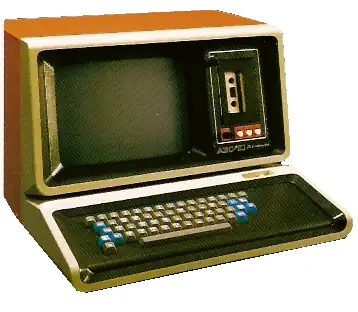

The ABC 10
The Ai Electronics ABC 10 was a Zilog Z80-based microcomputer system designed for a 32 KB RAM base configuration. The core logic centered on a 4 MHz Z80A CPU, with the 32 KB of dynamic RAM occupying the primary address space. The system was housed in an integrated all-in-one chassis that contained the main logic board, a linear power supply, and a 12-inch monochrome green CRT. This display was driven by a memory-mapped video subsystem providing an 80-character by 24-line text grid, utilizing a dedicated character generator ROM for the ASCII set.
Storage for the ABC 10 was provided by a cassette tape drive, that was built into the unit. The system included a built-in, 96-key full-travel keyboard with a 14-key numeric pad. For external connectivity, the rear I/O panel was equipped with two RS-232C serial ports and a single 36-pin Centronics-standard parallel port, allowing for direct communication with serial terminals or dot-matrix printers.
The software environment provided with the hardware was DOSKET-T a proprietary operating system that worked with a digital tape inteface. DOSKET-T served as the essential BIOS and BDOS layer, managing the Z80A’s interactions with the storage controller and memory-mapped hardware. Out of the box, the system included a disk-resident BASIC interpreter and a suite of utilities for disk initialization and file management. Because the OS and its associated buffers required a portion of the 32 KB RAM, the effective TPA (Transient Program Area) for user applications was constrained by the resident footprint of the DOSKET kernel.
Architecturally, the ABC 10 utilized a modular internal backplane that allowed the 32 KB base memory to be expanded via additional RAM cards to the Z80A's full 64 KB addressing limit. The internal cooling was facilitated by a single exhaust fan at the rear of the unit to dissipate heat from the dense TTL logic and the CRT's high-voltage components. The system was designed as a "turnkey" solution, where the hardware and DOSKET software were tuned to operate as a singular, cohesive unit without requiring additional third-party interface cards for standard operation.
Ai Electronics ABC 10: System Memory Mapping (32KB Base)
| Address Range (Hex) | Component / Allocation | Description |
|---|---|---|
| $0000–$00FF | System Vectors | Z80 Restart (RST) vectors and DOSKET jump tables for low-level BIOS calls. |
| $0100–$7FFF | User RAM (32KB Base) | Primary Transient Program Area (TPA) for DOSKET utilities and user BASIC workspace. |
| $8000–$BFFF | Expansion Space | Unpopulated in standard 32KB units; reserved for secondary RAM expansion cards. |
| $C000–$DFFF | System ROM | 8KB Monitor ROM; contains bootstrap loader for DOSKET and hardware diagnostic routines. |
| $E000–$E7FF | Video RAM (VRAM) | Memory-mapped display buffer for the 80x24 green monochrome CRT. |
| $E800–$EFFF | Character ROM | Hardware font data; maps ASCII codes to pixel patterns for the internal display. |
| $F000–$FFFF | Mapped I/O Ports | Control registers for the Teac FDD controller, dual RS-232C ports, and Centronics LPT interface. |
Ai Electronics ABC 10: Z80 I/O Port Mapping
| Port Range (Hex) | Component / Controller | Description |
|---|---|---|
| $00–$03 | Z80 CTC (Counter Timer) | Manages baud rate generation for RS-232C ports and system heartbeat interrupts. |
| $04–$07 | Z80 SIO (Serial I/O) | Primary controller for dual RS-232C asynchronous/synchronous communication channels. |
| $08–$0B | Z80 PIO (Parallel I/O) | Interfaces with the 36-pin Centronics parallel port and internal system status lines. |
| $10–$13 | Keyboard Matrix | Direct hardware access for scanning the 96-key keyboard and numeric keypad. |
| $20–$27 | FDC Control (Teac) | Secondary access for floppy disk controller command/data registers and DMA triggering. |
| $FE–$FF | System Config | Used for triggering hardware resets or switching between DOSKET and CP/M memory modes. |
DOSKET Operating System
Ai DOSKET (short for Disk Operating System for Diskette) was created and deployed by Ai Electronics (Ai Denshi Sokki) across several of their systems—from early AIDACS minicomputers to the ABC series of Z80-based business and desktop micros. It served as the default OS on models like the ABC-24 and ABC-26, and was also present on earlier machines such as the AIDACS-2000 and 3000 series
The ABC line, launched around 1979, was equipped with a Z80A CPU, 64 KB of RAM (expandable), built-in display controllers, floppy drives, and typical I/O interfaces like serial, parallel, and GPIB DOSKET provided system services tailored specifically for these hardware configurations.Technical Characteristics
While documentation on DOSKET is sparse, it is known that the OS operated alongside other more common systems—machines like the ABC-24/26 could also run CP/M, MP/M, or UCSD Pascal This implies DOSKET was purpose-built to deliver a specialized or optimized system environment—potentially offering integrated language support, efficient disk handling, and seamless access to bundled utilities. On the AIDACS-3000, DOSKET was offered alongside options like CP/M and UCSD Pascal, suggesting flexibility in OS deployment depending on customer or application needs.Role in the ABC Series Ecosystem
For the Ai ABC models, DOSKET likely served as the “factory” OS—streamlined for rapid boot, disk operations, and compatibility with Ai’s suite of office software (such as Fortran IV, COBOL, BASIC-2, PL/3, and even localized tools like an Arabic word processor). Though precise technical specs—like the memory layout, file structure, or multitasking capabilities—haven’t surfaced in the sources readily available today, DOSKET’s inclusion alongside more recognized systems indicates it was competent enough for general business applications but perhaps lacked the extensibility or widespread third-party software support of CP/M variants.CPU - The Zilog Z80
The Z80 quickly became popular in the personal computer market, with many early personal computers, such as the TRS-80 and Sinclair ZX80, using the Z80 as their central processing unit (CPU). It was also widely used in home computers, such as the MSX range, SORD, and the Amstrad CPC, as well as in many arcade games. Additionally, it was also used in other applications such as industrial control systems, and embedded systems. The Z80 was widely used until the mid-1980s, when it was gradually replaced by newer microprocessors such as the Intel 80286 and the Motorola 68000.
The Z80 microprocessor was developed by Zilog, a company founded by Federico Faggin in 1974. The Z80 was released in July 1976, as a successor to the Intel 8080. It was designed to be fully compatible with the 8080, but also included new features such as an improved instruction set, more powerful interrupts, and a more sophisticated memory management system.
Originally the Z80 was intended for use in embedded systems, just as the 8080 CPU. But the combination of compatibility, superior performance to other CPUs of the era, and the affordability led to a widespread use in arcade video game systems, and later in home computers such as the Osborne 1, TRS-80, ColecoVision, ZX Spectrum, MSX, Sega's Master System and many more. The Z-80 ran the original Pac-Man arcade cabinet. The Z-80 was used even in the Game Gear (1990s), and the TI-81 and succeeding graphic calculators.
The Z-80 remained in production until June of 2024, 48 years after its original release. Zilog replaced the processor with its successor the eZ80, an 8-bit microprocessor that features expanded memory addressing up to 16 megabytes, and running up to 50MHz, comparable to a Z80 clocked at 150MHz.

RAM max: unknown
ROM: unknown
VRAM: unknown