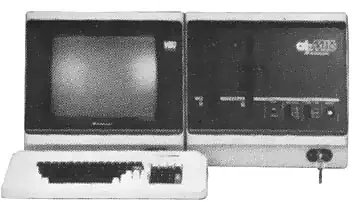

Ai Electronics M16 UNIX computer
The Ai Electronics M16 was a UNIX system that came out in 1982. It was based on the 8086 CPU and was even equipped with a 8087 co-processor for mathmatical calculations. It also had a 8089 co-processor for I/O and a 8088 CPU for backwards compatibility with it's 8-bit predecessors.
The system came with one or two 8 inch 1MByte floppy disk drives, or one disk drive and an 8MByte winchester hard disk. The machine had no less than six RS232c ports, with an option of a total of 14 for multi-user configuration, had a centronics parallel port, and optional IEE-796 and IEE-48 bus expansion ports.
CP/M-86 Operating System
CP/M-86 was the 16-bit successor to Gary Kildall’s original CP/M (Control Program for Microcomputers), which had dominated the 8-bit microcomputer market in the late 1970s. Introduced in 1981, CP/M-86 was adapted to run on Intel’s 8086 and 8088 processors, providing a familiar environment for developers and users migrating from 8-bit systems like the Intel 8080 and Zilog Z80. It retained the fundamental architecture of CP/M: a resident operating system split into the BIOS (hardware-dependent routines), BDOS (the core file and device management logic), and the CCP (Console Command Processor, which provided the user’s command interface). With this modular design, vendors could customize CP/M-86 for their hardware while maintaining compatibility with application binaries.
Technically, CP/M-86 offered a flat file system with 8.3 filename conventions, sequential or random file access methods, and support for user areas (a primitive form of directory segmentation). The BDOS interface provided consistent system calls for file manipulation, console I/O, and device access, allowing software to be written once and deployed across different machines. Because the 8086 architecture used segmented memory addressing, CP/M-86 had to manage memory in 64 KB segments, but unlike MS-DOS it did not adopt the same FCB (File Control Block) compatibility hacks. Instead, it extended some of its BDOS functions to better utilize the wider word size of the 16-bit environment, though its lineage remained evident in the command set and utility structure inherited from the 8-bit CP/M.
Despite its technical merits, CP/M-86 struggled in the marketplace. It was priced higher than Microsoft’s competing MS-DOS and often shipped later than DOS on the same hardware, such as the IBM PC. While CP/M-86 could run a growing library of native software and offered a smoother transition for CP/M-80 developers, its limited adoption meant fewer commercial applications and reduced support over time. By the mid-1980s, MS-DOS had effectively displaced CP/M-86, though its influence persisted in the modular OS structure and command conventions that many users carried forward. For retrocomputing enthusiasts, CP/M-86 represents an intriguing “what-if” moment—an alternate trajectory where the dominant 8-bit operating system of the late ’70s attempted to evolve into the 16-bit world but was ultimately overshadowed by Microsoft’s more aggressively marketed DOS.
KUDOS-86 Operating System
KUDOS86 was a 16-bit operating system created in Japan in the early 1980s for Intel 8086/8088-class business microcomputers, most notably the Ai Electronics ABC series. It provided a full disk-based environment with multitasking and multiuser support, enabling multiple terminals to be connected over serial lines. Architecturally, it followed a layered model similar to other contemporary business operating systems: a hardware abstraction layer, a core kernel managing processes and memory, and a command interpreter with a suite of utilities. Its file system implemented structured, record-oriented access, which made it well-suited for database and business applications.
On the technical side, KUDOS86 took advantage of the 8086’s segmented memory model, allowing programs to be run in distinct address spaces up to the system’s available RAM (commonly 256 KB to 1 MB). The kernel featured a scheduler to manage foreground and background tasks, along with spooling facilities for print jobs. A set of system calls exposed file manipulation, device I/O, and interprocess communication to applications, providing developers with a consistent API across different ABC machines. High-level languages such as Fortran IV, COBOL, and PL/3 were supported natively, and applications could run in parallel from multiple terminals. Though less widely known outside Japan, KUDOS86 represents an advanced and business-oriented 16-bit OS that brought timesharing capabilities to microcomputers during a transitional era from CP/M-like systems to UNIX and MS-DOS dominance.
CPU - The Intel 8086
The 8086 CPU from Intel is a 16-bit microprocessor and was designed between 1976 and 1978. The 8086 is the foundation of the x86 cpu architecture which is Intel's most successful line of processors.
The 8086 used the same microarchitecture as the 8-bit 8008, the 8080, and the 8085. This allowed assembly language programs to run seamlesly on the 8086. New instructions and features were added and the bus structure was designed to allow for collaboration with co-processors, such as the 8087 that was released later.
Source: WikiPediaCoprocessor - The 8089 Communications Coprocessor
The Intel 8089 Input/Output Coprocessor (IOP), introduced in the early 1980s, was designed as a companion chip to the Intel 8086/8088 CPUs. Its primary purpose was to offload complex I/O tasks from the main processor, enabling more efficient multitasking and data transfer. The 8089 featured its own instruction set, internal registers, and control logic, allowing it to independently manage peripheral devices such as disks, printers, and communication interfaces. By handling I/O operations asynchronously, it reduced CPU overhead and improved system throughput, particularly in multitasking operating systems and environments requiring high-performance data management.
The 8089 could coordinate multiple I/O channels simultaneously, using a specialized structure called Task Blocks to define control parameters for each operation. This design enabled efficient Direct Memory Access (DMA)-like transfers and real-time communication between memory and peripherals without constant CPU intervention. Architecturally, the 8089 was sophisticated for its time, providing mechanisms for priority handling, interrupts, and concurrent task execution. Though not as widely adopted as other Intel support chips, it represented an early step toward intelligent peripheral controllers and laid groundwork for later advancements in bus-mastering I/O and dedicated DMA engines.
CPU - The Intel 8088
The Intel 8088 microprocessor is a variant of the Intel 8086. The 8088 has an 8-bit external bus instead of the 16-bit bus that the 8086 has. The 16-bit registers and the 1MByte address range are unchanged, however. The 8086 and the 8088 have the same execution unit (EU), only the Bus Interface Unit (BIU) differs.
The original IBM PC architecture is based on the Intel 8088. The CPU runs at 5 to 16 MHz, has a 20-bit address bus and can work together with the 8087 Co-Processor. The 8088 was launched in 1979. The 8088 is compatible with the Intel 8085.
Coprocessor - The 8087 Math Coprocessor
The Intel 8087, introduced in 1980, was Intel’s first floating-point coprocessor, designed to work alongside the 8086 and 8088 CPUs. Before its release, most floating-point arithmetic on microcomputers was performed in software, which was slow and inefficient for scientific, engineering, and graphics workloads. The 8087 implemented the IEEE 754 floating-point standard (before it was formally ratified), handling single-precision (32-bit), double-precision (64-bit), and extended-precision (80-bit) formats. This gave systems using the 8087 the ability to execute complex mathematical functions—including logarithms, exponentials, trigonometric operations, and transcendental functions—in hardware, at speeds far exceeding software emulation.
Technically, the 8087 interfaced tightly with the 8086/8088 through a special coprocessor interface. It operated in a “loosely coupled” manner, monitoring the instruction stream for special floating-point opcodes (the ESC, or “escape,” instructions) issued by the main CPU. When the 8086 encountered one of these instructions, it effectively handed off execution to the 8087, which performed the operation in parallel with the CPU’s integer pipeline. The results were stored in an internal stack-based register architecture consisting of eight 80-bit registers (ST(0) through ST(7)), arranged as a push-down stack. This design simplified instruction encoding and matched the mathematical structure of many calculations but also introduced quirks in register management for programmers.
The integration of the 8087 with the 8086 family marked a major step toward hardware-assisted floating-point computation in personal and business computing. Software written in high-level languages like FORTRAN, Pascal, or C could transparently take advantage of the coprocessor if compiled with floating-point support enabled, while still running on systems without an 8087 (falling back to software routines). This optional design kept costs down for general users while providing performance acceleration for scientific and technical markets. The success of the 8087 set the pattern for Intel’s later coprocessors, such as the 80287 and 80387, and ultimately led to floating-point units being integrated directly onto the CPU die with the 80486, making separate coprocessor chips obsolete.
VRAM: 1MByte
CP/M 86
MP/M 86