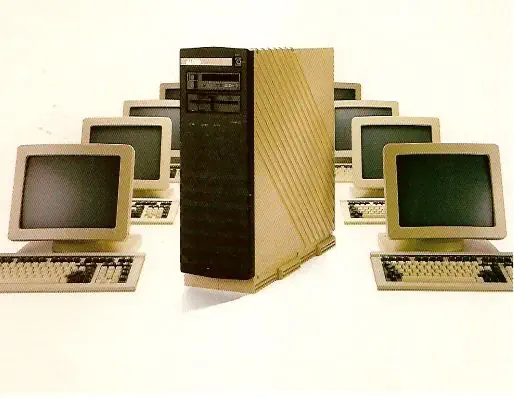

The Altos 3068 multi-user Super Micro Computer
The 3068 Altos was a system based on the Motorola 68020 processor. The machine ran Unix System V or the provided Pick-OS 2.15 operating system. The system supported up to 40 separate terminals. The machine had an intelligent 8086 based file processor subsystem with four separate DMA channels for fast file processing. The machine also had up to 4 8086-based serial communciations modules each with its own 128kB of RAM.
The Altos 3068 can be considered a super-microcomputer due to the fact it was designed to support many different users at the same time. It handled up to 40 different terminals at a fraction of the cost of a similarly performing superminicomputer or mainframe.
PICK Operating System - Pick-OS
The Pick Operating System, often just called Pick-OS, was a multiuser, multitasking operating system first developed in the early 1970s by Richard Pick for the U.S. Army’s Generalized Information Retrieval Language System (GIRLS) project. What set Pick apart was its tight integration of the operating system, a database management system, and the programming environment into a single unified architecture. At its core, Pick-OS implemented a multi-value database model: instead of traditional flat files or strictly relational tables, data could be stored in hierarchical, nested structures where fields could contain lists or sublists. This gave Pick systems a reputation for being extremely flexible in handling complex business data with minimal overhead.
From a systems perspective, Pick-OS provided robust multiuser support, allowing dozens or even hundreds of terminals to be connected simultaneously to a single minicomputer or microcomputer running the environment. It featured demand-paged virtual memory, integrated file and database management, and its own high-level programming language called Data/BASIC (sometimes called Pick BASIC), tailored for database-centric applications. The tight coupling of OS, database, and development tools meant that applications could be written quickly and deployed directly without separate layers of software. This all-in-one approach made Pick-OS popular in vertical markets such as accounting, inventory, and manufacturing, where rapid application development and multiuser performance were critical. Even as relational databases and Unix gained dominance, derivatives of Pick-OS (such as uniVerse, Reality, and D3) continued to be used well into the modern era, marking it as one of the more durable alternative operating system/database hybrids.
Unix System V
Unix System V, first released by AT&T’s Unix Support Group in 1983, was one of the most influential branches of the Unix family tree. Based largely on the earlier UNIX System III, it incorporated many enhancements from commercial and academic Unix variants. At its core, System V used the monolithic Unix kernel model, featuring process isolation, hierarchical file systems, and standard interprocess communication (IPC) primitives. One of its technical hallmarks was the introduction of System V IPC mechanisms—message queues, semaphores, and shared memory segments—which allowed processes to coordinate and share data more efficiently than through pipes or files alone. This became a defining feature of System V and distinguished it from the Berkeley BSD line.
Memory management in System V also evolved significantly. Early releases still relied on swapping, but later revisions (notably Release 3 and Release 4) added demand paging and more advanced virtual memory capabilities, making better use of available RAM and supporting larger applications. File system support centered on the System V File System (s5fs), which used a fixed block allocation scheme, in contrast to the more flexible Berkeley Fast File System. System V also formalized the use of shared libraries, allowing multiple processes to use common code in memory simultaneously, thereby reducing duplication and conserving system resources.
From an administrative and user standpoint, System V standardized many conventions still seen today. It introduced the init process and the System V runlevel mechanism, providing a structured framework for booting, shutting down, and managing system services. Terminal handling was managed through termio, later superseded by termios, which unified control of character devices. System V Release 4 (SVR4), developed in collaboration with Sun Microsystems, was especially important: it merged features from BSD, SunOS, and Xenix, consolidating divergent Unix flavors. This release introduced the KornShell (ksh), STREAMS for modular networking and device I/O, and broader support for TCP/IP networking. For retrocomputing and Unix historians, System V stands as the commercial backbone of Unix’s spread in the 1980s, and its conventions continue to echo in modern Unix-like systems.
CPU - The Motorola 68000
The Motorola 68000 is a 16/32-bit microprocessor that was first released in 1979. It was widely used in computers and other electronic devices during the 1980s and early 1990s. The 68000 was known for its advanced architecture, which included a 32-bit internal bus and a 24-bit address bus, allowing it to access up to 16 megabytes of memory. This made it more powerful than many other processors of its time, such as the Intel 8086 and Zilog Z80. It was also designed to be highly modular and expandable, with a large number of on-chip and off-chip peripherals.
Some of the most famous and successful computers that used the 68000 was the Commodore Amiga and the Atari ST, both of which were popular in the home and personal computer markets. Additionally, it was also used in workstations, such as the Sun 3 and Apollo DN3000, and in a wide variety of embedded systems and industrial control systems. The 68000 was also used in the Macintosh, the first model of the Macintosh was powered by a Motorola 68000 CPU. The processor was eventually succeeded by the 68020 and 68030, which offered improved performance and additional features.
The 68000 has a 32-bit instruction set, with 32-bit registers and a 16-bit internal data bus. The address bus is 24-bit and does not use memory segmentation, making it easier to address memory. There are three ALU's (Arithmetic Logic Unit), two for calculating addresses, and one for data, and the chip has a 16-bit external address bus.
The 68000 architecture was expanded with 32-bit ALUs, and caches. Here is a list with some 680x0 versions and their major improvements:
- 68010 - Virtual memory support
- 68020 - 32-bit ALU & Instruction Cache
- 68030 - On-Chip MMU, 2x 256 byte cache
- 68040 - 2x 4K Cache, 6 stage pipeline, FPU
- 68LC040 - No Floating Point Unit (FPU)
- 68060 - 2x 8K Cache, 10 stage pipelinet
Source: WikiPedia - Motorola 6800
Source: WikiPedia - 68000 Series
RAM max: 16MB
Unix System V
Up to 3x 5.25" HDD (50
80
or 190MB)
60MByte streaming tape drive