
Multiple Processor and Memory Management
While the 8086 serves as the master CPU, the two Z80 based intelligent I/O handles serial I/O functions and the 8089 based intelligent disc controller manages mass data storage with direct memory accessing (DMA).
The 986 carries a proprietary memory management system. It can subdivide up to 1MByte of memory into 4K blocks. It assigns a logical to physical address translation and various access attributes to each block so that noncontiguous physical memoary can be assigned to any given task. The MMS also provides write protection and access protection to increase reliability and performance.
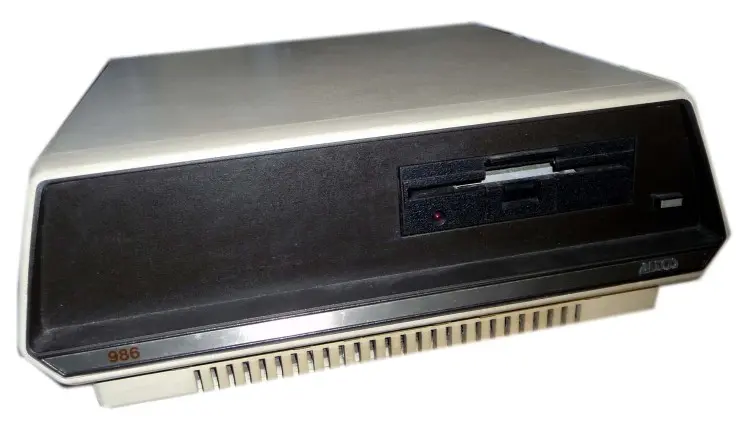
The Altos 986-40E is a multi user computer from August 1985. It is technically much the same as the earlier 586, running on an Intel 8086 processor. The big difference from earlier models are that the 986 has 1 MB RAM and four extra serial ports supporting nine simultaneous users. 3COM developed their new Ethernet card for the 986 model, running Xenix 3.0 and sold as a network disk server for IBM PC, XT computers installed with 3Com Ethernet expansion cards, it also had a 30, or 42 MB Winchester hard drive.
Founded in 1977 by David G Jackson and Roger William Vass Sr, Altos was one of the first producers of multiuser computers, and the company stayed true to that focus to 1990 when it was bought by Acer. Altos’s earliest models were based on the Z80 CPU and CP/M or its multiuser variant MP/M. Later, the company would focus primarily on UNIX-based systems. However, it also sold systems with MS-DOS or Pick.
By late 1981, Altos claimed to have installed 15,000 systems and was selling them at a rate of 1,000 a month. The company was acquired by Acer in 1990.
The 580 and 586 lines were announced in January and July of 1982, respectively. The 580 was a Z80 system running CP/M or MP/M while the 586 was based on the 8086 CPU running Xenix/UNIX. Both systems are nearly identical in appearance as was the 986 model introduced in November 1983.
Base Configuration:
- 10MHz 8086 CPU
- 1MB RAM
- two Z80 coprocessors
- hard disk drive
- 10 serial ports
- Xenix
- Users Supported: 9
- Options: Worknet LAN
Xenix Operating System
Xenix was Microsoft’s port of AT&T Unix to microcomputer platforms, beginning in the early 1980s, and represents one of the first serious attempts to bring Unix down from minicomputers and workstations into the 16-bit microprocessor world. It was derived initially from Version 7 Unix and later System III, adapted to run efficiently on hardware like the Intel 8086/8088, Zilog Z8000, and later the Motorola 68000. Unlike MS-DOS, Xenix was a fully preemptive, multitasking, multiuser system, exposing the same hierarchical file system, permissions model, process control primitives, and interprocess communication features familiar from its minicomputer ancestors. For developers, this meant that on relatively modest hardware, one could run a standard C compiler, link editor, assembler, and make use of pipes, redirection, and shell scripting—capabilities nearly absent from DOS at the time.
One of Xenix’s key engineering challenges was adapting Unix’s relatively heavy kernel model to machines with limited RAM and no memory management hardware. The 8086 implementation, for instance, had to work within a segmented memory model, forcing Microsoft’s engineers to fit process address spaces into 64 KB segments and implement kernel/user separation in a constrained way. Despite these limitations, Xenix supported demand-paged swapping, multiple terminals connected via serial interfaces, and block-structured file systems with mountable volumes. Device drivers were modular, and the system could support Winchester hard drives, tape backups, and various terminal types. For systems like the Altos 8600 series, this meant Xenix could handle up to 8 or more users running concurrently, each with their own shell and processes.
From a systems perspective, Xenix was significant because it created a bridge between the proprietary minicomputer Unix systems and the personal computing world. It brought features like multiuser time-sharing, background jobs, and networking primitives (in later releases) to machines typically seen as “single-user” boxes. Many third-party ISVs wrote business applications specifically for Xenix, including accounting packages, word processors, and database systems, leveraging its stability and multiuser design. Although eventually eclipsed by DOS and later Windows in the Microsoft ecosystem, Xenix seeded a Unix culture into the microcomputer world and influenced later efforts such as SCO Unix, which inherited much of Xenix’s base and kept it alive into the 1990s. For retro computing enthusiasts, it remains a fascinating example of Unix squeezed into 16-bit constraints yet still delivering an authentic multiuser Unix environment.
CPU - The Intel 8086
The 8086 CPU from Intel is a 16-bit microprocessor and was designed between 1976 and 1978. The 8086 is the foundation of the x86 cpu architecture which is Intel's most successful line of processors.
The 8086 used the same microarchitecture as the 8-bit 8008, the 8080, and the 8085. This allowed assembly language programs to run seamlesly on the 8086. New instructions and features were added and the bus structure was designed to allow for collaboration with co-processors, such as the 8087 that was released later.
Source: WikiPediaCPU - The Zilog Z80
The Z80 quickly became popular in the personal computer market, with many early personal computers, such as the TRS-80 and Sinclair ZX80, using the Z80 as their central processing unit (CPU). It was also widely used in home computers, such as the MSX range, SORD, and the Amstrad CPC, as well as in many arcade games. Additionally, it was also used in other applications such as industrial control systems, and embedded systems. The Z80 was widely used until the mid-1980s, when it was gradually replaced by newer microprocessors such as the Intel 80286 and the Motorola 68000.
The Z80 microprocessor was developed by Zilog, a company founded by Federico Faggin in 1974. The Z80 was released in July 1976, as a successor to the Intel 8080. It was designed to be fully compatible with the 8080, but also included new features such as an improved instruction set, more powerful interrupts, and a more sophisticated memory management system.
Originally the Z80 was intended for use in embedded systems, just as the 8080 CPU. But the combination of compatibility, superior performance to other CPUs of the era, and the affordability led to a widespread use in arcade video game systems, and later in home computers such as the Osborne 1, TRS-80, ColecoVision, ZX Spectrum, MSX, Sega's Master System and many more. The Z-80 ran the original Pac-Man arcade cabinet. The Z-80 was used even in the Game Gear (1990s), and the TI-81 and succeeding graphic calculators.
The Z-80 remained in production until June of 2024, 48 years after its original release. Zilog replaced the processor with its successor the eZ80, an 8-bit microprocessor that features expanded memory addressing up to 16 megabytes, and running up to 50MHz, comparable to a Z80 clocked at 150MHz.

Hard Drive