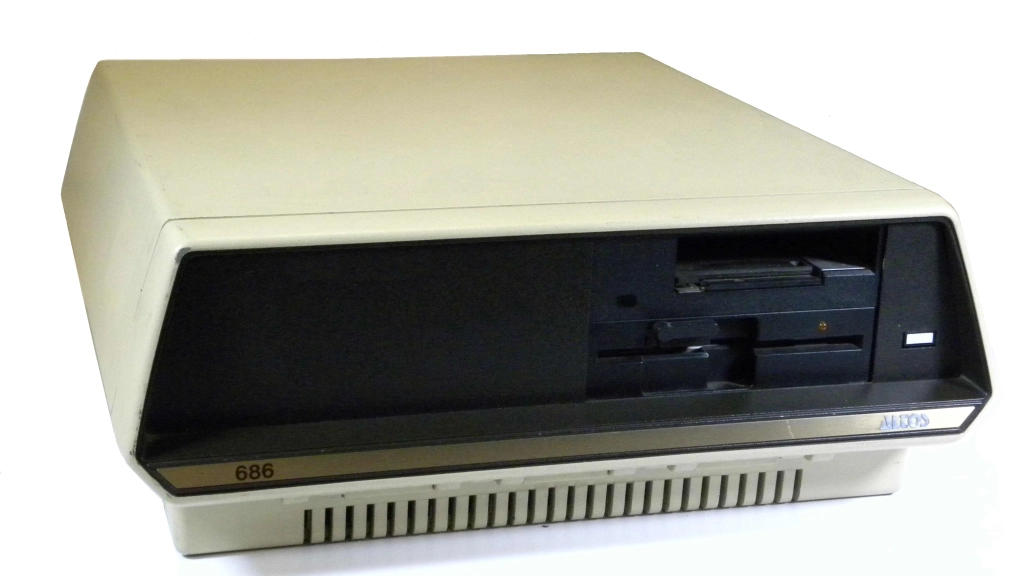

The Altos 686 multi-user desktop.
The Altos 686 offers support for up to six users in a compact desktop conputer. The Intel 80286 operates at 7.5MHz without wait states, providing high performance for a variety of business applications at a relative low cost per user price for the time. There were a variety of memory and mass storage options available in three models. The machine uses a Z80 I/O processor to support up to 5 users plus a printer, or 6 users.
All models include 512kB of RAM and may be expanded up to 2.5MB with 1MB expansion boards. An optional 80188 based WorkNet LAN board allowed access to the Altos WorkNet LAN network while including an extra serial port to support a 6th user.
The system ran XENIX 3.0, an enhanced version of the UNIX system III Operating System. Two modules were available: XENIX Run Time and XENIX Development System.
Features
- 80MByte HDD expansion enclosure
- Z-80 based I/O processor, supporting 6 serial I/O ports
- Optional 60MByte 1/4" Tape drive
- Optional 80188 based WorkNet LAN board
- Optional Floating Point Co-processor
- Binary code compatible with other Altos 80286 systems
- Application compatible with other Altos 80286 systems
- Application compatible with PC/AT software under Xenix.
Configuration of the 686
Here are the three different configurations that the Altos-686 was sold in:Model 686-25
6 I/O ports, 512kB RAM, 25MB HDD, No tapeModel 686-50
6 I/O ports, 512kB RAM, 50MB HDD, Optional TapeModel 686-T50
6 I/O ports, 512kB RAM, 50MB HDD, 1/4" 60MB Tape
Xenix Operating System
Xenix was Microsoft’s port of AT&T Unix to microcomputer platforms, beginning in the early 1980s, and represents one of the first serious attempts to bring Unix down from minicomputers and workstations into the 16-bit microprocessor world. It was derived initially from Version 7 Unix and later System III, adapted to run efficiently on hardware like the Intel 8086/8088, Zilog Z8000, and later the Motorola 68000. Unlike MS-DOS, Xenix was a fully preemptive, multitasking, multiuser system, exposing the same hierarchical file system, permissions model, process control primitives, and interprocess communication features familiar from its minicomputer ancestors. For developers, this meant that on relatively modest hardware, one could run a standard C compiler, link editor, assembler, and make use of pipes, redirection, and shell scripting—capabilities nearly absent from DOS at the time.
One of Xenix’s key engineering challenges was adapting Unix’s relatively heavy kernel model to machines with limited RAM and no memory management hardware. The 8086 implementation, for instance, had to work within a segmented memory model, forcing Microsoft’s engineers to fit process address spaces into 64 KB segments and implement kernel/user separation in a constrained way. Despite these limitations, Xenix supported demand-paged swapping, multiple terminals connected via serial interfaces, and block-structured file systems with mountable volumes. Device drivers were modular, and the system could support Winchester hard drives, tape backups, and various terminal types. For systems like the Altos 8600 series, this meant Xenix could handle up to 8 or more users running concurrently, each with their own shell and processes.
From a systems perspective, Xenix was significant because it created a bridge between the proprietary minicomputer Unix systems and the personal computing world. It brought features like multiuser time-sharing, background jobs, and networking primitives (in later releases) to machines typically seen as “single-user” boxes. Many third-party ISVs wrote business applications specifically for Xenix, including accounting packages, word processors, and database systems, leveraging its stability and multiuser design. Although eventually eclipsed by DOS and later Windows in the Microsoft ecosystem, Xenix seeded a Unix culture into the microcomputer world and influenced later efforts such as SCO Unix, which inherited much of Xenix’s base and kept it alive into the 1990s. For retro computing enthusiasts, it remains a fascinating example of Unix squeezed into 16-bit constraints yet still delivering an authentic multiuser Unix environment.
CPU - The Intel 80286
The Intel 80286 is a 16-bit microprocessor introduced in 1982. It was the first 80x86 processor with a separate, address and data bus, the first to introduce protected virtual address mode or protected mode, as well as built in memory management abilities. The 80286 is instruction compatible with the 8086 and the 8088 processors. It contained all the 8086, the 80186 instructions, and also new instructions to handle protected mode.
Source: WikiPedia - Intel 80286RAM max: 2.5MB
25 or 50MB HDD