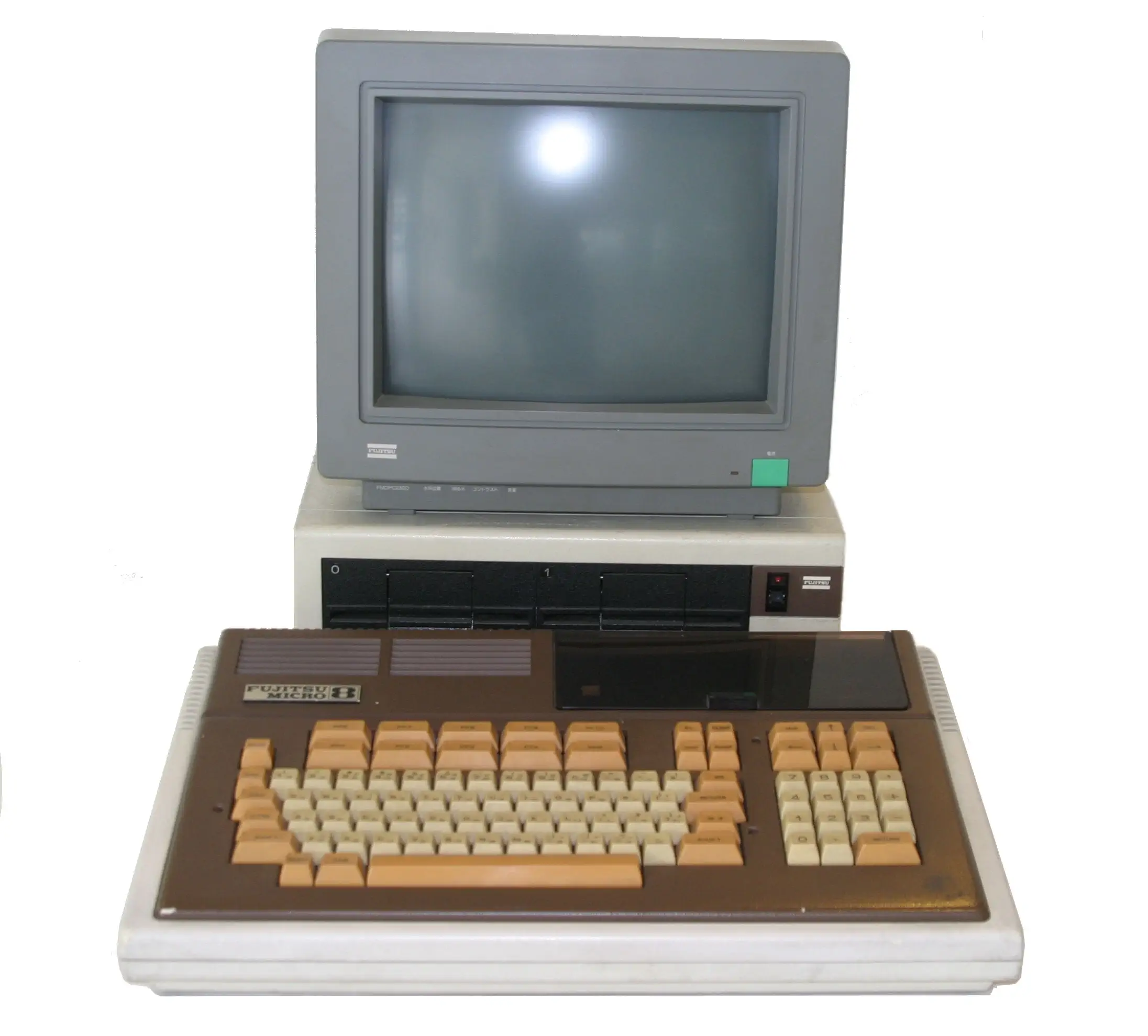

Fujitsu FM-8
The FM-8 (Fujitsu Micro 8) is a personal computer developed and manufactured by Fujitsu in May 1981. It was Fujitsu's second microcomputer released to the public after the LKIT-8 kit computer, and the first in the "FM" series. The FM-8 was an early adopter of bubble memory technology.
The FM-8 would later be replaced by two new models in November 1982 – the FM-11, aimed at businesses and the FM-7 aimed at the mass market.
Fujitsu BASIC (F-BASIC)
F-BASIC was Fujitsu’s house-branded dialect of Microsoft BASIC, supplied with the FM-7 and its successors. Like other Microsoft-derived implementations of the period, it resided in ROM and acted as the default operating environment at power-on. Users interacted with the machine almost entirely through this language, issuing commands to load or save programs, manipulate graphics and sound hardware, or run application code. For many owners, F-BASIC was effectively synonymous with the FM-7 itself, since no separate operating system was required to make practical use of the machine.
What set F-BASIC apart from earlier 8-bit BASICs was its extensive support for the FM-7’s advanced hardware. It included commands for high-resolution graphics modes, multiple color palettes, and even limited sprite and sound features. This integration meant that games, educational titles, and business programs could be written and run directly from the BASIC prompt without relying on assembly unless higher performance was necessary. Compared to the Apple II’s Integer BASIC or early Commodore BASIC, F-BASIC gave users more direct access to the multimedia features of the system.
Later versions of F-BASIC evolved alongside the FM series, particularly the FM-77 models, where extensions added disk commands, structured program features, and better handling of memory management. These improvements aligned it with contemporary trends in microcomputer BASICs, where the language was expanding from a teaching tool into a general software platform. As a result, F-BASIC was not just an introductory environment but also a foundation for serious applications, with commercial software written and distributed in it throughout the 1980s Japanese microcomputer market.
CPU - The Motorola 6809
The Motorola 6809 is an 8-bit microprocessor with some 16-bit features. It was designed by Motorola's Terry Ritter and Joel Boney and introduced in 1978. Although source compatible with the earlier Motorola 6800, the 6809 offered significant improvements over it and 8-bit contemporaries like the MOS Technology 6502, including a hardware multiplication instruction, 16-bit arithmetic, system and user stack registers allowing re-entrant code, improved interrupts, position-independent code and an orthogonal instruction set architecture with a comprehensive set of addressing modes.
6809 @1MHz
ROM: 48kB
VRAM: 48kB