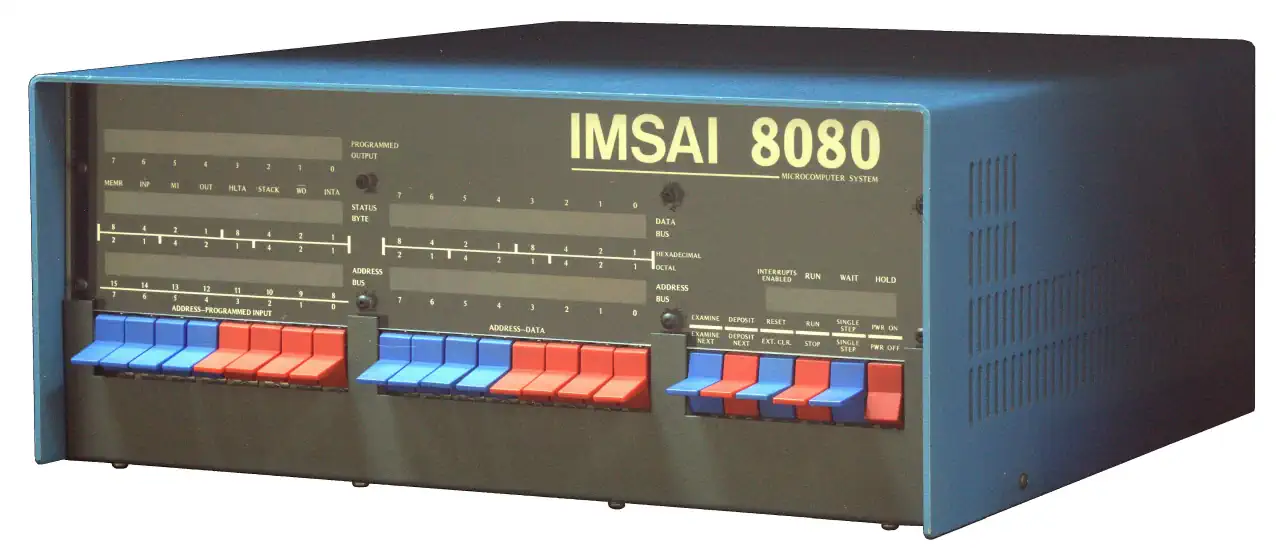

The IMSAI 8080, released in 1975 by IMS Associates, Inc., was engineered as a high-fidelity alternative to the MITS Altair 8800. At its core, the system utilized the Intel 8080A 8-bit microprocessor, a NMOS chip containing approximately 4,500 transistors. The CPU operated at a clock frequency of 2 MHz yielding an instruction cycle time of roughly 500 nanoseconds for simple register operations. Unlike the Altair’s somewhat fragile chassis, the IMSAI featured a heavy-duty aluminum enclosure and a professional-grade 22-slot motherboard, which became the definitive implementation of the S-100 bus (IEEE 696) architecture.
The system's architecture relied on a modular backplane where the CPU, memory, and I/O lived on discrete plug-in cards. The front panel, or "Programmer's Console," interfaced directly with the bus, allowing for manual manipulation of memory addresses and data via heavy-duty toggle switches. This panel utilized a series of LEDs to display the status of the address bus ($A_0-A_{15}$) and data bus ($D_0-D_7$). In terms of memory density, early units typically shipped with 4 KB static RAM (SRAM) cards, though the 16-bit address bus allowed for a maximum theoretical memory mapping of 64 KB
When compared to contemporary S-100 systems like the Cromemco Z-1 the IMSAI remained strictly aligned with the Intel 8080 instruction set, whereas Cromemco often moved toward the Zilog Z80. While the Z80 provided binary compatibility with the 8080, it offered an extended instruction set and typically higher clock speeds (often 4 MHz). However, the IMSAI was frequently preferred for industrial applications due to its robust power supply, which provided a massive 28 Amps at 8 Volts to the bus, ensuring voltage stability even when the 22-slot backplane was fully populated with power-hungry bipolar logic cards.
Expansion capabilities were the IMSAI’s primary technical advantage. The S-100 implementation allowed for the integration of specialized controllers, such as the IMSAI DIO disk interface or the VIO video interface. While the base 8080A lacked built-in interrupts or DMA controllers on-chip, these functions were mapped through the bus using support chips like the Intel 8212 or 8214. This modularity enabled the IMSAI 8080 to transition from a simple toggle-operated machine to a disk-based system running CP/M (Control Program for Microcomputers), effectively setting the hardware standards for the pre-IBM PC era.
The S-100 Architecture
The S-100 bus formalized as IEEE 696 is a passive backplane architecture originally designed for the MITS Altair 8800. Unlike modern active motherboards, the S-100 backplane contains no active logic; it consists of 100 parallel trace lines with physical slots for daughtercards. The original specification utilized a 100-pin edge connector to facilitate a 15.5-inch wide bus. Because it was designed around the Intel 8080, the signal definitions closely mirrored that processor’s pinout, including specialized status signals such as sMEMW (memory write) and sINP (input from I/O port).
Power distribution on the S-100 bus is characterized by its use of unregulated DC voltages: +8V +16V and -16V This necessitated the inclusion of local voltage regulators—typically TO-3 or TO-220 packages—on every individual expansion card to step the voltage down to the required TTL-level +5V or +/- 12V. While this distributed regulation increased the thermal load of each card, it effectively isolated noise and voltage drops across the long backplane traces, a critical factor for maintaining signal integrity in high-density 21-slot systems like the Cromemco Z-1.
The bus timing and control logic rely on a "master-slave" relationship, where a single CPU card typically acts as the permanent bus master. However, the IEEE 696 standard introduced a sophisticated Temporary Master protocol, allowing for up to 16 different bus masters. This is managed through four prioritized DMA control lines (HOLD pHLDA and the ADSB address disable signals). When a secondary controller, such as a high-speed disk interface, requires the bus, it asserts a request; the primary CPU then tri-states its address, data, and control buffers, effectively disconnecting from the bus to allow the temporary master full transparent access to the system memory.
Data handling on the S-100 bus was originally limited to 8-bit bidirectional communication, but the transition to 16-bit processors necessitated the implementation of the sXTRQ (Sixteen Request) and SIXTN (Sixteen Acknowledge) signals. These pins allow the bus to dynamically gang two 8-bit data paths (Data-In and Data-Out) into a single 16-bit wide data bus. Combined with a 24-bit extended addressing scheme—utilizing pins 12 through 17 and 59 through 64—the S-100 architecture successfully scaled from 64 KB of addressable space to a 16 MB range preserving its relevance through the early 1980s.
CPU - The Intel 8080
The Intel 8080 was an 8-bit microprocessor that was designed and manufactured by Intel Corporation. It was the first CPU in the x80 series, and was released in April 1974. The 8080 had a clock speed of 2 MHz and was capable of addressing 64 KB of memory. It had a total of 45 instructions and 7 registers, including the Accumulator, the Flags register and the stack pointer.
One of the key features of the 8080 was its ability to directly execute instructions for input/output operations, allowing for more efficient communication with peripheral devices such as keyboard, display, and storage. This made the 8080 a popular choice for early personal computers like the Altair 8800, the IMSAI 8080 and the first IBM PC.
Additionally, the 8080's architecture was widely adopted in industrial control systems and arcade games. It was also used as the basis for other microprocessors such as the Zilog Z80 which was widely used in home computers of the 1980s.
The 8080 was succeeded by the 8085 microprocessor in 1976, which was similar to the 8080 but had an additional instruction set and an integrated clock generator. The 8080 and the 8085 together with their variants and clones played an important role in the development of the microcomputer industry and the personal computer revolution.
RAM max: 64kB
terminal based
IMDOS