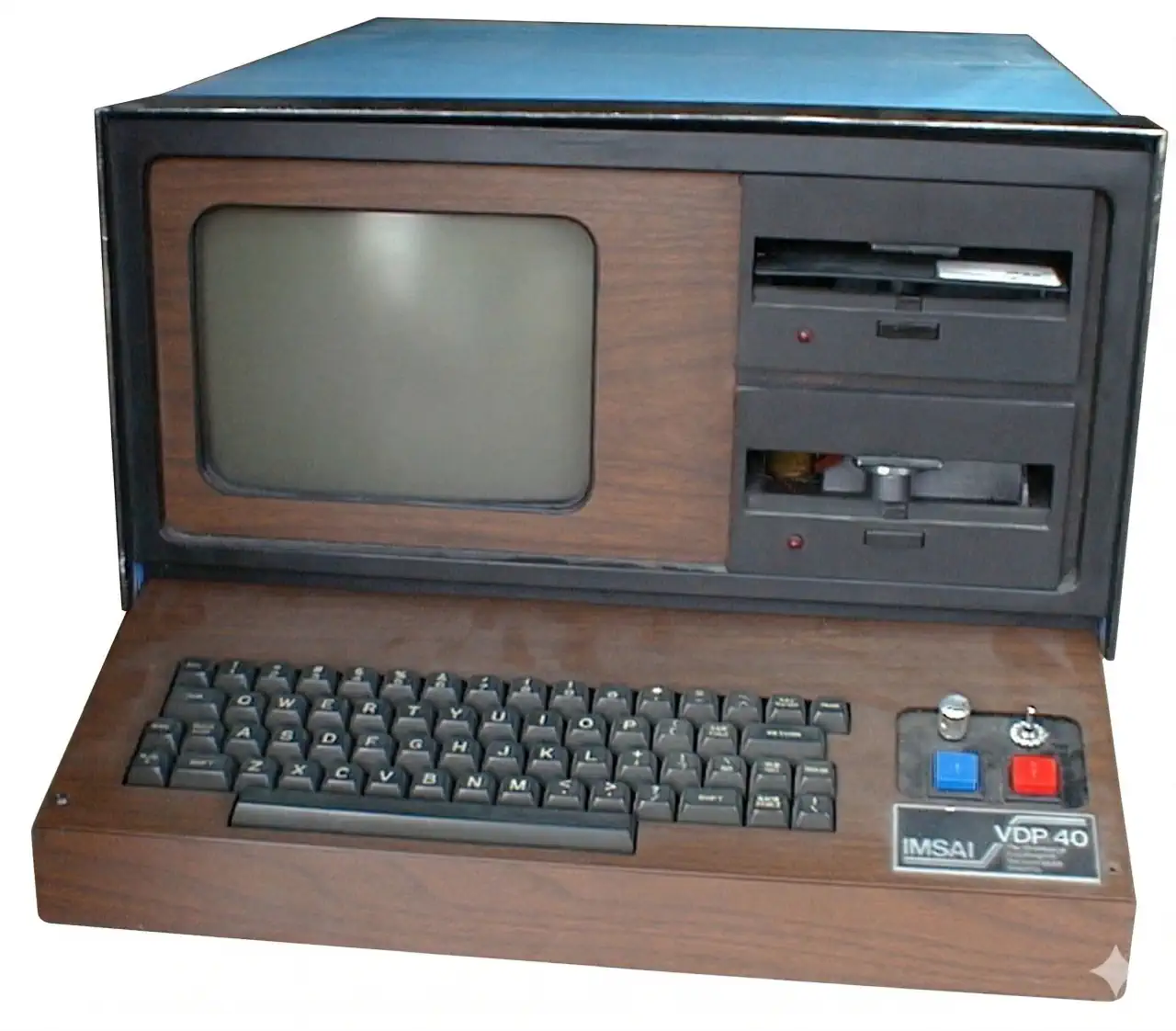

The IMSAI VDP-40 (Video Data Processor), introduced in 1977, represented an architectural shift from the modular, toggle-switch interface of the 8080 to an integrated, "desktop" workstation design. The system was built around the Intel 8085 microprocessor, an evolutionary step over the 8080 that integrated the clock generator and system controller onto the CPU die. Operating at a clock frequency of 3 MHz the 8085 provided a significant throughput advantage over its predecessor, utilizing a multiplexed address/data bus and requiring only a single +5V power supply, which simplified the internal motherboard power distribution compared to the triple-voltage requirements of the 8080.
The internal architecture of the VDP-40 maintained S-100 bus (IEEE 696) compatibility, but in a more compact, 6-slot horizontal backplane. This configuration typically included a specialized Video Interface Board (VIO) capable of generating a 24-line by 80-character display on the integrated 9-inch monochrome CRT. The memory subsystem was usually populated with 32 KB to 64 KB of RAM often utilizing the IMSAI RAM III boards. Storage was handled by dual integrated PerSci or Shugart 5.25-inch floppy disk drives, interfaced via a dedicated disk controller card on the S-100 bus, facilitating high-speed data transfer for the CP/M operating system.
A defining technical characteristic of the VDP-40 was its move toward "turnkey" operation. Unlike the 8080, which required manual boot-strapping via front-panel switches, the VDP-40 utilized a ROM-based monitor that could automatically initialize the system and hand over control to the disk controller for OS loading. The 8085 CPU also featured a hardware-vectored interrupt structure (TRAP, RST 5.5, 6.5, 7.5), allowing for more efficient I/O handling compared to the 8080’s reliance on the 8214 interrupt controller. This integration made the system technically denser, albeit less accessible for the raw bit-level manipulation common in earlier S-100 hobbyist kits.
Compared to the IMSAI 8080, the VDP-40 traded the expansive 22-slot modularity and physical "Programmer's Console" for a higher 3 MHz clock speed and a consolidated form factor. While the 8080 was a foundational development platform for bus architecture, the VDP-40 was a refined implementation that prioritized integrated video and disk storage for professional environments.
The S-100 Architecture
The S-100 bus formalized as IEEE 696 is a passive backplane architecture originally designed for the MITS Altair 8800. Unlike modern active motherboards, the S-100 backplane contains no active logic; it consists of 100 parallel trace lines with physical slots for daughtercards. The original specification utilized a 100-pin edge connector to facilitate a 15.5-inch wide bus. Because it was designed around the Intel 8080, the signal definitions closely mirrored that processor’s pinout, including specialized status signals such as sMEMW (memory write) and sINP (input from I/O port).
Power distribution on the S-100 bus is characterized by its use of unregulated DC voltages: +8V +16V and -16V This necessitated the inclusion of local voltage regulators—typically TO-3 or TO-220 packages—on every individual expansion card to step the voltage down to the required TTL-level +5V or +/- 12V. While this distributed regulation increased the thermal load of each card, it effectively isolated noise and voltage drops across the long backplane traces, a critical factor for maintaining signal integrity in high-density 21-slot systems like the Cromemco Z-1.
The bus timing and control logic rely on a "master-slave" relationship, where a single CPU card typically acts as the permanent bus master. However, the IEEE 696 standard introduced a sophisticated Temporary Master protocol, allowing for up to 16 different bus masters. This is managed through four prioritized DMA control lines (HOLD pHLDA and the ADSB address disable signals). When a secondary controller, such as a high-speed disk interface, requires the bus, it asserts a request; the primary CPU then tri-states its address, data, and control buffers, effectively disconnecting from the bus to allow the temporary master full transparent access to the system memory.
Data handling on the S-100 bus was originally limited to 8-bit bidirectional communication, but the transition to 16-bit processors necessitated the implementation of the sXTRQ (Sixteen Request) and SIXTN (Sixteen Acknowledge) signals. These pins allow the bus to dynamically gang two 8-bit data paths (Data-In and Data-Out) into a single 16-bit wide data bus. Combined with a 24-bit extended addressing scheme—utilizing pins 12 through 17 and 59 through 64—the S-100 architecture successfully scaled from 64 KB of addressable space to a 16 MB range preserving its relevance through the early 1980s.
CPU - The Intel 8085
The Intel 8085 microprocessor is produced by Intel in 1976. It is software-binary compatible with the Intel 8080, with two instructions added to support the newly added interrupt and serial I/O features.
The CPU requires less support circuitry, allowing foa a simpler and less expensive production process. The "5" in the 8085 signifies the single +5 volt power supply that is needed to power the CPU. In comparison the 8080 needed +5V, -5V and +12V in order to run.
The 8085 uses a multiplexed address/data bus (AD0 through AD7). Intel introduced several support chips with this address latch built in, such as the 8155 RAM chip, and I/O chips. This architecture reduced the number of traces between the 8085 and supporting memory and I/O chips.
The Zilog Z80 eclipsed both the 8080 and the 8085 in capabilities and added instructions. But thanks to the built-in serial I/O and five prioritized interrupts, the Intel 8085 played a large role as a controller in many products.
RAM max: 64kB
CP/M