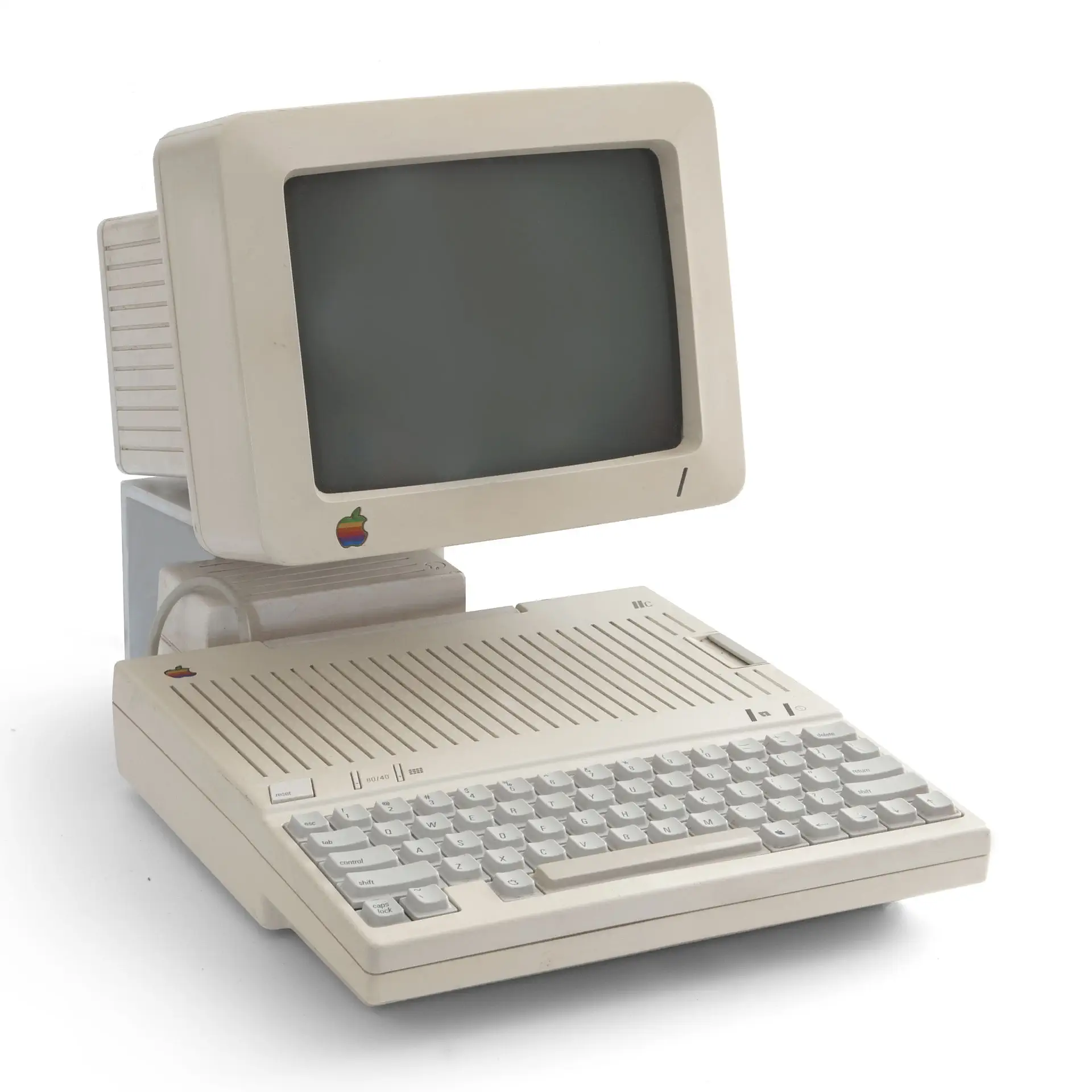

Apple IIc
The Apple IIc is the fourth model in the Apple II series of computers. It is Apple's first attempt to design a portable computer. At 7.5lbs, today it would be considered luggable rather than portable. The "c" in the name stood for compact. The case was smaller, and had venting slots on top, so it could no longer support a monitor. Apple provdied a separate stand for that.
The IIc used a new CMOS-based 65C02 CPU that had 27 more instructions over the 6502. Unfortunately some software used undocumented instructions on the 6502, that were not carried over in the design for the 65C02, resulting in incompatibilities.
The text display of the IIc added 32 unique characters that could be combined to create simple icons, windows and menus so a simple Graphical User Environment could be simulated out of text characters.
Apple DOS / Apple ProDOS
Apple DOS
Apple DOS was the first disk operating system for the Apple II series, released in 1978 and developed by Shepardson Microsystems under contract to Apple. Built to run on the 6502 microprocessor, it provided a layer of software between user programs and the Disk II controller hardware, which had been designed by Steve Wozniak. The OS was loaded from floppy disk and occupied a small portion of memory, exposing a set of machine-language routines for file management, disk access, and program loading. Apple DOS used a flat file system with 35 tracks per 5.25-inch disk side, each track divided into sectors managed by a simple catalog structure. Filenames were limited to 30 characters, and files were typed as Integer BASIC, Applesoft BASIC, binary, or text.Technically, Apple DOS provided three primary components: the DOS image (disk-resident routines), the File Manager, and the Program Manager. The File Manager translated high-level commands into sector-level disk operations, while the Program Manager handled loading and saving of executable binaries. Disk I/O was tightly coupled to the unique design of the Disk II controller, which relied on software timing loops instead of complex controller hardware. Because Apple DOS lacked subdirectories and advanced metadata, disks were essentially single-level volumes, limiting scalability but maximizing simplicity. Despite these constraints, Apple DOS became the foundation of Apple II software distribution for years, until it was eventually replaced by ProDOS in 1983, which introduced hierarchical directories, improved file handling, and support for larger disks.
Apple ProDOS
Introduced in 1983, this Apple’s successor to Apple DOS, designed to address the growing limitations of the earlier system as Apple II hardware and storage devices became more advanced. Built for the 6502 processor, ProDOS supported hierarchical subdirectories, time/date stamps, and device-independent block I/O, making it a much more flexible and scalable operating system. It replaced Apple DOS’s flat catalog with a tree-structured file system, allowing better organization of files across large disks and hard drives. ProDOS also standardized on a 512-byte block size, which aligned with newer disk technologies and allowed it to support volumes up to 32 MB—significant compared to the 140 KB floppy disks Apple DOS was originally designed for.From a technical perspective, ProDOS reorganized the system architecture into a modular kernel with machine-language routines resident in memory, exposing a set of entry points for file, device, and memory management. It reserved high memory for itself while leaving the lower regions available as a consistent application execution environment, which improved software portability across Apple II models. ProDOS also introduced more rigorous file typing and access control flags (read, write, destroy, rename), as well as real-time clock integration when supported by hardware. Though it was less forgiving than Apple DOS in terms of compatibility quirks, ProDOS became the standard Apple II operating system throughout the mid-to-late 1980s, supporting not only floppies but also hard disks, RAM disks, and eventually 3.5-inch drives, ensuring the Apple II line remained viable in an era of expanding storage demands.
This was the direct replacement for Apple DOS 3.3 and was entirely 8-bit, designed to run on all Apple II models with a 6502 or 65C02 CPU. It introduced hierarchical directories, block-based I/O, and support for larger disks. This version remained the standard OS for 8-bit Apple II machines.
ProDOS was strictly limited to a 64 KB address space, with the kernel, file system handlers, and I/O routines resident in the upper portion of memory. Applications were constrained to what remained of conventional RAM. File buffers and directory structures were mapped into fixed RAM locations, limiting the maximum complexity of applications.
With ProDOS Apple introduced a new file system with a hierarchical directory tree, 512-byte block allocation, and 32 MB volume support. It exposed a set of machine-language entry points (the MLI, or Machine Language Interface) for file and device access. These were strictly 8-bit routines, with parameters passed through fixed memory locations.
ProDOS Served as the general-purpose disk operating system for all Apple II models (II+, IIe, IIc). It was lightweight, fit within the 64 KB space, and became the baseline for nearly all 8-bit Apple II software in the mid-1980s.
CPU - The Motorola 6502
The 6502 is an 8-bit MicroProcessor designed by MOS Technology. The team was led by Chuck Peddle and had also worked on the Motorola 6800. The 6502 is a simplified, but faster and cheaper design than the 6800.
The 6502 was introduced in 1975 and was the cheapest microprocessor on the market. Together with the Zilog Z80, the 6502 helped start the home computer revolution of the 1980s. The 6502 was used in a wide range of devices: the Atari 2600, the 8-bit Atari home computers, the Apple II, the Nintendo Entertainment System, the Commodore 64, the BBC Micro and many others. All used the 6502 or a variation of it.
The 6502 is a 1MHz design, while the 6502A is designed for 2MHz. The 6502A is 100% compatible with the original 6502.
Commodore soon bought MOS Technology, but conitnued to sell the microprocessor to competitors and licensed the design to other manufacturers.
Source: WikiPedia - MOS Technology 6502The 650x Instruction Set
| Mnemonic | Operation | Description |
|---|---|---|
| ADC | Add with Carry | Adds a memory location and the carry bit to the accumulator. |
| AND | Logical AND | Performs a logical AND between memory and the accumulator. |
| ASL | Arithmetic Shift Left | Shifts all bits one position to the left (in memory or accumulator). |
| BCC | Branch on Carry Clear | Branches to a new address if the carry flag is clear (0). |
| BCS | Branch on Carry Set | Branches to a new address if the carry flag is set (1). |
| BEQ | Branch on Equal (Zero Set) | Branches to a new address if the zero flag is set (1). |
| BIT | Bit Test | Tests bits in memory with the accumulator without modifying the accumulator. |
| BMI | Branch on Minus | Branches to a new address if the negative flag is set (1). |
| BNE | Branch on Not Equal | Branches to a new address if the zero flag is clear (0). |
| BPL | Branch on Plus | Branches to a new address if the negative flag is clear (0). |
| BRK | Force Break | Forces an interrupt request and pushes status and PC to the stack. |
| BVC | Branch on Overflow Clear | Branches to a new address if the overflow flag is clear (0). |
| BVS | Branch on Overflow Set | Branches to a new address if the overflow flag is set (1). |
| CLC | Clear Carry Flag | Clears the processor carry flag. |
| CLD | Clear Decimal Mode | Clears the processor decimal mode flag. |
| CLI | Clear Interrupt Disable | Clears the interrupt disable flag, allowing maskable interrupts. |
| CLV | Clear Overflow Flag | Clears the processor overflow flag. |
| CMP | Compare Accumulator | Compares the contents of a memory location with the accumulator. |
| CPX | Compare X Register | Compares the contents of a memory location with the X register. |
| CPY | Compare Y Register | Compares the contents of a memory location with the Y register. |
| DEC | Decrement Memory | Subtracts one from the value held at a specified memory location. |
| DEX | Decrement X Register | Subtracts one from the X register. |
| DEY | Decrement Y Register | Subtracts one from the Y register. |
| EOR | Exclusive OR | Performs a logical Exclusive OR between memory and the accumulator. |
| INC | Increment Memory | Adds one to the value held at a specified memory location. |
| INX | Increment X Register | Adds one to the X register. |
| INY | Increment Y Register | Adds one to the Y register. |
| JMP | Jump | Sets the program counter to a new address. |
| JSR | Jump to Subroutine | Pushes the return address to the stack and jumps to a new address. |
| LDA | Load Accumulator | Loads a byte of memory into the accumulator. |
| LDX | Load X Register | Loads a byte of memory into the X register. |
| LDY | Load Y Register | Loads a byte of memory into the Y register. |
| LSR | Logical Shift Right | Shifts all bits one position to the right (in memory or accumulator). |
| NOP | No Operation | Performs no operation, consuming 2 machine cycles. |
| ORA | Logical Inclusive OR | Performs a logical OR between memory and the accumulator. |
| PHA | Push Accumulator | Pushes a copy of the accumulator onto the stack. |
| PHP | Push Processor Status | Pushes a copy of the status flags onto the stack. |
| PLA | Pull Accumulator | Pulls a byte from the stack into the accumulator. |
| PLP | Pull Processor Status | Pulls a byte from the stack into the processor status flags. |
| ROL | Rotate Left | Rotates all bits one position left through the carry flag. |
| ROR | Rotate Right | Rotates all bits one position right through the carry flag. |
| RTI | Return from Interrupt | Pulls the processor flags and program counter from the stack. |
| RTS | Return from Subroutine | Pulls the program counter from the stack and resumes execution. |
| SBC | Subtract with Carry | Subtracts memory and the inverse of the carry bit from the accumulator. |
| SEC | Set Carry Flag | Sets the processor carry flag. |
| SED | Set Decimal Flag | Sets the processor decimal mode flag. |
| SEI | Set Interrupt Disable | Sets the interrupt disable flag, preventing maskable interrupts. |
| STA | Store Accumulator | Stores the contents of the accumulator in memory. |
| STX | Store X Register | Stores the contents of the X register in memory. |
| STY | Store Y Register | Stores the contents of the Y register in memory. |
| TAX | Transfer Accumulator to X | Copies the current value of the accumulator into the X register. |
| TAY | Transfer Accumulator to Y | Copies the current value of the accumulator into the Y register. |
| TSX | Transfer Stack Pointer to X | Copies the current value of the stack pointer into the X register. |
| TXA | Transfer X to Accumulator | Copies the current value of the X register into the accumulator. |
| TXS | Transfer X to Stack Pointer | Copies the current value of the X register into the stack pointer. |
| TYA | Transfer Y to Accumulator | Copies the current value of the Y register into the accumulator. |
NCR/GTE 65C02 @1.023MHz (Enhanced IIe)
RAM max: 1MB
560x192 16 colors