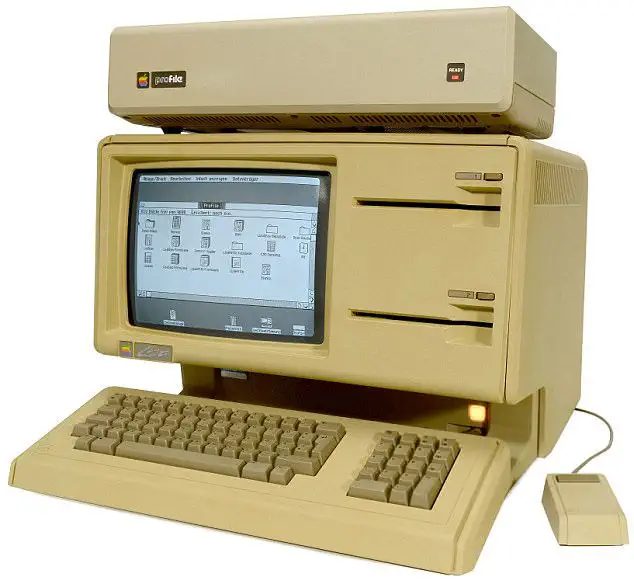

Apple Lisa
Apple released the Lisa computer in 1983 as one of the first desktop computers with a graphical user interface, or GUI. Although the Lisa was technologically great, commercially it was not a success. The high price point of $9,995 was so prohibitive that only about 10,000 Apple Lisa's were sold in the first two years.
Here are some of the technological advancements over other computers from the same era:
- Graphical User Interface
- Hard drive support
- 1MByte RAM, expandable to 2MB
- Protected Memory OS
There were some downsides to some of the technical implementations as well. The Lisa OS was complex, and the protected memory was implemented without a memory manager, making the CPU work overtime. This caused the Lisa GUI to feel sluggish and it had an impact on hard drive performance as well
The Apple Lisa was quickly followed by the Apple Macintosh, which, despite it's lesser technical qualifications, was a resounding commercial success.
Apple's LISA Operating System
Apple’s Lisa OS, released in 1983 alongside the Lisa computer, was one of the first commercial operating systems to fully implement a graphical user interface (GUI) with windows, icons, menus, and mouse-driven interaction. At its core, Lisa OS was a cooperative multitasking system built on a microkernel-like architecture, with processes called “tasks” managed by a central scheduler. Each application ran in its own protected memory space, and the system supported demand-paged virtual memory—an advanced feature for its time on a Motorola 68000-based machine without hardware memory management. The Lisa file system used a hierarchical tree structure with long filenames, file versioning, and resource forks, anticipating features later popularized in the Macintosh HFS.
Technically, Lisa OS separated the core OS kernel (responsible for task scheduling, memory management, and I/O) from the Lisa Office System environment, a tightly integrated desktop suite of applications. Interprocess communication was supported through message passing, and the system used device drivers for modular hardware control. The GUI layer relied on a window manager and an event-driven model, giving applications asynchronous access to user input. Despite its sophistication, Lisa OS was resource-intensive, requiring 1 MB of RAM and a hard disk for practical use, which limited adoption due to hardware cost. Nonetheless, its architectural ideas—including memory protection, virtual memory, and integrated GUI design—were influential in shaping later operating systems, both within Apple (in the Macintosh System Software and A/UX) and in the broader industry.
CPU - The Motorola 68000
The Motorola 68000 is a 16/32-bit microprocessor that was first released in 1979. It was widely used in computers and other electronic devices during the 1980s and early 1990s. The 68000 was known for its advanced architecture, which included a 32-bit internal bus and a 24-bit address bus, allowing it to access up to 16 megabytes of memory. This made it more powerful than many other processors of its time, such as the Intel 8086 and Zilog Z80. It was also designed to be highly modular and expandable, with a large number of on-chip and off-chip peripherals.
Some of the most famous and successful computers that used the 68000 was the Commodore Amiga and the Atari ST, both of which were popular in the home and personal computer markets. Additionally, it was also used in workstations, such as the Sun 3 and Apollo DN3000, and in a wide variety of embedded systems and industrial control systems. The 68000 was also used in the Macintosh, the first model of the Macintosh was powered by a Motorola 68000 CPU. The processor was eventually succeeded by the 68020 and 68030, which offered improved performance and additional features.
The 68000 has a 32-bit instruction set, with 32-bit registers and a 16-bit internal data bus. The address bus is 24-bit and does not use memory segmentation, making it easier to address memory. There are three ALU's (Arithmetic Logic Unit), two for calculating addresses, and one for data, and the chip has a 16-bit external address bus.
The 68000 architecture was expanded with 32-bit ALUs, and caches. Here is a list with some 680x0 versions and their major improvements:
- 68010 - Virtual memory support
- 68020 - 32-bit ALU & Instruction Cache
- 68030 - On-Chip MMU, 2x 256 byte cache
- 68040 - 2x 4K Cache, 6 stage pipeline, FPU
- 68LC040 - No Floating Point Unit (FPU)
- 68060 - 2x 8K Cache, 10 stage pipelinet
Source: WikiPedia - Motorola 6800
Source: WikiPedia - 68000 Series
Unix