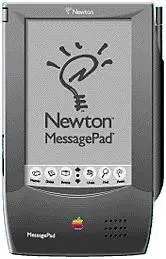

Apple Newton Message Pad 100
Apple Newton OS
The Apple Newton OS, formally known as Newton OS, was a highly modular, object-oriented operating system developed by Apple specifically for the Newton line of personal digital assistants (PDAs) introduced in 1993. It was built around a C++-like system programming language, but its applications and interface were implemented in NewtonScript, a prototype-based, garbage-collected language optimized for resource-constrained environments. NewtonScript featured dynamic inheritance, slot-based objects, and late binding, enabling developers to create compact applications that were extensible at runtime. This design allowed the system to handle memory efficiently while supporting features such as handwriting recognition and graphical user interface elements on devices with limited ROM and RAM.
Architecturally, Newton OS employed a cooperative multitasking kernel that managed tasks as “soups” and “stores.” Soups were persistent, schema-less object databases that enabled data-centric application design, eliminating the need for developers to implement explicit file I/O. Stores represented physical memory locations (such as internal RAM, ROM, or external flash cards) where soups were kept. The operating system included a sophisticated virtual memory system with demand paging to manage its limited memory footprint, and it exposed a high-level event-driven programming model. Handwriting recognition, one of its defining features, was implemented as a layered service integrated directly into the OS, with support for both cursive and printed text recognition.
Later revisions, such as Newton OS 2.0 and 2.1, refined the system’s architecture, improving performance, data management, and the reliability of handwriting recognition. These updates introduced a more consistent user interface framework and APIs for communications protocols (including fax, email, and serial connections), as well as improved internationalization and support for larger storage devices. The modular design allowed extensions for networking and infrared communication to be added without rewriting the core OS. Despite its discontinuation in 1998, Newton OS remains historically significant as one of the earliest examples of a pen-based, object-oriented operating system that anticipated design patterns later seen in mobile platforms.
CPU - The ARM 610
The ARM 610 was a 32-bit RISC (Reduced Instruction Set Computer) microprocessor developed by ARM Ltd. in the early 1990s and deployed by Apple in the second-generation Newton MessagePad series, beginning with the MessagePad 110 in 1994. Fabricated using a 0.8 µm CMOS process, the ARM 610 ran at clock speeds around 20 MHz and delivered significantly higher performance than the ARM 610’s predecessor, the ARM 600, while retaining low power consumption—critical for battery-operated handheld devices. The chip featured a three-stage pipeline, a von Neumann architecture with a unified address space for instructions and data, and a 26-bit program counter mode compatible with earlier ARM cores, enabling both compact code and efficient execution.
Technically, the ARM 610 was built with on-chip cache (4 KB instruction cache and 4 KB data cache), which dramatically reduced the penalty of accessing slower DRAM in a mobile device. Its memory interface could address up to 64 MB of RAM and ROM, more than enough for the Newton’s design constraints. The processor implemented conditional execution for every instruction, one of ARM’s hallmark features, reducing branch penalties and increasing code density. It also supported a hardware multiplier for 32 × 32 → 64-bit operations, which improved performance for graphics rendering, handwriting recognition, and compression tasks central to the Newton OS.
The ARM 610’s efficiency and performance demonstrated the viability of ARM as a processor family for low-power mobile computing, long before smartphones. In the Newton, it enabled advanced features such as real-time handwriting recognition, object-oriented graphical interfaces, and persistent storage management within the constraints of a handheld device. Its balance of low power draw and respectable integer performance was one of the reasons Apple invested heavily in ARM technology during the Newton’s development, eventually helping to establish ARM as the dominant architecture in mobile and embedded systems. The ARM 610 thus represents both a technical milestone in RISC design and a historical turning point, linking Apple’s Newton experiments to the broader ARM ecosystem that powers today’s mobile devices.
ROM: 4MB