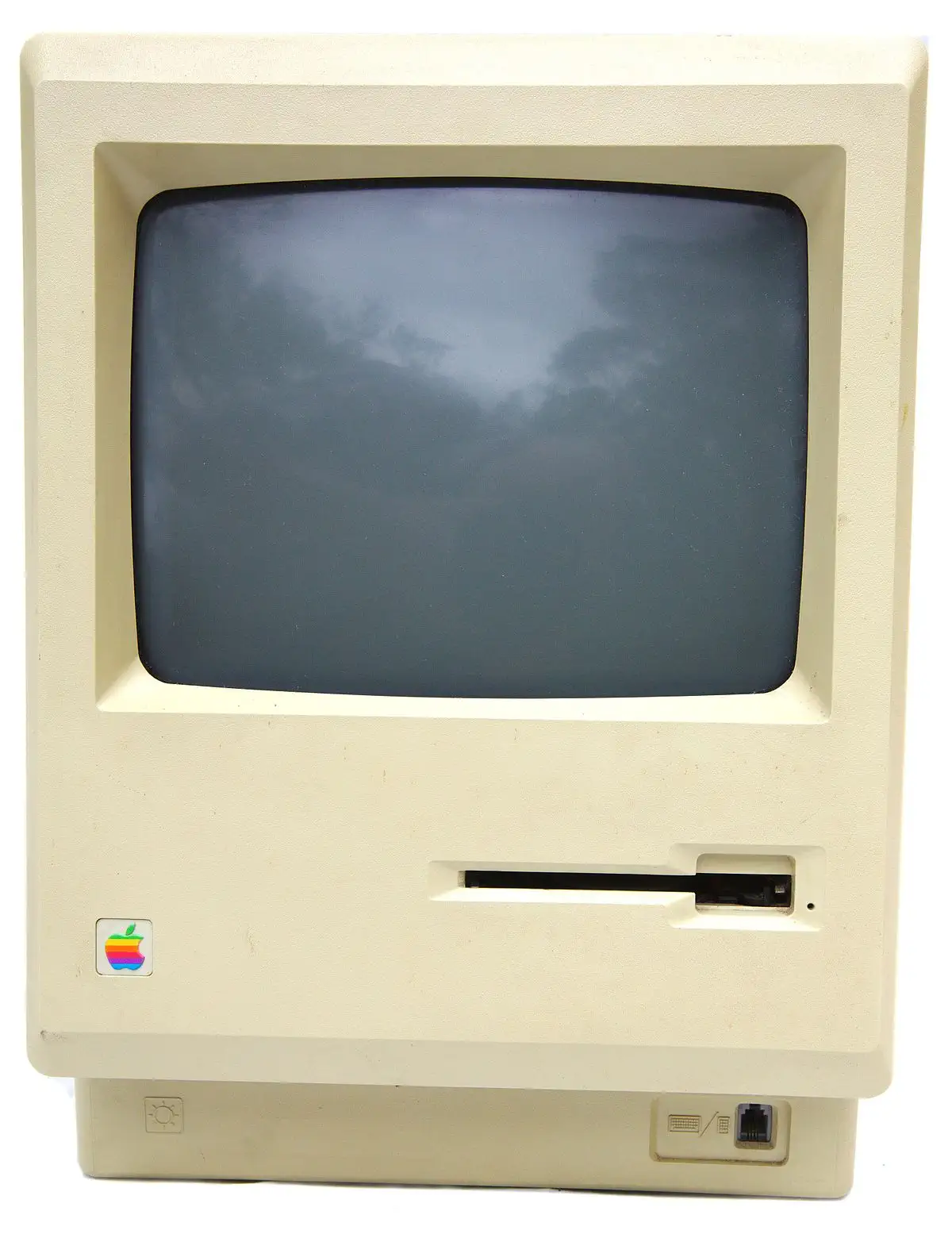

Macintosh 512K
The Macintosh 512K was the successor of the Macintosh 128K (or simply Macintosh) and introduced by Apple Computer in 1984. The machine was nicknamed "fat Mac" because of it's larger memory, 512KByte. The machine was however technically different from the original Macintosh. It had a completely redesigned logic board to easily accomodate both 128KByte and 512KByte RAM during manufacturing. The new design allowed for easier upgrades of the Macintosh 128K.
The increased memory allowed for more powerful applications, such as the popular Microsoft Multiplan spreadsheet application. The other specifications were similar to the original Macintosh
MacOS
The original Macintosh Operating System, later retroactively called Mac OS “System Software”, debuted in 1984 with the launch of the Macintosh 128K. Its design philosophy was radically different from Apple’s earlier operating systems like Apple DOS, ProDOS, or SOS. Instead of a command-line interface, it was built around a graphical user interface (GUI) with windows, icons, menus, and mouse-driven interaction, influenced heavily by work at Xerox PARC. The system combined the Finder (the desktop file manager) with the underlying System file and Toolbox ROM routines, which together provided graphics, windowing, event handling, and device abstractions. Because the first Macintosh had only 128 KB of RAM, the OS was highly optimized, relying on compact routines in ROM and carefully written assembly code.
By System 1.0 through 3.x, Apple refined this early GUI-based OS but kept it fundamentally single-tasking and cooperative. Applications ran one at a time in the system’s flat memory space, and the Finder provided file management by treating disks and directories as visible “desktops” with draggable icons. System 2.x added support for AppleTalk networking and hierarchical folders, while System 3.x introduced the Macintosh Plus (1986) features such as the Hierarchical File System (HFS), which replaced the flat Macintosh File System (MFS) and supported long filenames and nested directories. These changes marked the OS’s transition from a demonstration-oriented GUI to a practical business and creative tool.
System 4.0 (1987) arrived with the Macintosh SE and Macintosh II, introducing significant architectural advances. On the SE, System 4 supported internal expansion and the Apple Desktop Bus (ADB) for keyboards and mice. On the Macintosh II, it supported color graphics for the first time, requiring enhancements to QuickDraw (Color QuickDraw) and the Window Manager. It also added support for expansion slots via the NuBus architecture. Despite these improvements, multitasking was still absent, and memory management remained cooperative and fragile, but System 4 laid the groundwork for more capable versions. Together, the early System releases established the foundation of the Macintosh software ecosystem, showing how a GUI-based OS could evolve from a minimal ROM-assisted environment into a richer, extensible platform.
System 5 (1987) marked Apple’s first serious step toward multitasking on the Macintosh. It introduced MultiFinder, an extension to the Finder that enabled cooperative multitasking by keeping multiple applications resident in memory and allowing users to switch between them via a menu bar interface. This was not true preemptive multitasking—applications had to yield CPU control voluntarily—but it dramatically improved the user experience by making the Mac feel like a multi-application environment. System 5 also extended AppleTalk networking capabilities and improved printer and file server support, expanding the Mac’s role in office networks.
System 6 (1988) was a refinement release, emphasizing stability and efficiency. It combined the System file and Finder into a single integrated release, streamlining installation and version management. The OS improved memory handling with better support for larger RAM configurations, and offered new Desk Accessories and Control Panels to expand configurability. Color QuickDraw matured under System 6, allowing more sophisticated use of the Macintosh II’s color hardware. This version became one of the most widely deployed early Mac operating systems, as it struck a balance between speed, simplicity, and expanding functionality—remaining in common use well into the early 1990s even after newer systems became available.
System 7 (1991) was a major architectural leap. It integrated 32-bit clean memory addressing, allowing Macs with more than 8 MB of RAM to be fully utilized, and introduced virtual memory with disk-backed paging. The Finder was rewritten to support aliases (file system shortcuts) and balloon help, while networking was deeply embedded with System 7’s always-on AppleTalk. True multitasking still relied on cooperative scheduling, but inter-application communication improved with the introduction of Apple Events and the Publish & Subscribe mechanism. System 7 also introduced built-in support for TrueType fonts, 32-bit icons, and extensibility via Control Panels and Extensions. This release defined the Macintosh platform throughout the 1990s, serving as the backbone OS until the eventual transition to Mac OS 8 and 9 in the late decade.
CPU - The Motorola 68000
The Motorola 68000 is a 16/32-bit microprocessor that was first released in 1979. It was widely used in computers and other electronic devices during the 1980s and early 1990s. The 68000 was known for its advanced architecture, which included a 32-bit internal bus and a 24-bit address bus, allowing it to access up to 16 megabytes of memory. This made it more powerful than many other processors of its time, such as the Intel 8086 and Zilog Z80. It was also designed to be highly modular and expandable, with a large number of on-chip and off-chip peripherals.
Some of the most famous and successful computers that used the 68000 was the Commodore Amiga and the Atari ST, both of which were popular in the home and personal computer markets. Additionally, it was also used in workstations, such as the Sun 3 and Apollo DN3000, and in a wide variety of embedded systems and industrial control systems. The 68000 was also used in the Macintosh, the first model of the Macintosh was powered by a Motorola 68000 CPU. The processor was eventually succeeded by the 68020 and 68030, which offered improved performance and additional features.
The 68000 has a 32-bit instruction set, with 32-bit registers and a 16-bit internal data bus. The address bus is 24-bit and does not use memory segmentation, making it easier to address memory. There are three ALU's (Arithmetic Logic Unit), two for calculating addresses, and one for data, and the chip has a 16-bit external address bus.
The 68000 architecture was expanded with 32-bit ALUs, and caches. Here is a list with some 680x0 versions and their major improvements:
- 68010 - Virtual memory support
- 68020 - 32-bit ALU & Instruction Cache
- 68030 - On-Chip MMU, 2x 256 byte cache
- 68040 - 2x 4K Cache, 6 stage pipeline, FPU
- 68LC040 - No Floating Point Unit (FPU)
- 68060 - 2x 8K Cache, 10 stage pipelinet
Source: WikiPedia - Motorola 6800
Source: WikiPedia - 68000 Series