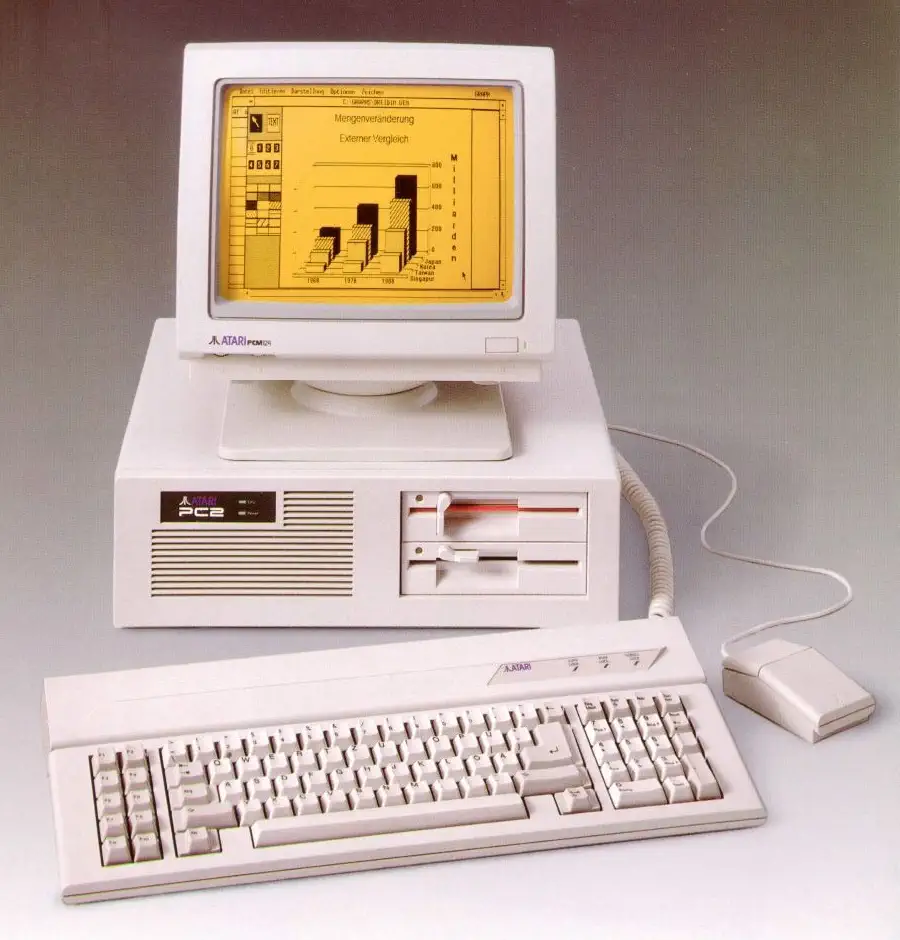

Atari PC-2
The Atari PC-2 is based on the same architecture as the Atari PC-1 but the case is much larger and allows for ISA expansion cards, something the PC1 did not have. The processor is still the Intel 8088.
The machine has 512KByte RAM, and onboard EGA Graphics using a NSI Logic EVC315-S. Also present are a 5.25 360KByte floppy disk drive and a 20MByte hard drive.
p>Atari bundled the follwing software with the PC-3- Micrsoft MS-DOS 3.2
- GW Basic 3.2
- GEM Desktop EGA 2.1
- GEM Paint
- GEM Write
Atari supplied the computer with an Atari 83 key PC-Keyboard, an Atari style mouse, and the Atari PCM-124 12" EGA Monochrome monitor
Graphics Environment Manager (GEM)
The Atari TOS (The Operating System) incorporated a graphical environment known as GEM (Graphics Environment Manager), which was originally developed by Digital Research. GEM provided the graphical user interface layer on top of the GEMDOS kernel, itself patterned after MS-DOS. The architecture separated device-level input/output management, the graphics subsystem, and the application environment, enabling consistent user interaction across the Atari ST series. GEM relied on the VDI (Virtual Device Interface) for abstracting graphics operations and GDOS (Graphics Device Operating System) extensions for device-independent font and printer management.
At the core of GEM’s operation were two key APIs: VDI and AES (Application Environment Services). VDI handled low-level drawing primitives, such as line drawing, bit block transfers, and raster operations, while maintaining independence from physical display hardware. AES provided higher-level window management, dialog handling, event dispatching, and interprocess communication. Applications interacted with the system by invoking AES functions for UI management and VDI calls for graphics, which were passed through a device driver layer before reaching the hardware. This layering enabled portability of the GEM environment beyond Atari machines, even though Atari’s implementation was closely tied to the Motorola 68000 CPU and the ST’s hardware.
From a system integration standpoint, GEM was relatively lightweight compared to contemporary GUIs such as the Apple Macintosh System Software. It ran in a cooperative multitasking model, with a single active application controlling the desktop environment at any given time, and desk accessories operating as TSR-like components. Memory usage was constrained by the ST’s limited RAM configurations, so GEM prioritized efficiency in message passing and window redrawing. Despite these constraints, GEM provided resolution-independent rendering and vector-based font capabilities when paired with GDOS, features that positioned it as a technically advanced graphical layer for mid-1980s personal computing.
CPU - The Intel 8088
The Intel 8088 microprocessor is a variant of the Intel 8086. The 8088 has an 8-bit external bus instead of the 16-bit bus that the 8086 has. The 16-bit registers and the 1MByte address range are unchanged, however. The 8086 and the 8088 have the same execution unit (EU), only the Bus Interface Unit (BIU) differs.
The original IBM PC architecture is based on the Intel 8088. The CPU runs at 5 to 16 MHz, has a 20-bit address bus and can work together with the 8087 Co-Processor. The 8088 was launched in 1979. The 8088 is compatible with the Intel 8085.
20MByte Hard Drive