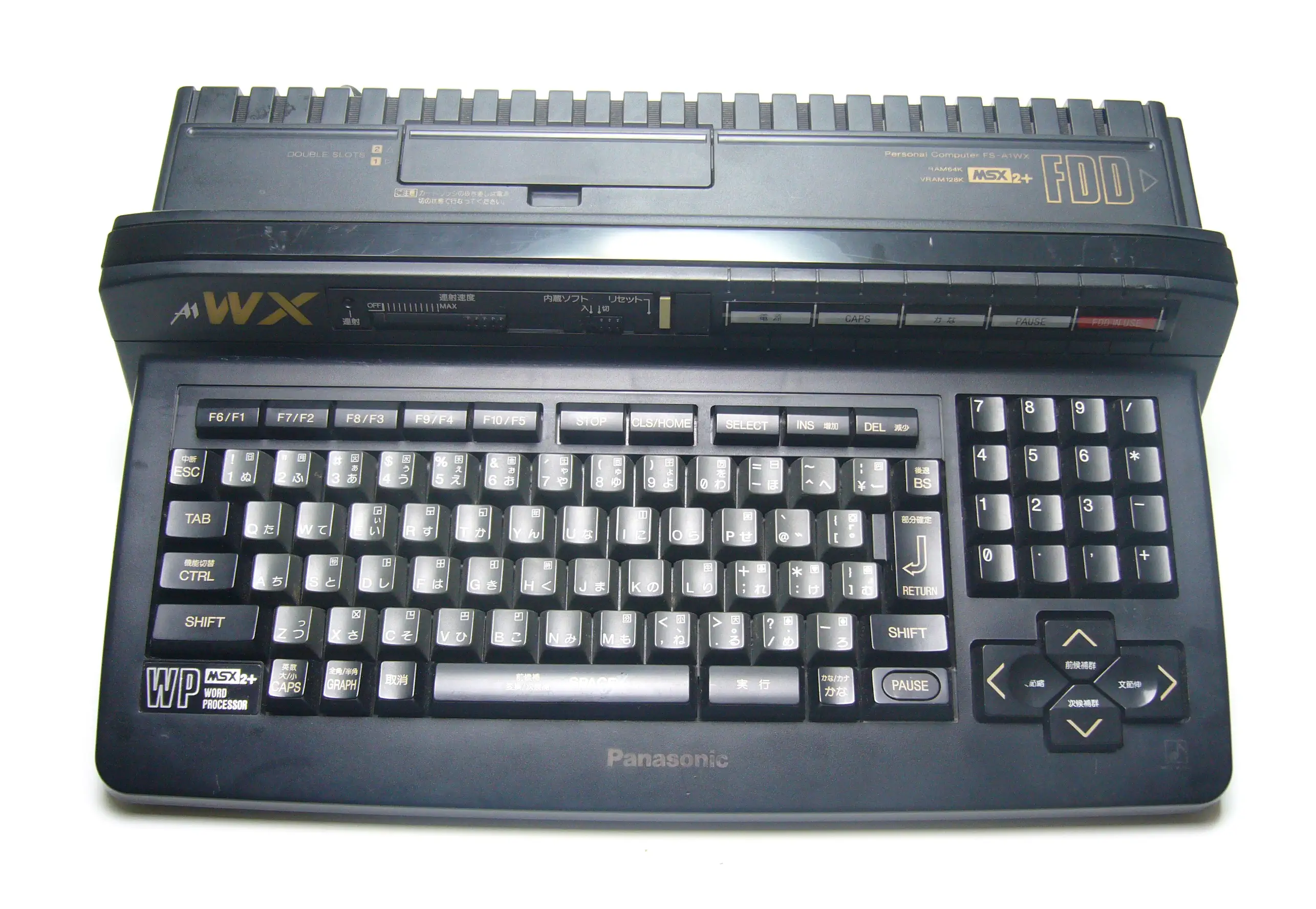

The Panasonic MSX Computer Line

- MSX 2
- MSX 2+
- MSX Turbo-R
Panasonic A1-WX MSX2+
The MSX Computer Standard
- CPU and Memory
- Video Output hardware
- Audio hardware
- Cassette and Disk drives
- Keyboard, mouse and joysticks
- Expansion and I/O ports
MSX was a standardized home computer platform announced on June 16th, 1983 as a joint effort between Microsoft and Japan’s ASCII Corporation. It was marketed by Kasuhiko Nishi, who was Vice-President at Microsoft and a director at the ASCII Corporation, with the goal of creating a unified hardware and software standard across multiple manufacturers. At the time, the home computer market was highly fragmented, with each company offering its own incompatible systems. The MSX standard addressed this by providing a common architecture that companies like Sony, Panasonic, Philips, Toshiba, and Yamaha could all build upon, ensuring that software and peripherals would run consistently across machines. At its core, the MSX used the popular Zilog Z80 processor, featured cartridge slots for games and applications, and supported both cassette tape and disk drives, making it versatile for both gaming and productivity.
The MSX Standard defines specifications for:
- CPU and Memory
- Video Output hardware
- Audio hardware
- Cassette and Disk drives
- Keyboard, mouse and joysticks
- Expansion and I/O ports
The MSX line saw several evolutions, including MSX2, MSX2+, and MSX Turbo R, each improving graphics, sound, and performance to keep pace with the growing demands of the market. While it never achieved major success in the United States, the MSX was a significant force in Japan, much of Europe, and South America, where it became a beloved platform for gaming, programming, and creative applications. Iconic game developers such as Konami and Hudson Soft produced influential titles on the MSX, helping to shape the future of video games. Today, the MSX is remembered as one of the most ambitious attempts to create a universal home computer standard, and it holds a cherished place in the history of 1980s computing.

MSX hardware ports
Cassette Interface
The MSX Standard calls for all MSX computers to have a standard data-cassette port. This port transports the audio-in/out signals to and from the datarecorder and the computer has a relay-switch on board to turn the recorder on and off.
MSX Cartridge
The MSX Cartridge system uses a 50-pin flat-edge connector to connect to the systems expansion bus. The cartridge slot maps into one of the main- or sub-slots.
MSX Joystick Port
The MSX Joystick connector is backwards compatible with the Atari 2600. It is a so called DB9 style connector and has the same pin-out as the original Atari connector, with the addition of an extra button. This port is also used in analog mode on the MSX to read a mouse, a light-pen or an analog joystick. The MSX Standard called for 2 joystick ports (Joystick A, and B).
Printer Port
The MSX uses a 14-pin Centronics port for connecting a printer. The printer port was not part of the mandatory MSX standard, but the standard strongly recommended manufacturers to implement a printer port.
Other Ports
Other mandatory ports on the MSX computer included a Composite Video or an RF output port for video. Many manufacturers also included an Audio port, a scart port on european models, the JP21 Scart variant for Japanese MSX computers, or an RGB port for better video connection to a monitor
MSX2+ and beyond
The MSX2+ was an advanced iteration of the MSX2 home computer standard, first introduced in 1988, predominantly in Japan. Building on its predecessor, the MSX2+ boasted enhanced graphical capabilities that made it popular among gaming enthusiasts and hobbyist programmers. It featured upgraded video processing with support for three new screen modes, providing smoother animations and more vibrant color depth with up to 19,268 colors. The inclusion of improved sound through the built-in FM sound chip enabled richer audio experiences for games and multimedia applications. Although the MSX2+ did not achieve widespread global adoption like other home computers of the era, it remained a beloved and influential platform within Japan and parts of Europe, setting the stage for the even more powerful MSX Turbo R that followed.
Sound - The AY-3-8910 PSG
The AY-3-8910 is a 3-voice Programmable Sound Generator, or PSG. It was designed by General Instruments in 1978 for use with their own 8-bit PIC1650 and their 16-bit CP1610 computers.
The PSG is widely used in many arcade cabinets, pinball machines, and many micro-computers. Here is a list of some of the major brands of computer that used the AY-3-8910:
- Intellivision
- Vectrex
- Amstrad CPC range
- Oric-1
- Color Genie
- Elektor TV Games Computer
- All MSX-1 and MSX-2 computers
- ZX Spectrum home computers
General Instrument spun of MicroChip Technology in 1987 and the chip was sold under the MicroChip brand, and licensed to Yamaha as the YM2149F which the Atari ST range of computers use. Functionally the PSG is very similar to the Texas Instruments SN76489.
Variants:
-
AY-3-8910
Comes with 2 general purpose 8-bit parallel I/O ports, used for Keyboard and Joystick in for instance MSX. -
AY-3-8912
Same chip, but in a 28-pin package. Parallel port B is not connected to save cost and space. -
AY-3-8913
Same chip, but in a 24-pin package. Both parallel ports are not connected. -
AY-3-8914
The AY-3-8914 has the same pinout and is in the same 40-pin package as the AY-3-8910, except the control registers on the chip are shuffled around, and the 'expected input' on the A9 pin may be different. It was used in Mattel's Intellivision console and Aquarius computer. -
AY-3-8930
Backwards compatible but BC2 pin is ignored
YM2149F -
YM3439-D
CMOS version of the Y2149 in 40-pin DIP -
YM3439-F
CMOS version of the Y2149 in 44-pin QFP -
YMZ294
Variant of the YM3249 in an 18-pin package. Parallel ports not connected, and all sound channels mixed on 1 port. -
T7766A
Toshiba variant of the AY-3-8910, fully compatible. Used in some MSX models. - Winbond WF19054, JFC95101, and File KC89C72: Fully compatible versions of the AY-3-8910 produced for slot machines.
Yamaha Produced chip, same pin-out as the AY-3-8910, but pin 26 could halve the master clock. Can be used to replace the AY-3-8910 if pin 26 is left disconnected.
CPU - The Zilog Z80
The Z80 quickly became popular in the personal computer market, with many early personal computers, such as the TRS-80 and Sinclair ZX80, using the Z80 as their central processing unit (CPU). It was also widely used in home computers, such as the MSX range, SORD, and the Amstrad CPC, as well as in many arcade games. Additionally, it was also used in other applications such as industrial control systems, and embedded systems. The Z80 was widely used until the mid-1980s, when it was gradually replaced by newer microprocessors such as the Intel 80286 and the Motorola 68000.
The Z80 microprocessor was developed by Zilog, a company founded by Federico Faggin in 1974. The Z80 was released in July 1976, as a successor to the Intel 8080. It was designed to be fully compatible with the 8080, but also included new features such as an improved instruction set, more powerful interrupts, and a more sophisticated memory management system.
Originally the Z80 was intended for use in embedded systems, just as the 8080 CPU. But the combination of compatibility, superior performance to other CPUs of the era, and the affordability led to a widespread use in arcade video game systems, and later in home computers such as the Osborne 1, TRS-80, ColecoVision, ZX Spectrum, MSX, Sega's Master System and many more. The Z-80 ran the original Pac-Man arcade cabinet. The Z-80 was used even in the Game Gear (1990s), and the TI-81 and succeeding graphic calculators.
The Z-80 remained in production until June of 2024, 48 years after its original release. Zilog replaced the processor with its successor the eZ80, an 8-bit microprocessor that features expanded memory addressing up to 16 megabytes, and running up to 50MHz, comparable to a Z80 clocked at 150MHz.
VRAM: 128kB
256x212 16 color
512x212 4 color
512x212 2 color
256x212 256 color
16x16
8/scanline
64 total
external Tape
ROM cartridges