
Introduction
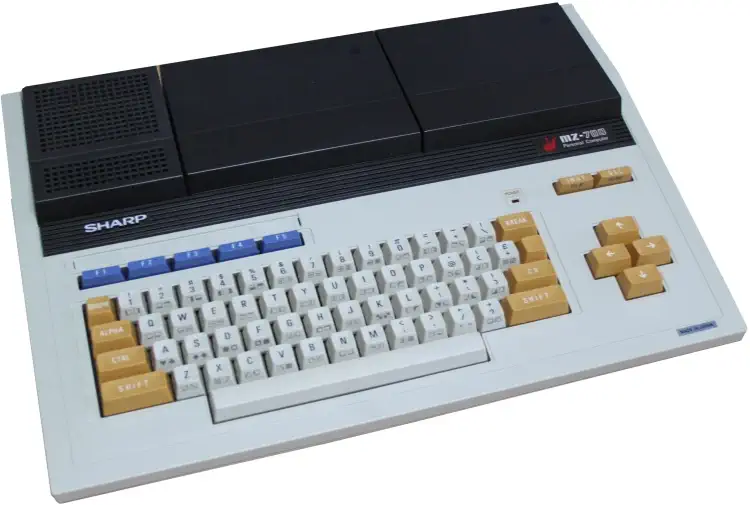
In november of 1928 the Sharp Corporation started selling the Sharp MZ-700 computer. There were three variations that could be purchased:
- Sharp MZ-711: bare bones computer
- Sharp MZ-721: built in cassette tape player
- Sharp MZ-731: built in cassette player, and color plotter
The MZ-700 came with 64K Memory and 4K VRAM. The VRAM is addressable within the normal Z80 Address space, and can be swapped for regular RAM using bank switching. The MZ-700 was not capable of graphics, however it came with a second characterset built into ROM that had predefined characters that could be used for games.
The MZ-700 Character Set
Graphics and Characters
The Sharp MZ-700 had no real graphic capabilities. There is a screen mode where you have 160x48 graphics, which is simulated by using the block characters out of the character set, and all software driven. The MZ-700 did come with a dual character set in ROM, which can be turned used by setting a bit in the character attribute on the screen, each screen character has an attribute byte that determines the color and the character set used. The alternate character set game with some popular game icons, like the pacman character, race-cars, space invader style aliens, and parts and pieces to create a chess-set. Of course this was limited to the 256 characters available in the alternate set, but game developers were creative and re-used some of these characters in clever ways to create some impressive looking games.CPU - The Zilog Z80
The Z80 quickly became popular in the personal computer market, with many early personal computers, such as the TRS-80 and Sinclair ZX80, using the Z80 as their central processing unit (CPU). It was also widely used in home computers, such as the MSX range, SORD, and the Amstrad CPC, as well as in many arcade games. Additionally, it was also used in other applications such as industrial control systems, and embedded systems. The Z80 was widely used until the mid-1980s, when it was gradually replaced by newer microprocessors such as the Intel 80286 and the Motorola 68000.
The Z80 microprocessor was developed by Zilog, a company founded by Federico Faggin in 1974. The Z80 was released in July 1976, as a successor to the Intel 8080. It was designed to be fully compatible with the 8080, but also included new features such as an improved instruction set, more powerful interrupts, and a more sophisticated memory management system.
Originally the Z80 was intended for use in embedded systems, just as the 8080 CPU. But the combination of compatibility, superior performance to other CPUs of the era, and the affordability led to a widespread use in arcade video game systems, and later in home computers such as the Osborne 1, TRS-80, ColecoVision, ZX Spectrum, MSX, Sega's Master System and many more. The Z-80 ran the original Pac-Man arcade cabinet. The Z-80 was used even in the Game Gear (1990s), and the TI-81 and succeeding graphic calculators.
The Z-80 remained in production until June of 2024, 48 years after its original release. Zilog replaced the processor with its successor the eZ80, an 8-bit microprocessor that features expanded memory addressing up to 16 megabytes, and running up to 50MHz, comparable to a Z80 clocked at 150MHz.

3 octaves
80x50 simulated graphics