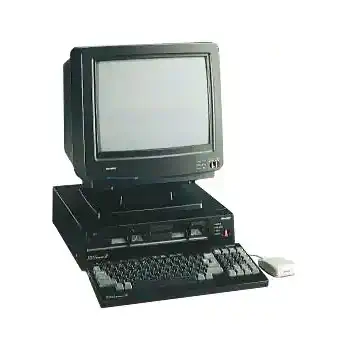

Introduction
The Sharp X1 turbo Z improved the graphics capabilities of the X1 platform yet again. The Turbo Z was released with a 4096 color analog RGB monitor. Lower resolution modes now allowed for 4096 colors on screen at the same time. The other improvement over the Turbo was that the disk drives now were high-density, doubling the storage capacity per disk.
The X1 Turbo Z had the following ports on the back:
- Composite video out
- Composite video in
- 6-pin DIN RGB Out
- TV Control (for use with special TVs)
- Analog RGB Out
- RC-connector for Video out
- RS-232C connector
- Floppy Disk connector
- Printer Connector
- Two standard joystick connectors
- Stereo Audio Out
- Two I/O slots
- Serial Keyboard Connector
- CMT TV Antenna connector
Video on how to use the SuperImpose feature on the X1.

CPU - The Zilog Z80
The Z80 quickly became popular in the personal computer market, with many early personal computers, such as the TRS-80 and Sinclair ZX80, using the Z80 as their central processing unit (CPU). It was also widely used in home computers, such as the MSX range, SORD, and the Amstrad CPC, as well as in many arcade games. Additionally, it was also used in other applications such as industrial control systems, and embedded systems. The Z80 was widely used until the mid-1980s, when it was gradually replaced by newer microprocessors such as the Intel 80286 and the Motorola 68000.
The Z80 microprocessor was developed by Zilog, a company founded by Federico Faggin in 1974. The Z80 was released in July 1976, as a successor to the Intel 8080. It was designed to be fully compatible with the 8080, but also included new features such as an improved instruction set, more powerful interrupts, and a more sophisticated memory management system.
Originally the Z80 was intended for use in embedded systems, just as the 8080 CPU. But the combination of compatibility, superior performance to other CPUs of the era, and the affordability led to a widespread use in arcade video game systems, and later in home computers such as the Osborne 1, TRS-80, ColecoVision, ZX Spectrum, MSX, Sega's Master System and many more. The Z-80 ran the original Pac-Man arcade cabinet. The Z-80 was used even in the Game Gear (1990s), and the TI-81 and succeeding graphic calculators.
The Z-80 remained in production until June of 2024, 48 years after its original release. Zilog replaced the processor with its successor the eZ80, an 8-bit microprocessor that features expanded memory addressing up to 16 megabytes, and running up to 50MHz, comparable to a Z80 clocked at 150MHz.
VRAM: 48kB
620x400
4096 colors
CP/M