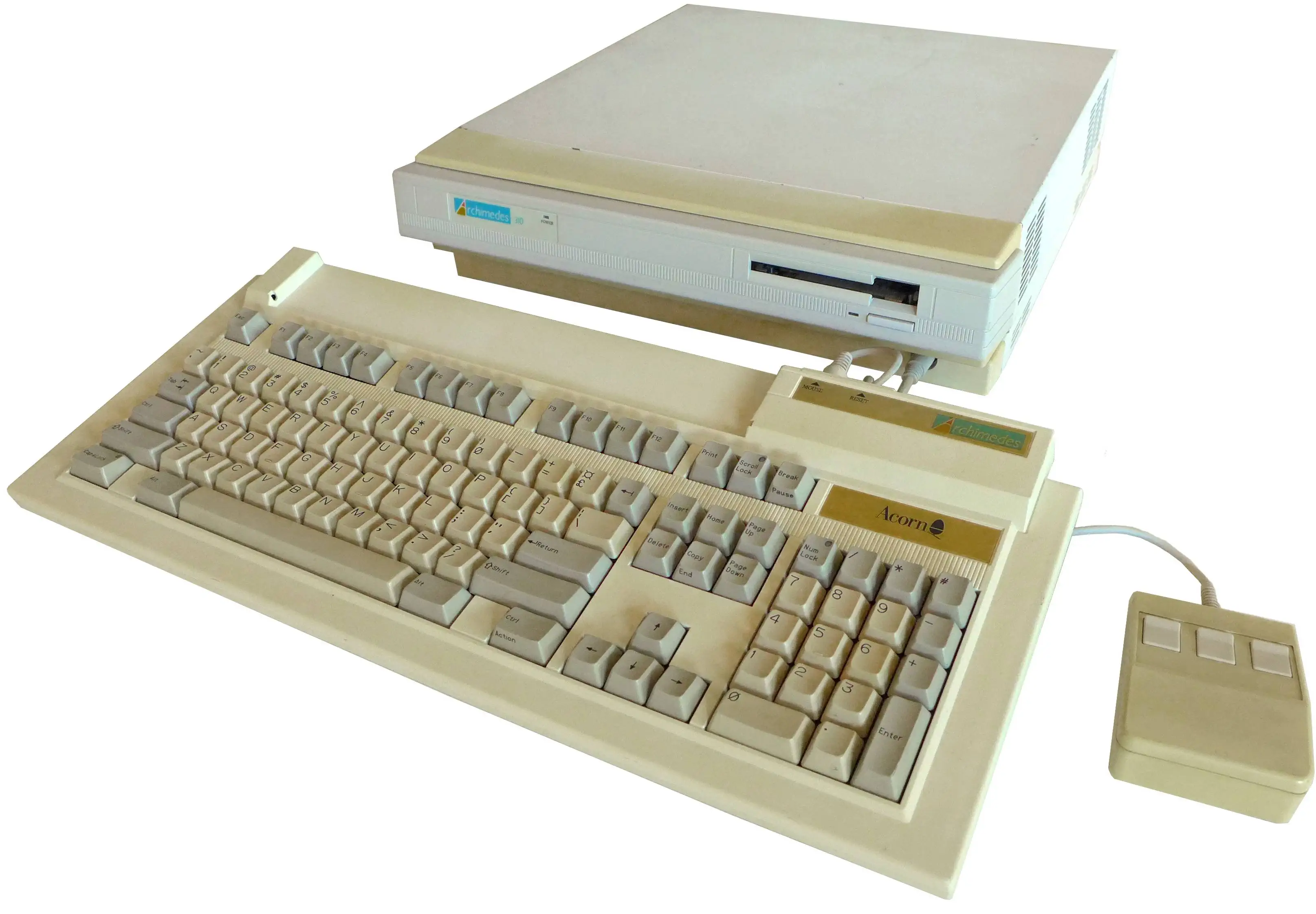

The Acorn Archimedes A310
The Archimedes A310 the bigger brother of Acorn Computers LTd's first line of general purpose home computers based on their in-house developed 32-bit ARM RISC CPU. The A310 had a full megabyte of ram, where it's smaller sibling the A305 had only 512 KByte. The A310 is part of the 300 series, released in 1987.
The Acorn Archimedes computer was the commercially available computer to use the RISC (Reduced Instruction Set CPU) architecture. The first models were launched in 1987, and Acorn developed updated models of the machines until the early 1990's. The CPU in the Acorn machines is the ARM chip, which stands for Acorn RISC Machine. ARM Chips are still used today, one popular example is the iPhone.
Video - Acorn VIDC1
The Acorn VIDC1 (commonly just called the VIDC, “Video Controller”) was the graphics and sound processor introduced with the Acorn Archimedes series in 1987. Architecturally, it was not a self-contained GPU like later chips but rather a video timing and data formatter. The VIDC1 worked alongside system RAM, the MEMC (Memory Controller), and the ARM CPU. The MEMC fetched display data from RAM and streamed it to the VIDC, which then generated the appropriate video signals, including pixel clocks, synchronization pulses, and palette lookup. This design meant the graphics system was highly dependent on memory bandwidth, but it gave flexibility in supported modes without requiring large amounts of dedicated VRAM.
Technically, the VIDC1 supported bitmapped graphics in planar arrangements, with depths ranging from 1 bit per pixel (2 colors) up to 8 bits per pixel (256 colors). The palette allowed each of those displayable entries to be mapped from a 12-bit (4:4:4) RGB space, giving 4096 possible colors. The chip could handle resolutions up to 1152×896 in monochrome, though in practice most Archimedes machines used 640×256, 640×512, or 800×600 in color modes, balancing bandwidth against memory and performance. Unlike contemporary PC graphics adapters which often had fixed VGA-style modes, the VIDC’s programmable timing registers meant it could generate a wide range of scan rates suitable for monitors or televisions.
The VIDC1 also integrated basic sound generation, which was unusual for a video controller of its time. It featured 8-bit digital audio playback with support for multiple channels mixed in hardware, using DMA data fetched by the MEMC. This gave the Archimedes stereo sampled sound without burdening the CPU, contrasting with many IBM PCs of the era that relied on simple beepers or required add-in cards like the Sound Blaster. Compared to contemporary chips such as the Motorola 6845 CRTC (used in Amstrad CPC and BBC Micro) or the TI TMS9918A (MSX), the VIDC1 was significantly more advanced, since it combined high-resolution bitmapped graphics with programmable color palettes and digital audio in one chip, optimized to work with the ARM architecture’s memory subsystem.
Arthur Operating System
The Acorn Archimedes computers were initially shipped with the Arthur OS, but could be upgraded to RISC OS, by replacing the ROM chips that contained the operating system. Because of these ROMs, the computer would boot immediatly into it's GUI, similar to the Atari ST line of computers. This gave them a significant advantage over PC's that loaded the operating system from disk.
The early Archimedes computers used the Arthur operating system, which was replaced in 1989 with RISC OS. RISC-OS featured co-operative multitasking, task management, solid window manipulation, adaptive rendering of bitmaps and coloring, and above all stability that the Arthur OS lacked. New applications quickly started to take advantage of the RISC-OS resulting in mature software such as Acorn Desktop Publisher, and even a PC Emulator.
Source WikiPediaCPU - The ARM
ARM, an acronym for Advanced RISC Machines (originally Acorn RISC Machines) is a Reduced Instruction Set Computer (RISC) cpu architecture. The ARM1, uses a 32-bit internal structure, but only had a 26-bit address space, limiting the processor to 64MByte of memory. This limit was removed in the ARMv3 series, which introduced a full 32-bit address space.
The first machine that used the ARM chip was the BBC Micro, it used the ARM as a secondary processor at 6MHz.
The result of the simulations on the ARM1 boards led to the late 1986 introduction of the ARM2 design running at 8 MHz, and the early 1987 speed-bumped version at 10 to 12 MHz. The ARM2 was roughly seven times the performance of a typical 7 MHz 68000-based system and twice as fast as an Intel 80386 running at 16 MHz.
The ARM2 featured a 32-bit data bus, 26-bit address space and 27 32-bit registers, of which 16 are accessible at any one time (including the Program Counter). The ARM2 had a transistor count of just 30,000, compared to Motorola's 68000 model with around 68,000. This simplicity enabled the ARM2 to have low power consumption, yet offer better performance than the Intel 80286.
A successor, ARM3, was produced with a 4 KB cache, which further improved performance. The address bus was extended to 32 bits in the ARM3.
source: WikiPediaFeatures of the ARM CPU
The Program Counter
In most CPU architectures, the Program Counter is locked away. If you want to change it (to loop or jump to a new function), you have to use dedicated branch or jump instructions.
In 32-bit ARM, the Program Counter (R15) is exposed as a general-purpose register. This means you can perform standard arithmetic directly on the PC just like you would on any other data register. You can literally add, subtract, or bit-shift the Program Counter to move through your code, which allows for incredibly efficient, dense programming tricks that are impossible on most other CPUs.
Strict Orthogonality
In CISC processors (like x86 or the Z80), registers often have highly specific, hardwired jobs. You might have a dedicated "Accumulator" for math, specific index registers, or internal invisible registers (like the W and Z registers on a Z80) that the CPU uses behind the scenes but the programmer cannot access directly.
ARM's registers (R0 through R12) are highly orthogonal. This means they are completely interchangeable. Any math, logic, or memory-loading instruction can use any of these registers equally. The CPU doesn't force you to route your data through a specific bottleneck register to do arithmetic.
Load/Store Enforcement
On non-RISC architectures, you can often perform math directly on a value sitting in RAM. You can tell the CPU, "Add 5 to the value at memory address 0x1234."
ARM strictly forbids this. Its architecture physically disconnects the Arithmetic Logic Unit (ALU) from the memory bus. The only instructions allowed to touch memory are LDR (Load) and STR (Store). All math and logic must happen entirely within the registers. While this sounds like a limitation, it guarantees that complex math operations never get stalled waiting for slow RAM, keeping the instruction pipeline moving at exactly one instruction per clock cycle.
Barrel Shifter
A great example of how ARM achieves the one instruction per clock cycle is the following:
ADD R0, R1, R2, LSL #2
In this example the operation is ADD, the destionation is R0 and the two source registers are R1 and R2. The instruction allows for a Barrel shift operation before R2 hits the ALU, effectively taking one step for which other processor would take at least two separate instructions, one to shift R2 left by 2 bits, and one to add R1, and R2.
8 bit stereo sound
640x512 16 colors
1024x1024 mono
BBC Basic