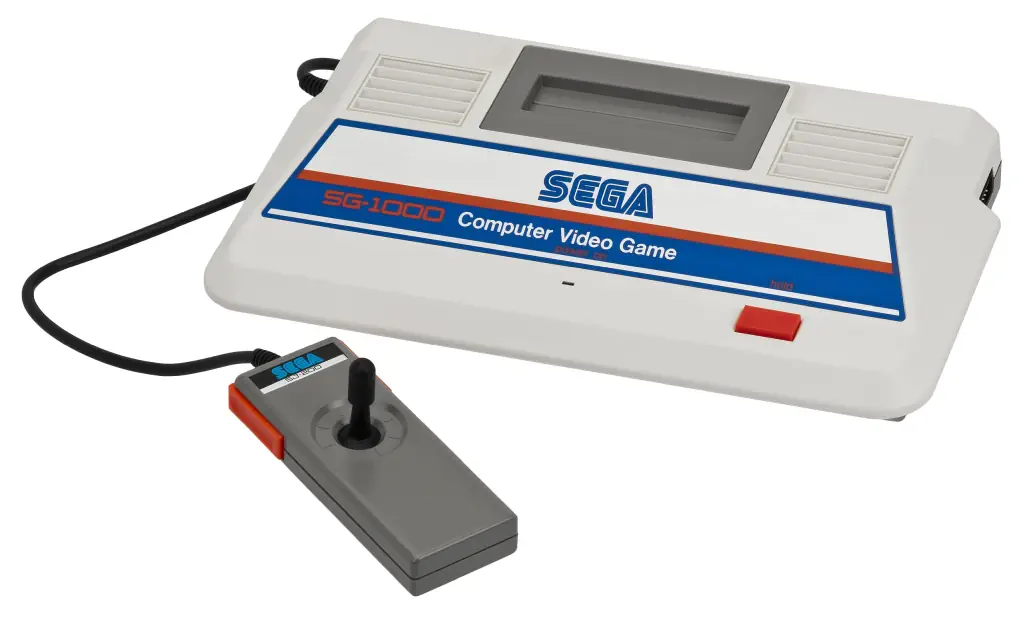

Sega SG-1000
This was Sega's first entry into the home video game market. The SG-1000 was developed alongside the SG-3000, which was a full computer version of the same architecture. Sega actually began with the SG-3000 but decided to also create a game-only version of the computer to compete with the Nintendo Entertainment System.
The SG-1000 was released in Japan in July of 1983 for the price of ¥15,000. The release coincided iwh Nintendo's launch of the Family Computer, or Famicom. The SG-1000 was released on the same day as the SG-3000 computer as well as the upgraded version of that system, the SG-3000H.
The console was released in several other coutnries: Australia, New Zealand, Italy, and Spain. It was not released for the North American market, nor for most other european countries. However an unautorized clone of the SG-1000 appeared in those markets, known as the Telegames Personal Arcade. This clone could play both SG-1000 and ColecoVision games, as the architecture of these systems was very similar.
TMS9918 Series Video Display Processor (99n8, 99n9, 91n8, 91n9)
The TMS9918 is a series of video display controllers (VDC) manufactured in 1979 by Texas Instruments, also refered to as 'Video Display Processor' (VDP). The TMS9918 and its variants were used in the ColecoVision, CreatiVision, Memotech MTX, MSX, NABU Personal Computer, SG-1000/SC-3000, Spectravideo SV-318, Spectravideo SV-328, Sord M5, Tatung Einstein, Texas Instruments TI-99/4, Casio PV-2000, Coleco Adam, Hanimex Pencil II, and Tomy Tutor.
Key Features:
- 256x192 pattern based color pixels per screen
- 16 different colors
- 8-bit memory mapped CPU interface
- No need for DMA, CPU can access VRAM
- 32 single color Sprites per screen (4 per scanline)
Variants:
- TMS9918A - 60Hz output, NTSC video
- TMS9928A - 60Hz output, YPbPr video
- TMS9929A - 50Hz output, YPbPr video
- TMS9118 - Different RAM than TMS9918A, otherwise identical
- TMS9128 - Different RAM than TMS9928A, otherwise identical
- TMS9129 - Different RAM than TMS9929A, otherwise identical
CPU - The Zilog Z80
The Z80 quickly became popular in the personal computer market, with many early personal computers, such as the TRS-80 and Sinclair ZX80, using the Z80 as their central processing unit (CPU). It was also widely used in home computers, such as the MSX range, SORD, and the Amstrad CPC, as well as in many arcade games. Additionally, it was also used in other applications such as industrial control systems, and embedded systems. The Z80 was widely used until the mid-1980s, when it was gradually replaced by newer microprocessors such as the Intel 80286 and the Motorola 68000.
The Z80 microprocessor was developed by Zilog, a company founded by Federico Faggin in 1974. The Z80 was released in July 1976, as a successor to the Intel 8080. It was designed to be fully compatible with the 8080, but also included new features such as an improved instruction set, more powerful interrupts, and a more sophisticated memory management system.
Originally the Z80 was intended for use in embedded systems, just as the 8080 CPU. But the combination of compatibility, superior performance to other CPUs of the era, and the affordability led to a widespread use in arcade video game systems, and later in home computers such as the Osborne 1, TRS-80, ColecoVision, ZX Spectrum, MSX, Sega's Master System and many more. The Z-80 ran the original Pac-Man arcade cabinet. The Z-80 was used even in the Game Gear (1990s), and the TI-81 and succeeding graphic calculators.
The Z-80 remained in production until June of 2024, 48 years after its original release. Zilog replaced the processor with its successor the eZ80, an 8-bit microprocessor that features expanded memory addressing up to 16 megabytes, and running up to 50MHz, comparable to a Z80 clocked at 150MHz.

1 noise generator
16 volume levels
4 simultanuously
000