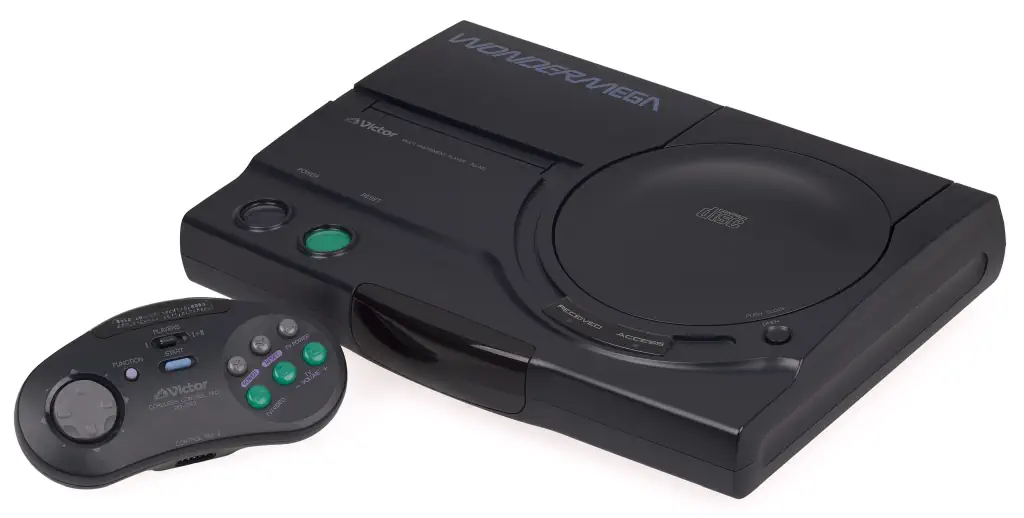

Sega Wonder Mega 2
The Victor Wonder Mega 2, or the RG-M2 was the first revision of the Victor WonderMega. The case had been completely redesigned and the controller ports were moved to the rear of the system. The front now had infrared receivers for the system's new, wireless controllers. Wired controllers could still be used using those ports on the back.
When the system was released in North America as the JVC X'Eye in 1994, the infrared receivers were omitted and instead the unit was packaged with two traditional 9-pin wired controllers, in an attempt to reduce cost. The S-Video connection on the X'eye was also removed and instead the unit came with a standard AV port, comparable to the Mega Drive II.
Both the American and the Japanese verion of the console run a version 2.00 of the system bios.
Technical Specifications
CPUs
- Motorola 68000 CPU @ 12.5MHz
- Motorola 68000 CPU @ 7.67MHz
- Zilog Z80A @ 3.58 MHz
Audio Capabilities
- Rico RF5C164 Audio Chip
- Yamaha YM2612
- Texas Instruments SN76489
- Midi Output
- Digital Signal Processor
Sound - The SN76489
The SN76489 Digital Complex Sound Generator (DCSG) is a TTL compatible programmable sound generator chip created by Texas Instruments. It main application was the generation of music and sound effects in home computers, arcade machines and home game consoles. Functionally the chip was similar to the General Instrument AY-3-8910.
Sound Capabilities:
- 3 Square Wave tone generators, 16 volume levels
- 1 White Noise Generator (white and periodic noice, 3 frequencies, 16 volumes)
The SN76489 Was originally designed to be used in the TI-99/4 computer, where it was first called the TMS9919 and later SN94624, and had a 500 kHz max clock input rate. Later, when it was sold outside of TI, it was renamed the SN76489, and a divide-by-8 was added to its clock input, increasing the max clock input rate to 4 MHz, to facilitate sharing a crystal for both NTSC colorburst and clocking the sound chip. A version of the chip without the divide-by-8 input was also sold
| Feature | Specification |
|---|---|
| Tone Channels | 3 Square Wave Generators |
| Noise Channels | 1 (Periodic or White Noise) |
| Attenuation | 16 levels per channel (4-bit) |
| Frequency Range | 122 Hz to 125 kHz (at 4 MHz clock) |
| Register Width | 10-bit for frequency, 4-bit for attenuation |
CPU - The Motorola 68000
The Motorola 68000 is a 16/32-bit microprocessor that was first released in 1979. It was widely used in computers and other electronic devices during the 1980s and early 1990s. The 68000 was known for its advanced architecture, which included a 32-bit internal bus and a 24-bit address bus, allowing it to access up to 16 megabytes of memory. This made it more powerful than many other processors of its time, such as the Intel 8086 and Zilog Z80. It was also designed to be highly modular and expandable, with a large number of on-chip and off-chip peripherals.
Some of the most famous and successful computers that used the 68000 was the Commodore Amiga and the Atari ST, both of which were popular in the home and personal computer markets. Additionally, it was also used in workstations, such as the Sun 3 and Apollo DN3000, and in a wide variety of embedded systems and industrial control systems. The 68000 was also used in the Macintosh, the first model of the Macintosh was powered by a Motorola 68000 CPU. The processor was eventually succeeded by the 68020 and 68030, which offered improved performance and additional features.
The 68000 has a 32-bit instruction set, with 32-bit registers and a 16-bit internal data bus. The address bus is 24-bit and does not use memory segmentation, making it easier to address memory. There are three ALU's (Arithmetic Logic Unit), two for calculating addresses, and one for data, and the chip has a 16-bit external address bus.
The 68000 architecture was expanded with 32-bit ALUs, and caches. Here is a list with some 680x0 versions and their major improvements:
- 68010 - Virtual memory support
- 68020 - 32-bit ALU & Instruction Cache
- 68030 - On-Chip MMU, 2x 256 byte cache
- 68040 - 2x 4K Cache, 6 stage pipeline, FPU
- 68LC040 - No Floating Point Unit (FPU)
- 68060 - 2x 8K Cache, 10 stage pipelinet
Source: WikiPedia - Motorola 6800
Source: WikiPedia - 68000 Series
CPU - The Zilog Z80
The Z80 quickly became popular in the personal computer market, with many early personal computers, such as the TRS-80 and Sinclair ZX80, using the Z80 as their central processing unit (CPU). It was also widely used in home computers, such as the MSX range, SORD, and the Amstrad CPC, as well as in many arcade games. Additionally, it was also used in other applications such as industrial control systems, and embedded systems. The Z80 was widely used until the mid-1980s, when it was gradually replaced by newer microprocessors such as the Intel 80286 and the Motorola 68000.
The Z80 microprocessor was developed by Zilog, a company founded by Federico Faggin in 1974. The Z80 was released in July 1976, as a successor to the Intel 8080. It was designed to be fully compatible with the 8080, but also included new features such as an improved instruction set, more powerful interrupts, and a more sophisticated memory management system.
Originally the Z80 was intended for use in embedded systems, just as the 8080 CPU. But the combination of compatibility, superior performance to other CPUs of the era, and the affordability led to a widespread use in arcade video game systems, and later in home computers such as the Osborne 1, TRS-80, ColecoVision, ZX Spectrum, MSX, Sega's Master System and many more. The Z-80 ran the original Pac-Man arcade cabinet. The Z-80 was used even in the Game Gear (1990s), and the TI-81 and succeeding graphic calculators.
The Z-80 remained in production until June of 2024, 48 years after its original release. Zilog replaced the processor with its successor the eZ80, an 8-bit microprocessor that features expanded memory addressing up to 16 megabytes, and running up to 50MHz, comparable to a Z80 clocked at 150MHz.

Motorola 68000@7.6MHz
Z80 @3.58MHz
VRAM: 64kB
72kB RAM
64kB VRAM
6Mbit Mega-CD RAM
512 kbit PCM RAM
128 kbit CD cache
64kbit backup RAM
Yamaha YM2612
Texas Instruments SN76489
20 per scanline.